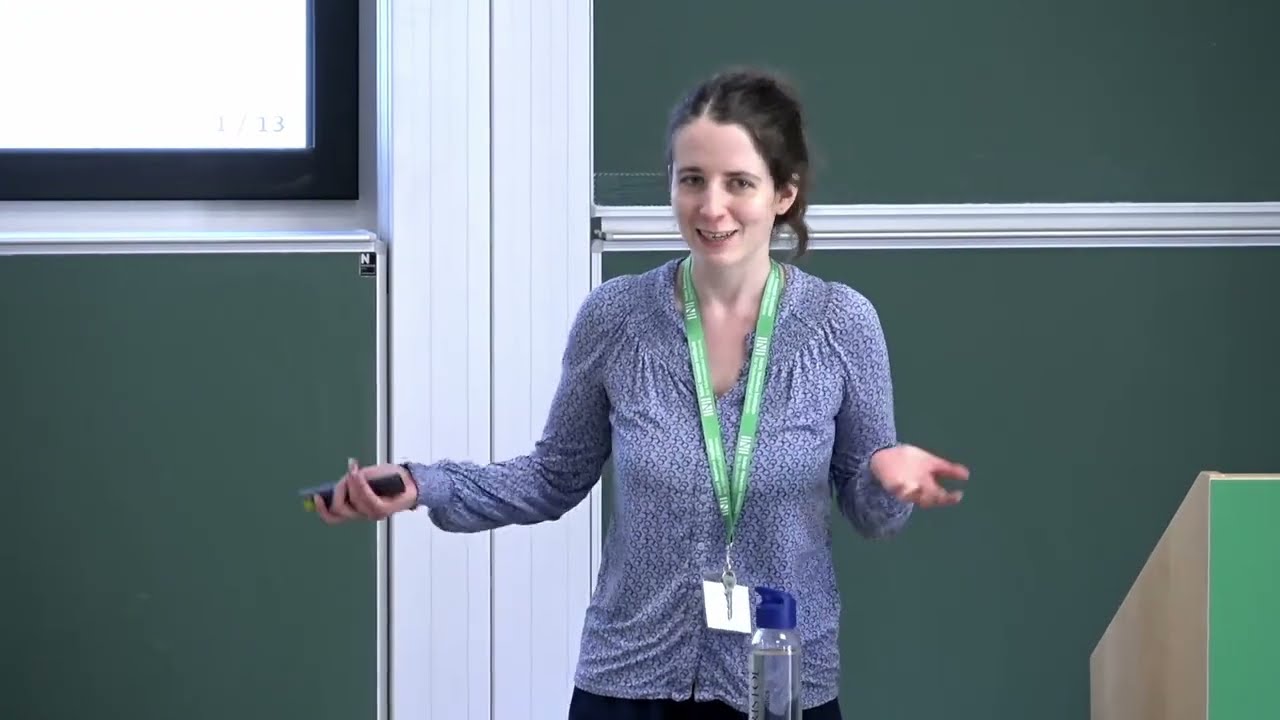
Dr. Laura Monk | Formalising mathematics and spectral geometry in Lean
Keywords
Summary
140 words
Critical Evaluation
Value of the Information & Strength of the Argument
The talk provides a clear and accessible introduction to Lean and its potential for formalising mathematics. The live demonstration effectively illustrates the process and the level of detail required. The argumentation is persuasive, emphasising the reliability of formal verification and the recent synergy with AI. The speaker’s personal experience and the example of Peter Scholze’s project add credibility. However, the talk is more of an overview than a deep technical analysis, and the speaker admits to not being an expert, which may limit the depth of the discussion.
Scientific Rigor, Source Quality, Title Accuracy
The talk is scientifically rigorous in its presentation, with clear explanations and a live demo. The speaker does not cite specific sources, but refers to the Mathlib library and the work of Peter Scholze. The title accurately reflects the content. The talk is part of a seminar series at the Isaac Newton Institute, which adds to its credibility. No comments were provided for analysis.
167 words
Title / Content Match
The title accurately reflects the content: the talk covers formalising mathematics in Lean and discusses spectral geometry as a potential future application.
Quality & Reliability
8/10
The speaker is a mathematician from the University of Bristol, presenting a technical topic with a live demonstration. The content is based on personal experience and community knowledge, but is not a formal study. The talk is part of an academic seminar series at the Isaac Newton Institute, adding credibility.
Key Moments
Markers derived by PSI from the transcript: the creator did not define chapters.
- Introduction and disclaimer by Dr Laura Monk.
- Explanation of Lean as a proof assistant and its history.
- Discussion of Mathlib and its growth.
- Example of Peter Scholze's project formalising a complex proof.
- Live demo: defining bounded above and proving sum of bounded functions.
- Explanation of Lean's kernel and the de Bruijn criterion.
- Discussion of trust issues, axioms, and the possibility of cheating.
- Interaction between Lean and AI, and the potential for verification.
- Current state of spectral geometry in Lean and future directions.
Cited Sources
- Isaac Newton Institute for Mathematical Sciences — Official website of the institute hosting the seminar.
- Seminar page — Details of the specific seminar.
- LinkedIn company page — Social media presence of the institute.
Concurring Sources
- Lean language official site — Official documentation and resources for Lean.
- Mathlib GitHub repository — Source code and development of Mathlib.
Contribution & Novelties
The talk provides a clear introduction to Lean and its potential for formalising mathematics, with a focus on spectral geometry. It highlights the recent synergy between Lean and AI, which lowers the entry barrier. The live demo is valuable for understanding the process.
Pour aller plus loin :
- Lean theorem prover — Official website for Lean.
- Mathlib — The main library of formalised mathematics.
- De Bruijn criterion — Explanation of the criterion for trustworthy proof assistants.
76 words
Radar Profile
The radar profile shows high scores in quality, technical level, and reliability, with a slightly lower score in quantity of information. This indicates a focused, expert-level talk with substantial depth but limited breadth.