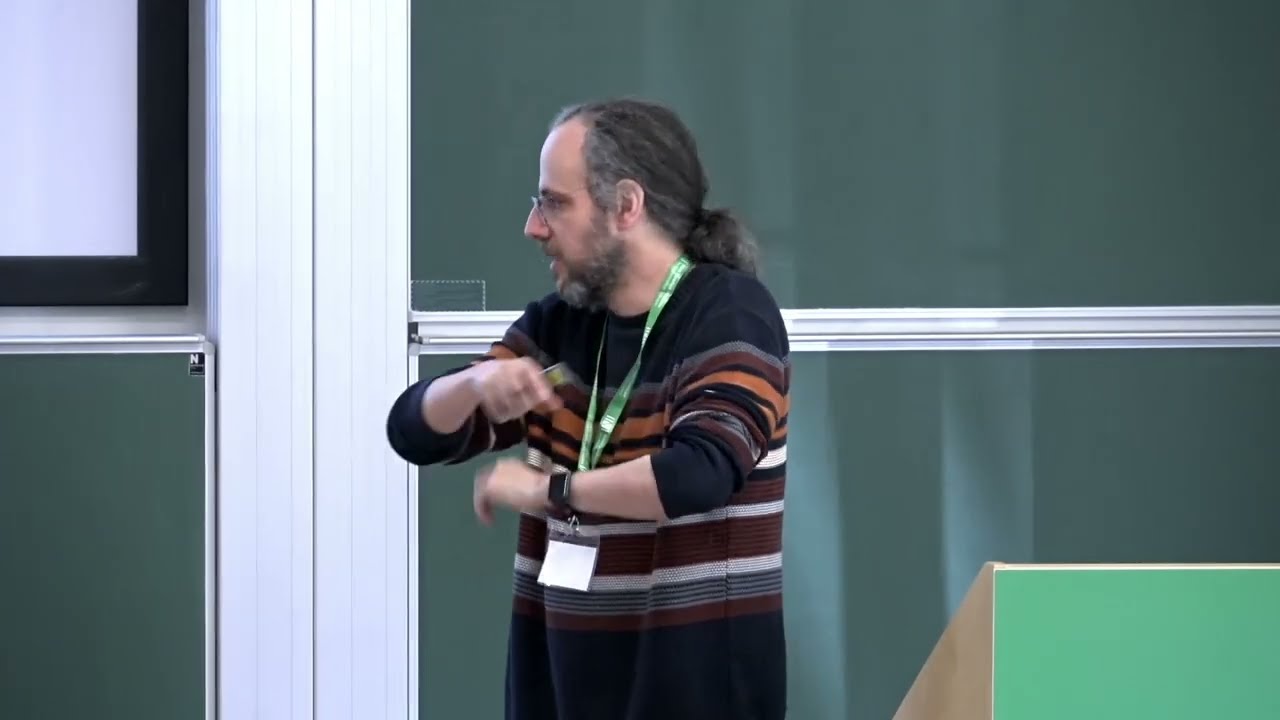
Prof. Javier Gómez-Serrano | AI-Driven Mathematical Discovery: Singularities, Algorithms, and Beyond
Keywords
Summary
238 words
Critical Evaluation
Value of the Information & Strength of the Argument
The talk provides valuable insights into the application of AI in mathematics, particularly in the context of singularity formation in PDEs. The speaker presents concrete examples and results, demonstrating the effectiveness of PINNs in discovering new solutions with high precision. The argumentation is solid, as he explains the methodology and the improvements over previous work, and he acknowledges the limitations and open questions. The discussion of AlphaFold’s potential for mathematical discovery is forward-looking and thought-provoking, though it is less detailed than the PINN part. Overall, the talk offers a balanced perspective on the current state and future possibilities of AI in mathematics.
Scientific Rigor, Source Quality, Title Accuracy
The talk is scientifically rigorous, with the speaker referencing specific papers and results, and he mentions a recent Quanta article for broader context. The sources cited include his own work and that of others, and he clearly distinguishes between established results and ongoing research. The title accurately reflects the content, covering both the singularity problem and the algorithmic approaches. The talk is given at a reputable institution (Isaac Newton Institute), which adds to its credibility. The speaker also engages with audience questions, clarifying technical details and acknowledging uncertainties, which further demonstrates scientific integrity.
210 words
Title / Content Match
The title accurately reflects the content: the speaker discusses AI-driven mathematical discovery, focusing on singularities in PDEs and the use of algorithms, including small models (PINNs) and large models (AlphaFold).
Quality & Reliability
8/10
The talk is given by a recognized researcher (Brown University) at the Isaac Newton Institute, presenting recent results and methods. The content is technical and appears rigorous, with references to published work and ongoing research. However, as a seminar talk, it lacks peer-reviewed detail and is partly based on unpublished results.
Key Moments
Markers derived by PSI from the transcript: the creator did not define chapters.
- Introduction: talk structure and motivation from fluid mechanics.
- Self-similar ansatz and transformation to stationary problem.
- PINN approach for Boussinesq equations and initial results.
- Improvements in accuracy: incorporating asymptotics and compactification.
- Multi-stage training and Gauss-Newton method for better convergence.
- Discussion on error measurement and computer-assisted proofs.
- Transition to large models: AlphaFold and genetic algorithms.
- AlphaFold's potential for mathematical discovery and exploration.
- Q&A: questions about error thresholds and proof feasibility.
- Concluding remarks and future directions.
Cited Sources
- INI Seminar Page — Official seminar page for the talk, part of the workshop 'AI in Spectral Geometry'.
- Isaac Newton Institute Website — General information about the institute and its research programs.
- Isaac Newton Institute LinkedIn — LinkedIn page of the institute, providing additional context.
Concurring Sources
- Quanta Magazine Article on AI and Mathematics — The speaker references a recent Quanta article covering AI in mathematics, which aligns with the talk's themes.
Contribution & Novelties
The talk presents recent advances in using AI for mathematical discovery, particularly in the context of singularity formation in fluid dynamics. The speaker’s work on PINNs achieves unprecedented accuracy in finding self-similar blowup profiles, potentially enabling computer-assisted proofs. The discussion of AlphaFold’s application to mathematics is novel and highlights the potential of large language models in exploring algorithmic spaces. The talk contributes to the growing field of AI-assisted mathematics by demonstrating both small and large model approaches.
Pour aller plus loin :
- Physics-informed neural networks — Overview of PINNs, the core method used in the first part.
- Navier-Stokes existence and smoothness — Background on the millennium problem related to the equations discussed.
- AlphaFold — Information on the AlphaFold system, which the speaker mentions as a large model for scientific discovery.
130 words
Radar Profile
The radar profile shows high scores in technical level and information quality, reflecting the advanced and rigorous nature of the talk. The quantity of information is also high, but the global reliability is slightly lower due to the informal setting and reliance on unpublished results. The overall balance indicates a technically dense and informative presentation.
💬 No comments were provided for analysis.