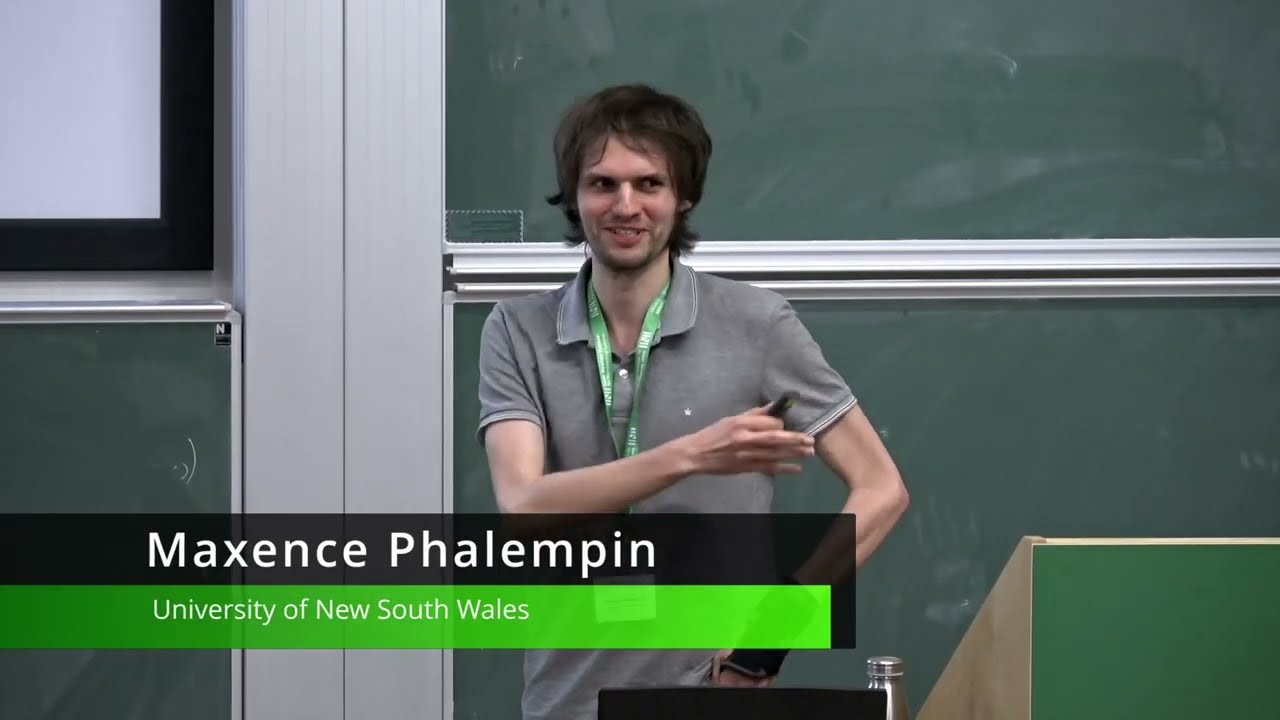
Estimating stationary measures for mean field coupled systems
Keywords
Summary
191 words
Critical Evaluation
Value of the Information & Strength of the Argument
The talk provides a clear and rigorous presentation of a novel numerical method for estimating stationary measures in mean field coupled systems. The argumentation is solid, building on established results (Keller’s theorem) and extending them with a discretization scheme and a Newton method. The speaker carefully explains the assumptions and the steps of the proofs, making the reasoning transparent. The numerical examples effectively demonstrate the advantages of the proposed methods, particularly the faster convergence of the Newton method. The value of the information is high for researchers in dynamical systems and numerical analysis, as it offers a practical algorithm with theoretical guarantees.
Scientific Rigor, Source Quality, Title Accuracy
The talk is based on original research, joint work with Paul Bass and Gary Fen. The speaker references the work of Keller and others, but does not provide explicit citations or URLs during the talk. The description includes links to the Isaac Newton Institute and the specific seminar page, which may contain further references. The title accurately reflects the content, focusing on estimation methods for stationary measures. The talk appears scientifically rigorous, with clear definitions, theorems, and proofs, though it is not peer-reviewed in this format.
203 words
Title / Content Match
The title accurately reflects the content: the talk focuses on estimating stationary measures for mean field coupled systems, presenting both theoretical and numerical methods.
Quality & Reliability
8/10
Talk by a researcher at a recognized institution (INI), presenting original research with a clear mathematical framework, proofs, and numerical illustrations. The content is technical and appears rigorous, though not peer-reviewed in this format.
Key Moments
Markers derived by PSI from the transcript: the creator did not define chapters.
- Introduction to expanding circle maps and transfer operators.
- Definition of mean field coupled systems and self-consistent transfer operator.
- Keller's theorem on existence of invariant density and spectral gap.
- Proof sketch of Keller's theorem using Lasota-Yorke inequalities.
- Introduction of discretization scheme with Fourier modes.
- Convergence of the iterative scheme and error analysis.
- Application of Newton method for faster convergence.
- Derivative of the skewed transfer operator and regularity conditions.
- Numerical implementation and comparison of convergence rates.
- Examples with different coupling functions and discussion.
Cited Sources
- Isaac Newton Institute for Mathematical Sciences — Official website of the institute hosting the talk.
- Seminar page for OMDW01 — Page for the specific seminar, likely containing abstract and references.
Concurring Sources
- Keller, G. (1984) - Stochastic stability in some chaotic dynamical systems — Referenced in the talk as the basis for the existence theorem.
Contribution & Novelties
The talk presents a novel numerical scheme for approximating stationary measures in mean field coupled systems, combining a discretization with Fourier modes and a Newton method. The main contribution is the theoretical justification of the convergence rates, including super-exponential convergence in the ideal case. This extends existing results on existence and uniqueness of invariant measures to practical estimation.
Pour aller plus loin :
- Transfer operator — Background on the operator used in the talk.
- Lasota-Yorke inequality — Key inequality used in the proofs.
- Newton’s method — Numerical method applied for faster convergence.
92 words
Radar Profile
The radar profile shows high scores in technical level and information quality, reflecting the advanced mathematical content and rigorous presentation. The quantity of information is also high, but the reliability score is slightly lower due to the lack of peer review and explicit citations.
💬 Sur les 0 commentaires analysés, aucune tendance n'est disponible.