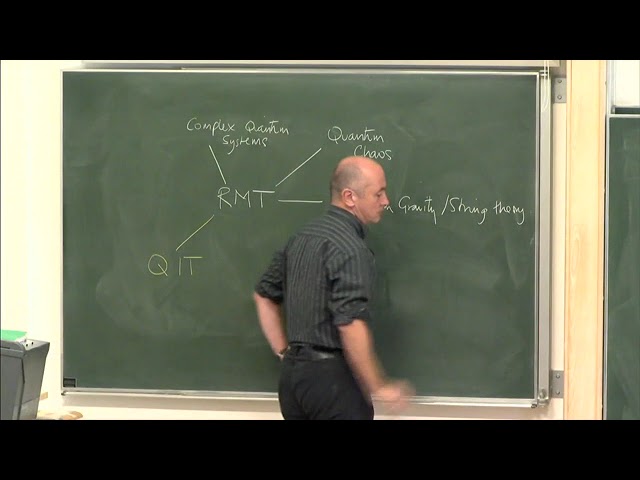
Prof. Jon Keating | Lecture 1: A Primer in Random Matrix Theory
Keywords
Summary
209 words
Critical Evaluation
Value of the Information & Strength of the Argument
The lecture provides a high-level synthesis of random matrix theory, offering valuable context and connections that are often missing in more technical treatments. Keating’s argumentation is clear and logical, building from historical motivations to the classification of ensembles. He effectively uses analogies (e.g., statistical mechanics) to explain the underlying philosophy. The talk is not a detailed derivation but rather a survey, which is appropriate for its purpose. The value lies in its breadth and the emphasis on the interconnectedness of RMT with other fields, which can inspire new research directions.
Scientific Rigor, Source Quality, Title Accuracy
The lecture demonstrates high scientific rigor. Keating, a leading expert, accurately describes the historical development and key results, citing the contributions of Wigner, Dyson, Wishart, and others. The content is consistent with established literature. The title accurately reflects the content: it is indeed a primer on random matrix theory. The lecture is part of a workshop at the Isaac Newton Institute, ensuring a high standard. No sources are explicitly cited in the talk itself, but the description provides a link to the seminar page, which likely contains further references.
194 words
Title / Content Match
The title accurately describes the content: a primer on random matrix theory, delivered as a lecture.
Quality & Reliability
9/10
Lecture by a leading expert (Professor of Mathematics at Oxford) at a recognized research institute (INI). Content is rigorous, well-structured, and historically accurate, with clear references to key developments and researchers.
Key Moments
Markers derived by PSI from the transcript: the creator did not define chapters.
- Introduction and overview of the lecture's purpose.
- Historical background: Wigner's vision in the 1950s, analogy with statistical mechanics.
- Development in the 1960s: Dyson, Mehta, and exact solvability.
- Quantum chaos in the 1970s: application to billiards and chaotic systems.
- Connections to quantum gravity and string theory in the 1990s.
- Origins in statistics: Wishart matrices and agricultural data.
- Origins in numerical analysis: von Neumann and condition numbers.
- Classification of random matrix ensembles: invariant, Wigner, Wishart.
- Gaussian ensembles and their unique properties.
- Dyson's three-fold way and extensions to Nambu spaces.
Cited Sources
- Seminar page: New mathematical directions for quantum information — Official page for the seminar where this lecture was given.
Concurring Sources
- Random matrix theory — General reference on the topic.
Contribution & Novelties
This lecture provides a valuable synthesis of random matrix theory, highlighting its historical development and wide-ranging connections. It is particularly useful for researchers in quantum information who may not be familiar with the broader context of RMT. The lecture suggests that quantum information theory might inspire new ensembles, which is a novel perspective.
Pour aller plus loin :
- Random matrix — Overview of random matrix theory.
- Wigner surmise — Key result in RMT.
- Wishart distribution — Statistical distribution of Wishart matrices.
- Quantum chaos — Field connecting RMT to quantum systems.
90 words
Radar Profile
The radar profile shows high scores across all dimensions, indicating a well-balanced and reliable lecture. The slightly lower score in 'niveau_technique' reflects the survey nature, but the overall quality is excellent.
💬 No comments were provided for analysis.