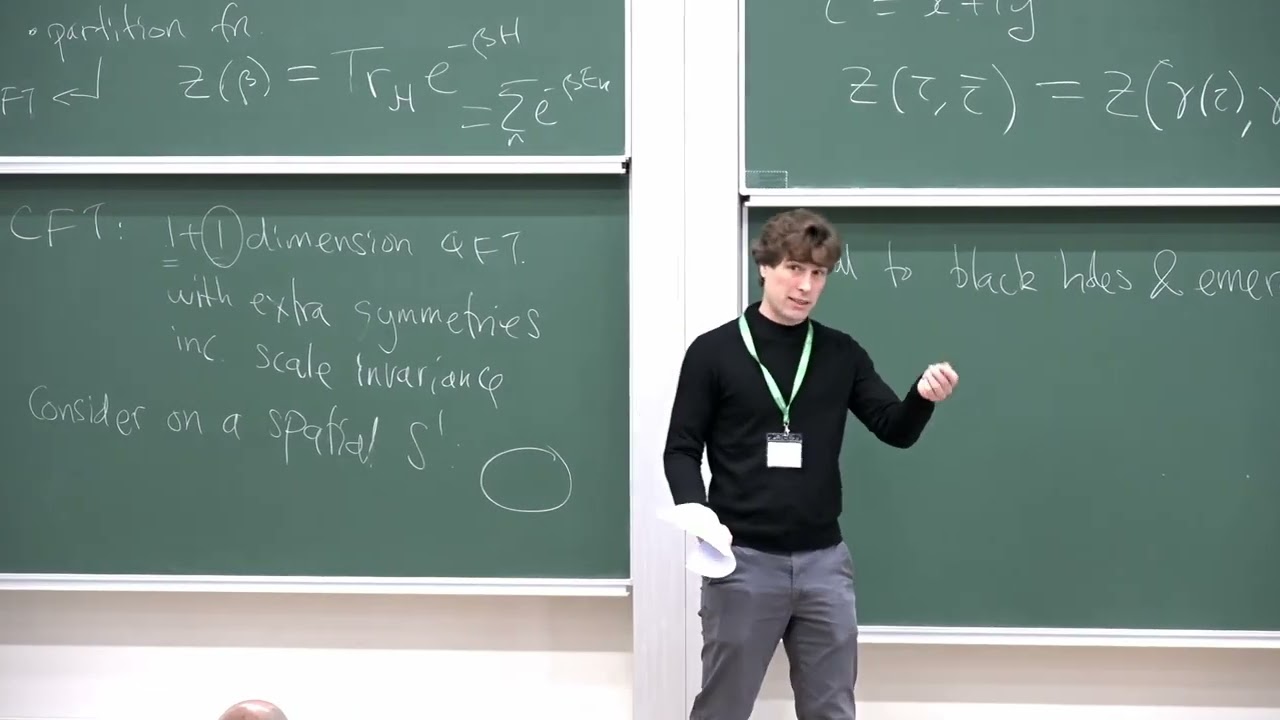
Recent appearances of automorphic Maass forms and L functions in physics.
Keywords
Summary
167 words
Critical Evaluation
Value of the Information & Strength of the Argument
The talk provides a clear conceptual framework for understanding the connection between physics and number theory, specifically the role of Maass forms and L-functions. Hartnoll effectively argues that harmonic analysis on the fundamental domain is a promising tool for studying chaotic CFTs, despite the technical challenges. He emphasizes the distinction between wave functions and partition functions, and the importance of modular invariance. The argumentation is logical and accessible, though it is an overview rather than a detailed proof. The value lies in its synthesis of ideas from different fields, making it a useful introduction for both physicists and mathematicians.
Scientific Rigor, Source Quality, Title Accuracy
The talk is scientifically rigorous, given the speaker’s expertise and the institutional context. Hartnoll references the work of colleagues (e.g., Nathan, Eric) and the broader literature on AdS/CFT, but does not provide specific citations in the talk itself. The description includes links to the Isaac Newton Institute and the seminar page, which are reliable sources. The title accurately reflects the content, focusing on recent appearances of automorphic forms in physics. The talk is well-structured and the technical level is appropriate for a mixed audience, though it assumes some familiarity with quantum field theory and modular forms.
210 words
Title / Content Match
The title accurately reflects the content: the talk focuses on recent appearances of automorphic Maass forms and L-functions in physics, particularly in the context of conformal field theories and black holes.
Quality & Reliability
8/10
Talk by a leading physicist (Sean Hartnoll) at a prestigious institute (INI), part of a research workshop. The content is a broad overview, not peer-reviewed, but the speaker is an expert and the context is academic. The talk is clear and well-structured, but it is an introductory survey rather than a detailed technical exposition.
Key Moments
Markers derived by PSI from the transcript: the creator did not define chapters.
- Introduction: Hartnoll explains he will give a broad overview, not his own work.
- Distinction between wave functions and partition functions in quantum mechanics.
- Introduction to conformal field theories (CFTs) in 1+1 dimensions and their partition functions.
- Modular invariance of CFT partition functions and the role of SL(2,Z).
- Connection between chaotic CFTs and black holes via AdS/CFT.
- Contrast between simple CFTs (Ising model) and complex chaotic CFTs.
- Proposal to expand partition functions in harmonics on the fundamental domain.
- Expansion in Maass cusp forms and Eisenstein series.
- Issue of non-normalizability and the need to subtract light operators.
- Definition of the spectral partition function and its modular invariance.
Cited Sources
- INI Seminar Page — Official page for the seminar, providing details about the talk and the workshop.
- Isaac Newton Institute — The institute hosting the talk, providing general information about the research programme.
- INI LinkedIn — Social media presence of the institute, not directly cited in the talk but part of the description.
Concurring Sources
- INI Seminar Page — The seminar page confirms the event details and the speaker's affiliation.
Contribution & Novelties
The talk provides a clear and accessible synthesis of recent developments connecting automorphic forms (Maass forms, L-functions) to physics, particularly in the context of conformal field theories and black hole entropy. It highlights the proposal to use harmonic analysis on the fundamental domain of SL(2,Z) to study chaotic CFTs, which is a novel approach. The talk also clarifies the distinction between wave functions and partition functions, and the technical challenges in defining a normalizable spectral partition function.
Pour aller plus loin :
- Maass form — Background on Maass forms, which are central to the talk.
- L-function — General concept of L-functions, relevant to the number-theoretic aspects.
- AdS/CFT correspondence — The duality that motivates the connection between CFTs and black holes.
- Modular form — Foundational for understanding modular invariance in CFTs.
130 words
Radar Profile
The radar profile shows high scores in quality and reliability, reflecting the speaker's expertise and the academic setting. The quantity of information is moderate, as it is an overview rather than a detailed technical talk. The technical level is high but accessible, and the overall reliability is strong.