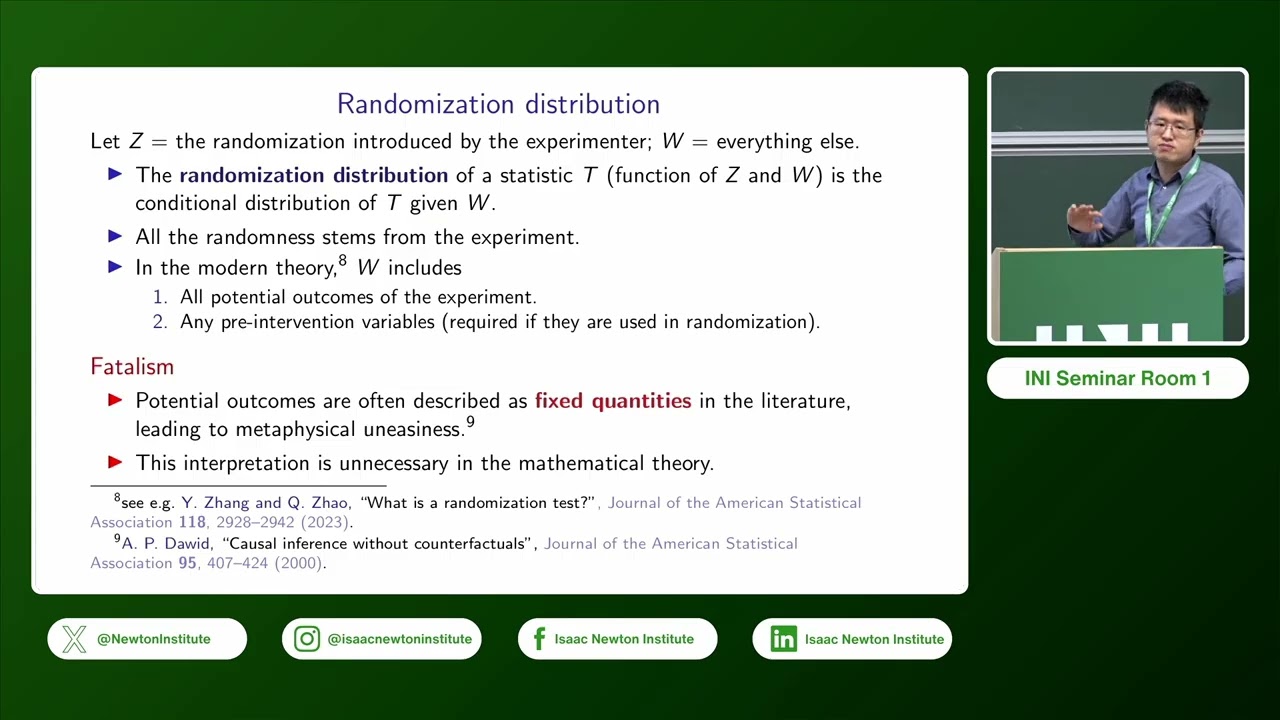
Prof. Qingyuan Zhao | Origins of randomization for causal inference
Keywords
Summary
139 words
Critical Evaluation
Value of the Information & Strength of the Argument
The talk provides a valuable historical perspective on randomization, synthesizing insights from key figures like Fisher, Neyman, and Cox. The argumentation is well-supported by references to primary sources and historical documents. Zhao effectively explains the conceptual evolution of randomization, from its practical use in avoiding bias to its theoretical role in exact inference. He also highlights the often-overlooked connection between genetics and statistics, offering a fresh angle on the development of these ideas. The presentation is coherent and persuasive, though it relies heavily on historical narrative rather than novel technical contributions.
Scientific Rigor, Source Quality, Title Accuracy
The talk demonstrates high scientific rigor, drawing on well-documented historical sources and peer-reviewed articles. Zhao cites specific works by Fisher, Neyman, Cox, and others, and provides context for their contributions. The title accurately reflects the content, which focuses on the origins of randomization. The talk is part of a workshop on foundations of causal inference, and the speaker is a recognized expert in the field. The sources are credible and appropriately used to support the historical narrative.
183 words
Title / Content Match
The title accurately reflects the content, which focuses on the historical origins of randomization and its role in causal inference.
Quality & Reliability
8/10
The talk is given by a professor at the University of Cambridge, based on historical review articles and his own expertise. It is well-structured and references key figures and papers. However, it is a historical narrative and not a peer-reviewed publication, and some claims are based on personal interpretation.
Key Moments
Markers derived by PSI from the transcript: the creator did not define chapters.
- Introduction and overview of the talk's structure.
- Discussion of Fisher's early work and the first randomized experiments.
- Explanation of the three roles of randomization according to Cox.
- Historical examples of randomized experiments in psychology and medicine.
- Fisher's geometric intuition and the randomization distribution.
- Neyman's potential outcomes model and its historical context.
- Cox's elegant proof of the variance formula for randomized experiments.
- Randomization tests and Fisher's exact p-value example.
- The interplay between genetics and statistics in the development of randomization.
- Wright's path analysis and the connection to randomization.
Cited Sources
- Isaac Newton Institute for Mathematical Sciences — The talk is hosted by the Isaac Newton Institute, and the speaker is affiliated with the University of Cambridge.
- Seminar page for the talk — Official seminar page with details about the event.
- Isaac Newton Institute LinkedIn — LinkedIn page of the institute, mentioned in the video description.
Concurring Sources
- The Design of Experiments — Fisher's book, which is central to the talk's discussion of randomization.
- Randomized controlled trial — The talk discusses the first randomized clinical trials, which are a key application of randomization.
Contribution & Novelties
The talk provides a comprehensive historical account of randomization, synthesizing insights from multiple sources and highlighting the often-overlooked connection between genetics and statistics. It offers a fresh perspective on the development of causal inference and emphasizes the continued relevance of historical ideas in modern research.
Pour aller plus loin :
- Randomization in statistics — Provides a general overview of randomization in experimental design.
- R.A. Fisher — Biographical information on Fisher, a central figure in the talk.
- Potential outcomes framework — Overview of the potential outcomes model, which is discussed in the talk.
- Design of experiments — General reference on experimental design, including randomization.
- Causal inference — Overview of causal inference methods, including randomization-based approaches.
114 words
Radar Profile
The radar profile shows high scores in information quantity, quality, and reliability, with a slightly lower technical level, reflecting the talk's historical and conceptual focus rather than deep mathematical detail. The overall profile indicates a well-rounded and credible presentation.
💬 No comments were provided for analysis.