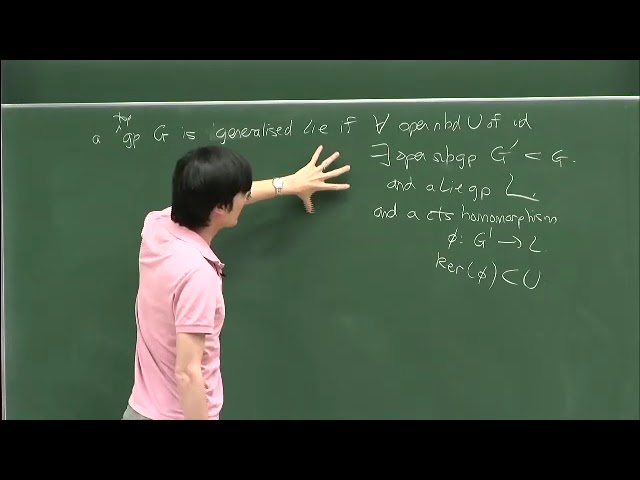
On Gromov's theorem on groups of polynominal growth and related topics
Keywords
Summary
116 words
Critical Evaluation
Value of the Information & Strength of the Argument
The talk provides valuable insights into the connections between different areas of mathematics, such as geometric group theory, Lie theory, and additive combinatorics. Tao’s argumentation is clear and persuasive, even without formal proofs. He motivates each concept with examples and explains the logical flow between theorems. The presentation is coherent and highlights the unifying principle behind several deep results.
Scientific Rigor, Source Quality, Title Accuracy
The talk is scientifically rigorous, given the speaker’s expertise and the institutional setting. Tao does not cite specific sources during the talk, but the content is based on well-established theorems and recent research. The title accurately reflects the content, which focuses on Gromov’s theorem and related topics. No comments were provided for analysis.
127 words
Title / Content Match
The title accurately reflects the content, which focuses on Gromov's theorem and related results.
Quality & Reliability
9/10
Talk by a leading mathematician (Terence Tao) at a recognized institution (INI Cambridge). The content is high-level, but the speaker is an authority and the presentation is coherent. No formal proofs are given, but the statements are accurate and well-motivated.
Key Moments
Markers derived by PSI from the transcript: the creator did not define chapters.
- Introduction and overview of the talk's theme: controlled growth implies algebraic structure.
- Statement of Gromov's theorem: finitely generated groups of polynomial growth are virtually nilpotent.
- Definition of polynomial growth and examples: abelian and nilpotent groups.
- Introduction of approximate groups and examples.
- Statement of the theorem on finite approximate groups and its connection to Gromov's theorem.
- Discussion of the Gleason-Yamabe theorem and Hilbert's fifth problem.
- Explanation of the correspondence principle between finite approximate groups and locally compact groups.
- Use of the pigeonhole principle to connect polynomial growth to approximate groups.
- Mention of related theorems: Jordan's theorem, Tits alternative, and Kronecker's theorem.
- Conclusion and summary of the unifying principle.
Cited Sources
- INI Seminar Page — Official page for the seminar, providing details about the talk.
Concurring Sources
- Gromov's theorem on groups of polynomial growth — Wikipedia article confirming the statement of Gromov's theorem.
Contribution & Novelties
The talk provides a high-level synthesis of several deep results in group theory, highlighting a common principle. It is not original research but offers valuable perspective. For further exploration:
Pour aller plus loin :
- Gromov’s theorem — Overview of the theorem and its proof.
- Approximate group — Definition and examples.
- Hilbert’s fifth problem — Background on the Gleason-Yamabe theorem.
59 words
Radar Profile
The radar profile shows high scores in quality, technical level, and reliability, with a slightly lower score in quantity of information due to the high-level nature of the talk. This indicates a dense, expert-level presentation with strong content but limited breadth.