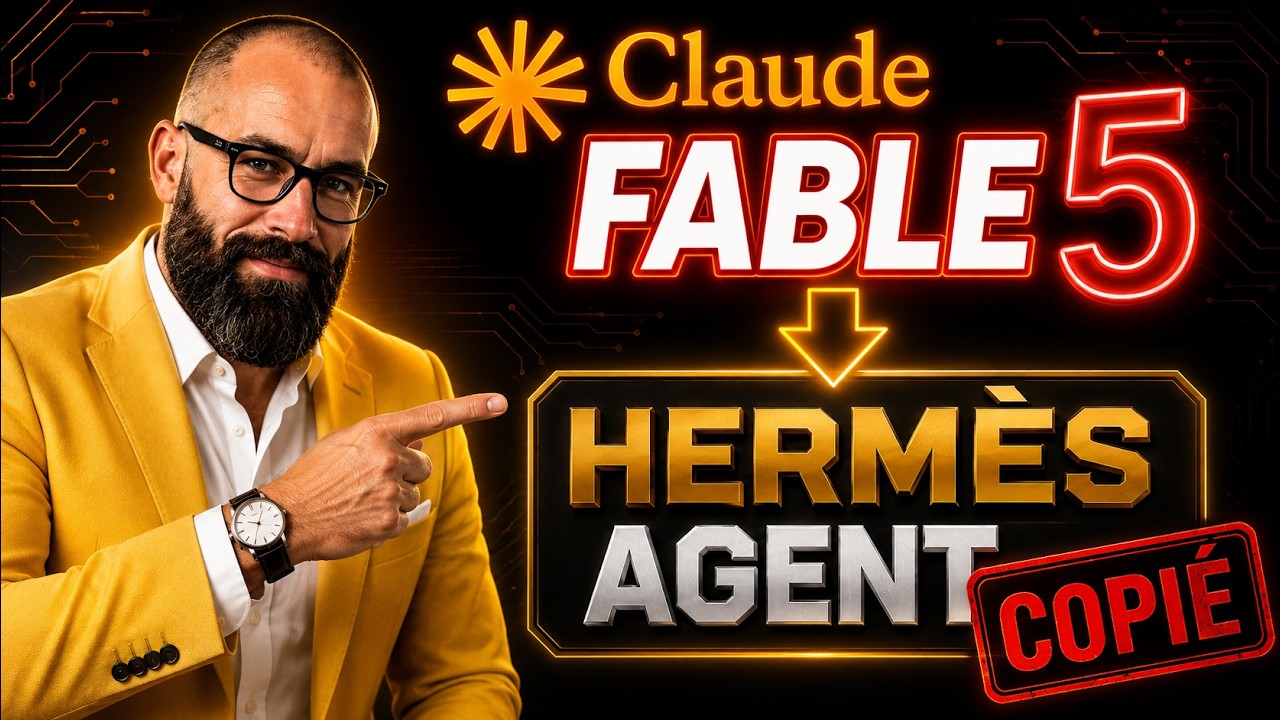
Claude Fable c'est FINI ! | Comment créer ton propre modèle IA Fable dans Hermes IA
Model 03:18EnglishClaude Fable is OVER! | How to create your own AI model
Keywords
Summary
166 words
Critical Evaluation
Value of the Information & Strength of the Argument
The video provides a practical, step-by-step guide to a novel workflow: distilling a proprietary model’s traces into open-source models and deploying them locally. This is valuable for users seeking to reduce dependency on API costs and maintain control over their AI tools. The argumentation is coherent, explaining the rationale behind distillation and quantization, and the importance of agentic architectures. However, the claims about the effectiveness of the distilled models and the urgency of market changes are not supported by concrete evidence or data. The creator’s assertion that ’everything you’ve been told about AI is wrong’ is an overgeneralization and serves to promote his own training courses.
Scientific Rigor, Source Quality, Title Accuracy
The video lacks rigorous scientific sourcing. The creator mentions datasets on Hugging Face and tools like LM Studio and Hermes Agent, but provides no direct links or citations to these resources. The only link in the description is to his own training platform. The title accurately reflects the content, but the video’s promotional segments and unsubstantiated claims about job market impacts reduce its overall reliability. The creator’s expertise is implied but not demonstrated through verifiable credentials or references.
199 words
Title / Content Match
The title accurately reflects the content: the video explains the end of Claude Fable and demonstrates how to create a local model using distilled traces.
Quality & Reliability
5/10
The video presents a practical tutorial on distilling a proprietary model (Claude Fable) into smaller open-source models, but it lacks verifiable sources, contains promotional segments, and makes unsubstantiated claims about model capabilities and market impact.
Key Moments
Markers derived by PSI from the transcript: the creator did not define chapters.
- Introduction: Claude Fable is being discontinued, and the video will show how to distill its knowledge into smaller models.
- Explanation of distillation: using traces of Claude Fable's behavior to train smaller models.
- Discussion of datasets on Hugging Face with 2.3 million examples.
- Introduction to LM Studio and how to download and select quantized models.
- Explanation of quantization levels (Q2, Q4, Q6, Q8) and their trade-offs.
- Demonstration of loading a model in LM Studio and configuring context length.
- Promotional segment for the creator's training courses.
- Testing the model in chat and showing its multimodal capabilities.
- Setting up LM Studio as a local server and generating an API key.
- Installing Hermes Agent and connecting it to LM Studio.
- Configuring Hermes Agent to use the local model and testing a request.
Cited Sources
- Parlons IA - Formations — Link to the creator's training platform, mentioned as a resource for further learning.
Concurring Sources
- Hugging Face — The video mentions datasets and models hosted on Hugging Face, which is a well-known platform for open-source AI resources.
Dissenting Sources
- Anthropic — The video claims that Claude Fable is being discontinued and that Anthropic is motivated by profit. Anthropic's official communications would be needed to verify these claims, but no such source is cited.
Contribution & Novelties
The video presents a practical method for creating a local AI model by distilling the behavior of a proprietary model (Claude Fable) into open-source models. This approach empowers users to maintain control and reduce costs. The tutorial is a valuable contribution for those interested in local AI deployment.
Pour aller plus loin :
- Model distillation (Wikipedia) — Overview of the distillation technique used to transfer knowledge from a large model to a smaller one.
- Quantization (Wikipedia) — Explanation of quantization, a key concept for reducing model size and computational requirements.
- Hugging Face — Platform hosting the datasets and models mentioned in the video, central to the open-source AI community.
- LM Studio — The software used in the tutorial to run local models.
- Hermes Agent — The agent platform used to interact with the local model.
135 words
Radar Profile
The radar profile shows a moderate quantity of information, but lower quality and reliability due to lack of verifiable sources and promotional content. The technical level is relatively high, reflecting the tutorial's focus on practical implementation.