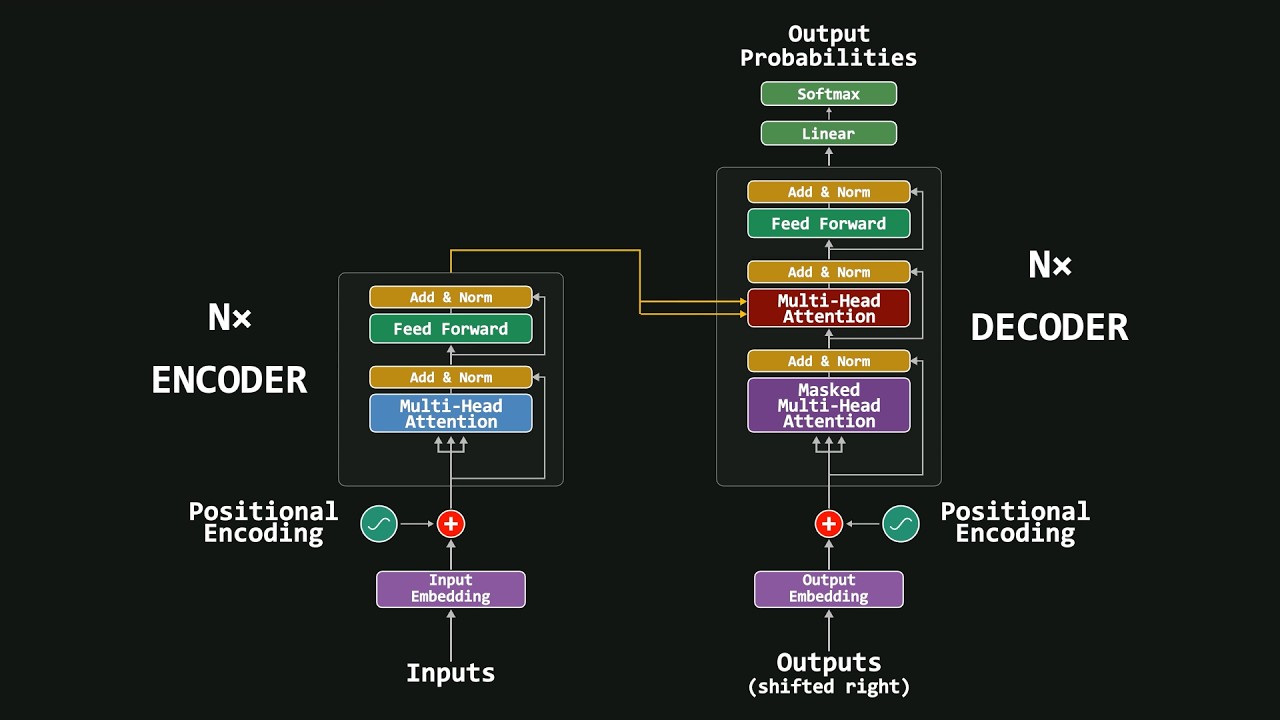
Transformers Visually Explained
Keywords
Summary
148 words
Critical Evaluation
Value of the Information & Strength of the Argument
The video excels in providing a clear and intuitive explanation of complex concepts, using visual animations and step-by-step reasoning. It builds the transformer architecture from the ground up, ensuring that each component is motivated by a specific problem. The argumentation is solid, as it explains the ‘why’ behind each design choice, such as the need for scaling in attention and the use of multiple heads. The content is accurate and aligns with the original ‘Attention is All You Need’ paper, making it a valuable educational resource.
Scientific Rigor, Source Quality, Title Accuracy
The video demonstrates scientific rigor by referencing the original transformer paper and providing links to prerequisite topics. The explanations are mathematically sound, and the visualizations aid understanding. The title accurately reflects the content, as the video indeed provides a visual explanation of transformers. The sources cited are relevant and credible, including the arXiv paper and educational resources. The video does not include any advertising or sponsored content.
168 words
Title / Content Match
The title accurately reflects the content, as the video provides a visual and intuitive explanation of transformers.
Quality & Reliability
8/10
The video provides a thorough and accurate explanation of transformer architecture, referencing the original paper and using clear visualizations. It covers key concepts such as self-attention, multi-head attention, and positional encoding with correct mathematical details. The content is well-structured and pedagogically sound, though it does not include original research or critical evaluation of the architecture.
Chapters
- Introduction – Why Transformers?
- Tokenization and One-Hot Encoding
- Word Embeddings Explained
- Static Embeddings Problem (Bank Example)
- Self-Attention
- Why Scaling by √dk?
- Self Attention Recap
- Multihead Self Attention
- Positional Encoding Intuition
- Transformer Architecture Overview
- Residual Connections + LayerNorm
- Feed Forward Network Explained
- Transformer Architecture Overview
- Masked Multi-Head Attention
- Cross Attention Explained
- Transformer Architecture Overview
- Stacked Layers (Nx)
- Training vs Inference
- Transformers Advantage
Cited Sources
- Attention Is All You Need — Original paper introducing the Transformer architecture.
- ByteQuest GitHub — Channel's GitHub repository for code and animations.
- Animation codes for Transformers — Source code for the animations used in the video.
- Manim Community — Open-source Python library used for creating mathematical animations.
- ByteQuest Reddit — Community forum for the channel.
- Neural Networks — Prerequisite video on neural networks.
- Backpropagation — Prerequisite video on backpropagation.
- Normalization — Prerequisite video on normalization.
- BatchNorm — Prerequisite video on batch normalization.
- RNNs — Prerequisite video on recurrent neural networks.
- Residual Connections — Prerequisite video on residual connections.
Concurring Sources
- Attention Is All You Need — The video's explanations align with the original paper's concepts.
- The Illustrated Transformer — A widely referenced visual guide that matches the video's content.
Contribution & Novelties
The video provides a clear and intuitive visual explanation of the Transformer architecture, making complex concepts accessible. It effectively uses animations to illustrate self-attention, multi-head attention, and positional encoding. The step-by-step approach helps viewers build a solid understanding of how transformers work, which is valuable for learners.
Pour aller plus loin :
- Attention Is All You Need — The original paper detailing the Transformer architecture.
- The Illustrated Transformer — A popular blog post with visual explanations of transformers.
- Transformer (machine learning model) — Wikipedia article providing an overview of the architecture.
- BERT: Pre-training of Deep Bidirectional Transformers for Language Understanding — A landmark paper applying transformers to NLP tasks.
- GPT-3: Language Models are Few-Shot Learners — Paper introducing GPT-3, a large-scale transformer-based language model.
124 words
Radar Profile
The radar profile shows high scores in quantity of information and technical level, indicating a comprehensive and detailed tutorial. The quality of information and reliability are also strong, reflecting accurate and well-sourced content. The overall profile suggests a highly informative and reliable educational video.
💬 Sur les 0 commentaires analysés, aucune tendance n'est disponible.