Visualizing Decision Trees: The Ultimate Guide
Keywords
Summary
145 words
Critical Evaluation
Value of the Information & Strength of the Argument
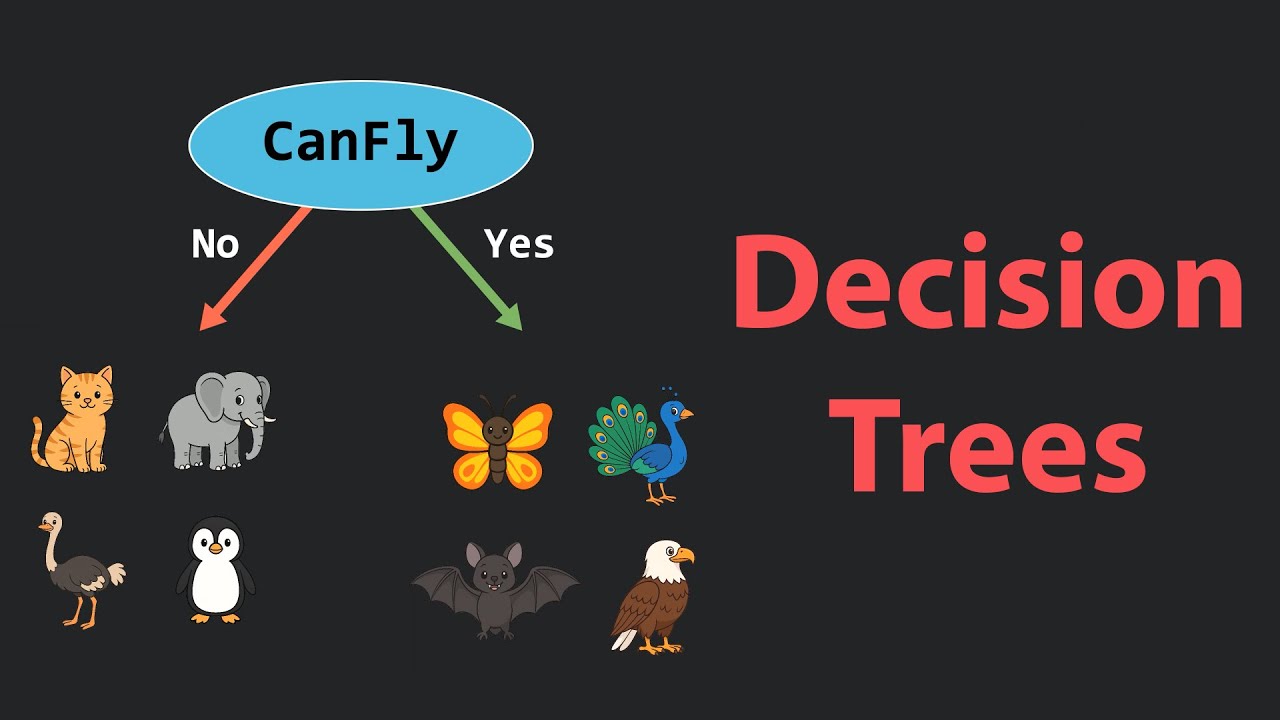
The video provides a solid introduction to decision trees and random forests, with clear explanations and visualizations. It effectively demonstrates the core concepts of impurity measurement, feature selection, and tree construction. The argumentation is logical and easy to follow, building from simple examples to more complex ideas. The use of Gini impurity and variance reduction is correctly explained, and the discussion of pruning and handling different data types adds practical value. The video does not delve into advanced topics or limitations, but it serves as an excellent starting point for beginners.
Scientific Rigor, Source Quality, Title Accuracy
The video is scientifically accurate in its explanations of decision tree algorithms. It does not cite external sources, but the concepts are standard and correctly presented. The title accurately reflects the content, which focuses on visualizing decision trees. The video includes a link to a related video on training-validation-testing data, which is relevant. The animations are well-crafted and aid understanding. The content is suitable for beginners and does not contain misleading information.
178 words
Title / Content Match
The title accurately reflects the content, which focuses on visualizing and explaining decision trees, including their construction, pruning, and extension to random forests.
Quality & Reliability
8/10
The video provides a clear, accurate introduction to decision trees and random forests, with correct explanations of Gini impurity, variance reduction, one-hot encoding, and pruning. The content is well-structured and uses intuitive examples. Minor simplifications are appropriate for the target audience, and the mathematical formulas are correctly presented. The video does not cite external sources, but the concepts are standard and correctly explained.
Chapters
Cited Sources
- GitHub - ByteQuest0 — Channel's GitHub repository for code and resources.
- Manim Community — Open-source Python library used for creating the animations.
- Reddit - ranjan4045 — Channel's Reddit profile for community engagement.
- Training-Validation-Testing Data Video — Referenced video for further explanation on data splitting.
Concurring Sources
- Decision Tree Learning - Wikipedia — Provides a comprehensive overview of decision tree algorithms, including splitting criteria and pruning.
- Random Forest - Wikipedia — Explains the random forest algorithm, its advantages, and variations.
Contribution & Novelties
The video provides a clear and visually engaging introduction to decision trees and random forests, making complex concepts accessible through animations. It covers key topics such as Gini impurity, feature selection, pruning, and handling different data types, which are essential for understanding these algorithms. The tutorial is well-structured and suitable for beginners.
Pour aller plus loin :
- Decision tree learning (Wikipedia) — Provides a comprehensive overview of decision tree algorithms, including splitting criteria and pruning.
- Random forest (Wikipedia) — Explains the random forest algorithm, its advantages, and variations.
- Gini coefficient (Wikipedia) — While not directly the same as Gini impurity, it offers background on the concept of impurity measures.
- Bootstrap aggregating (bagging) (Wikipedia) — Discusses the bagging technique used in random forests.
122 words
Radar Profile
The radar chart shows a balanced profile with high scores in information quantity, quality, and reliability, and a slightly lower score in technical level. This indicates that the video is informative and reliable, but may not delve deeply into advanced technical details, making it suitable for beginners.