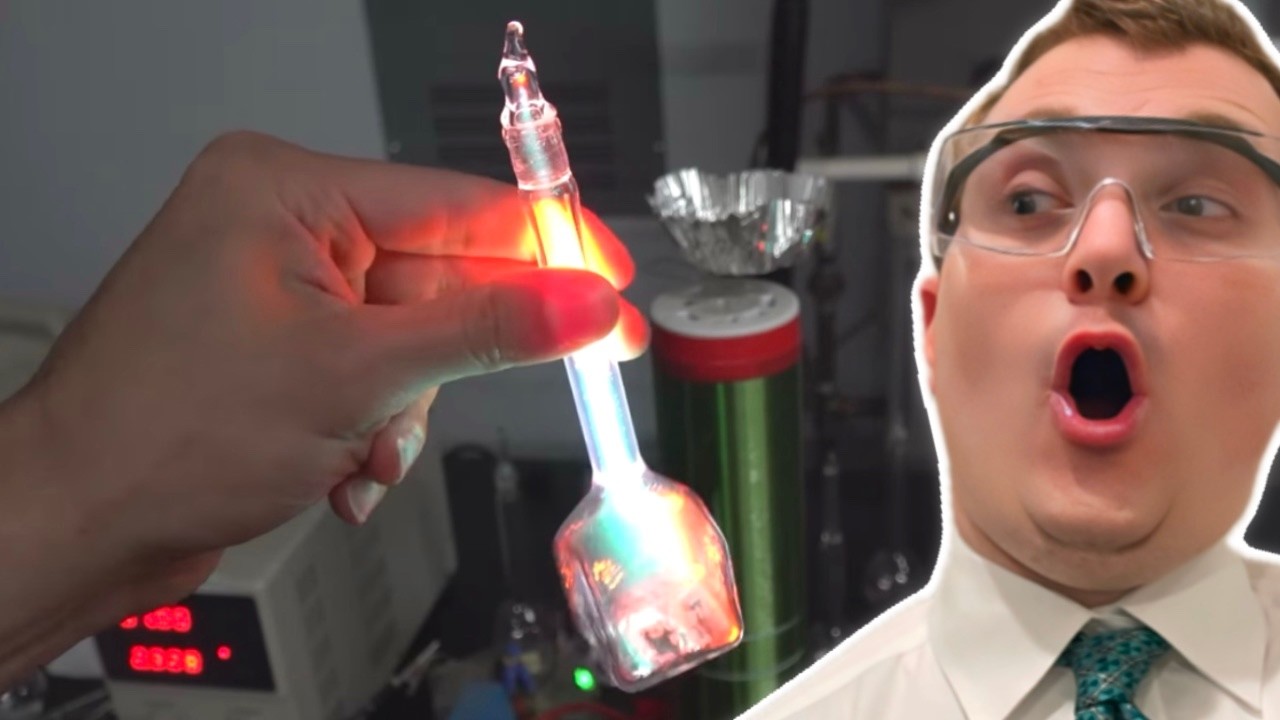
Styropyro's Mechanical Light Bulb from 1675? - Nuclear Engineer Reacts
Keywords
Summary
127 words
Critical Evaluation
Value of the Information & Strength of the Argument
The video offers substantial value by bridging historical science with modern engineering practice. The engineer’s commentary is well-argued, drawing on his professional experience to explain complex concepts in an accessible manner. He effectively uses analogies to nuclear reactor systems to illustrate principles like mean free path and contamination control. The argumentation is solid, as he supports his points with concrete examples and acknowledges uncertainties. The discussion of mercury toxicity is nuanced, distinguishing between elemental and compound forms and emphasizing the importance of exposure pathways. The engineer also highlights the value of failure and iteration in engineering, which adds depth to the narrative.
Scientific Rigor, Source Quality, Title Accuracy
The video demonstrates scientific rigor by accurately explaining the physics and engineering principles involved. The engineer references the original Styropyro video and provides context from his own expertise. The title accurately reflects the content, as the video is a reaction to Styropyro’s mechanical light bulb project. The engineer does not cite external sources, but his commentary is grounded in established scientific knowledge. The video’s production quality is high, with clear explanations and visual aids. The engineer’s credibility as a nuclear engineer adds to the reliability of the information presented.
206 words
Title / Content Match
The title accurately reflects the content: a nuclear engineer reacts to Styropyro's video about a mechanical light bulb from 1675.
Quality & Reliability
8/10
The video provides a detailed and technically accurate reaction to Styropyro's experiment, with the reactor engineer offering expert commentary on vacuum physics, plasma, mercury safety, and engineering principles. The content is well-explained and grounded in practical experience, though it is primarily a commentary rather than an original study.
Key Moments
Markers derived by PSI from the transcript: the creator did not define chapters.
- Introduction and overview of Styropyro's video.
- Discussion of the 1675 discovery by Jean Picard.
- Styropyro attempts glassblowing to create a stem for the flask.
- Engineer comments on the importance of adapting to limitations.
- Styropyro adds mercury to the flask and discusses its properties.
- Vacuum pump setup and observation of standing waves in mercury.
- Engineer explains vacuum pressure definitions and mean free path.
- Sealing the flask under vacuum and the challenges involved.
- First test of the mechanical light bulb and faint glow observed.
- Comparison to Cherenkov radiation and historical context.
Cited Sources
- Styropyro's original video — The original video by Styropyro that the engineer is reacting to.
Concurring Sources
- Wikipedia: Triboelectric effect — Supports the explanation of charge generation in the mercury.
- Wikipedia: Mean free path — Relevant to the discussion of vacuum and plasma.
Contribution & Novelties
This video provides a unique perspective by having a nuclear engineer analyze a historical experiment, offering insights into the physics and engineering principles that are often overlooked. The engineer’s commentary adds depth to the original content, making it valuable for viewers interested in applied physics and engineering.
Pour aller plus loin :
- Triboelectric effect — Explains the charge separation that drives the glow.
- Mean free path — Relevant to vacuum physics and plasma behavior.
- Cherenkov radiation — Mentioned in the video as a comparison to the historical glow.
88 words
Radar Profile
The radar profile shows high scores across all dimensions, indicating a well-rounded and informative video. The strengths lie in the quality and quantity of information, as well as the technical depth, while the reliability is also high due to the engineer's expertise.
💬 Très positif. Sur les 30 commentaires analysés, les spectateurs expriment une admiration pour Styropyro et apprécient les explications de l'ingénieur, avec des commentaires humoristiques et des éloges pour la pédagogie.