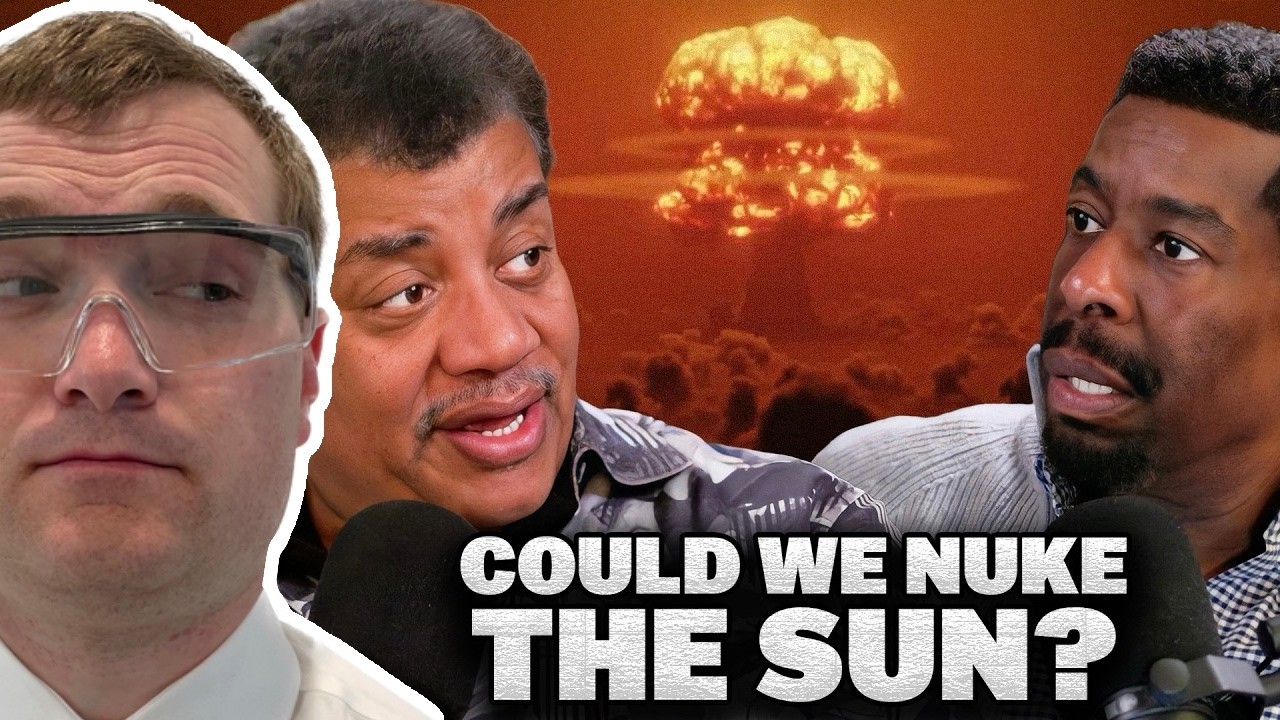
"Saving" The Sun with Nukes? - Nuclear Engineer Reacts to Startalk
Keywords
Summary
136 words
Critical Evaluation
Value of the Information & Strength of the Argument
The video provides valuable insights into nuclear physics and astrophysics, correcting common misconceptions about the sun and nuclear weapons. The argumentation is solid, grounded in well-established scientific principles such as the Lawson criterion and the scale of solar energy output. The engineer effectively uses analogies (e.g., spark plug, spitballs) to illustrate the futility of the proposed idea, and his explanations are clear and logical. The discussion on temperature in space and radiative heat transfer is particularly informative, clarifying a common misunderstanding.
Scientific Rigor, Source Quality, Title Accuracy
The video demonstrates high scientific rigor, with the engineer accurately explaining concepts like fusion, the Lawson criterion, and the Stefan-Boltzmann law. The primary source is the StarTalk video, which is referenced in the description. The title accurately reflects the content, and the engineer’s expertise adds credibility. The video does not cite external sources beyond the original StarTalk episode, but the explanations are consistent with established physics. The adéquation between title and content is strong.
170 words
Title / Content Match
The title accurately reflects the content, which is a reaction to a StarTalk video discussing the feasibility of using nuclear weapons to 'save' the sun.
Quality & Reliability
8/10
The video features a nuclear engineer providing expert commentary on astrophysical concepts, with accurate explanations of fusion, the Lawson criterion, and radiative heat transfer. The content is well-reasoned and aligns with established scientific principles, though it is presented as opinion/reaction rather than original research.
Key Moments
Markers derived by PSI from the transcript: the creator did not define chapters.
- Introduction and setup: reacting to StarTalk video about nuking the sun.
- Discussion of the movie 'Sunshine' and the premise of sending nuclear material to the sun.
- Explanation of fission vs. fusion and why nuclear weapons are irrelevant to the sun.
- Introduction of the Lawson criterion and why fusion requires specific conditions.
- Scale comparison: Tsar Bomba energy vs. solar output.
- Discussion of the sun's structure and why fusion only occurs in the core.
- Idea of mixing the sun's layers to extend its life, but acknowledging it's beyond current capabilities.
- Temperature in space: radiative heat transfer and the inverse square law.
- Heat shield challenges and the rotisserie analogy for spacecraft.
- Conclusion: the sun is not a machine to be restarted; advanced civilizations might do such things.
Cited Sources
- StarTalk: Could We Nuke the Sun? — The original StarTalk video that the nuclear engineer is reacting to, which discusses the feasibility of using nuclear weapons to revive the sun.
Concurring Sources
- NASA: The Sun — Provides general information about the sun's structure and fusion processes, consistent with the video's explanations.
Contribution & Novelties
The video offers a unique perspective from a nuclear engineer, providing technical depth that is often missing in popular science discussions. It clarifies misconceptions about fusion and the sun’s energy production, and explains why nuclear weapons are utterly insufficient. The engineer also provides insights into heat transfer in space and the challenges of approaching the sun, which are not commonly addressed in such detail.
Pour aller plus loin :
- Lawson criterion — The condition for sustained fusion, central to the discussion.
- Tsar Bomba — The most powerful nuclear weapon ever tested, used as a scale comparison.
- Dyson sphere — A hypothetical megastructure that could capture a star’s energy, mentioned as a type II civilization concept.
- Kardashev scale — A method of measuring a civilization’s energy consumption, referenced in the video.
130 words
Radar Profile
The radar profile shows high scores in information quality and reliability, with slightly lower scores in technical level and quantity, indicating a well-balanced and accessible scientific commentary.
💬 Très positif. Sur les 30 commentaires analysés, la grande majorité exprime un soutien enthousiaste, des demandes pour plus de collaborations avec StarTalk, et des appréciations pour les explications claires et le ton humoristique.