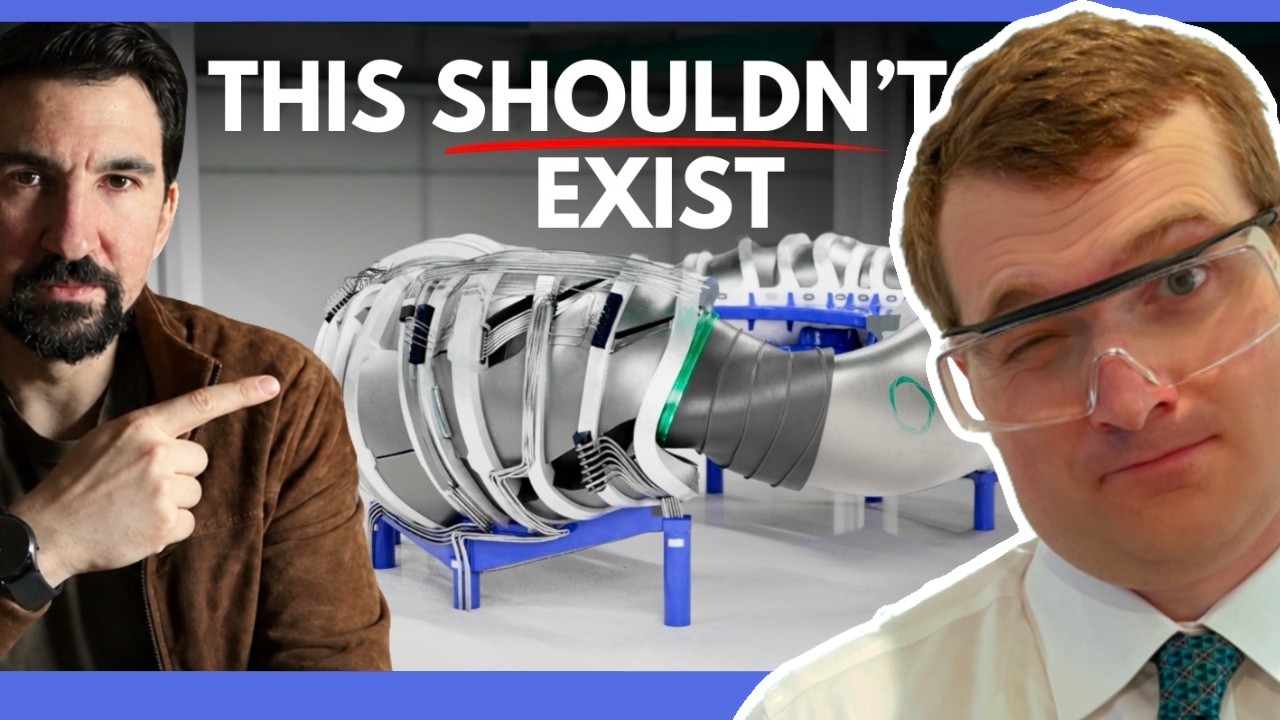
Europe's "Impossible" Fusion Reactor - Nuclear Engineer Reacts to Dr. Ben Miles
Keywords
Summary
194 words
Critical Evaluation
Value of the Information & Strength of the Argument
The video’s value lies in the reactor’s expert corrections and clarifications, which add depth to the original content. He provides accurate technical details, such as the 14.1 MeV neutron energy, the triple product, and the E×B drift, and explains the engineering trade-offs between stellarators and tokamaks. The argumentation is solid, based on physics and engineering principles, and he effectively debunks common myths about fusion (e.g., ’limitless fuel’, ’no waste’). The reactor’s perspective as a nuclear engineer gives credibility to his analysis of materials, neutron damage, and maintenance issues.
Scientific Rigor, Source Quality, Title Accuracy
The reactor demonstrates scientific rigor by referencing specific physics concepts and historical facts (e.g., Lyman Spitzer, the 1968 Soviet T3 tokamak). He uses the original video as a source and provides a link to it. The title is accurate and not misleading. The commentary is well-structured, and the reactor clearly distinguishes between his own opinions and established facts. The video does not include any advertising or sponsorship.
170 words
Title / Content Match
The title accurately reflects the content: a nuclear engineer's reaction to a video about Europe's stellarator fusion project, highlighting the engineering challenges.
Quality & Reliability
8/10
The reactor's expertise as a nuclear engineer provides credible technical analysis, correcting misconceptions and explaining complex physics accurately. The video is a reaction/commentary, not peer-reviewed, but the technical content is sound and well-articulated.
Key Moments
Markers derived by PSI from the transcript: the creator did not define chapters.
- Introduction to the reaction video and the topic of Proxima Fusion's stellarator.
- Discussion on the 'star on Earth' analogy and the engineering reality.
- Explanation of the fusion fuel cycle, including tritium breeding and neutron energy.
- Clarification that fusion is a heat source, not direct electricity, and the role of steam turbines.
- Addressing misconceptions about waste and meltdown, and the issue of neutron activation.
- Explanation of the triple product and the challenges of confinement.
- Detailed explanation of magnetic confinement and the problem of charge separation in a torus.
- Discussion on the E×B drift and the need for a twisted field, leading to the stellarator concept.
- Historical overview of stellarators, from Lyman Spitzer to the difficulties in manufacturing.
- Comparison with tokamaks and the Soviet T3 breakthrough, and the trade-offs between designs.
Cited Sources
- Original Video: Europe's 'Impossible' Fusion Reactor - Dr. Ben Miles — The original video that the reactor is reacting to, providing the base content and context.
Concurring Sources
- Original Video: Europe's 'Impossible' Fusion Reactor - Dr. Ben Miles — The original video provides the base information that the reactor agrees with and expands upon.
Contribution & Novelties
The video adds value by providing an expert nuclear engineer’s perspective, correcting misconceptions and adding technical depth to the original content. It clarifies the engineering challenges of fusion, particularly the precision required for stellarators and the trade-offs with tokamaks. The reactor also emphasizes the practical issues of materials, neutron damage, and maintenance, which are often overlooked in popular discussions.
Pour aller plus loin :
- Stellarator - Wikipedia — Provides a comprehensive overview of stellarator designs and history.
- Tokamak - Wikipedia — Explains the tokamak concept and its development.
- Fusion power - Wikipedia — Discusses the broader context of fusion energy and its challenges.
103 words
Radar Profile
The radar profile shows high scores in information quality and technical level, reflecting the reactor's expertise and the depth of the content. The quantity of information is also high, but the overall score is slightly lower due to the subjective nature of a reaction video.
💬 No comments were provided for analysis.