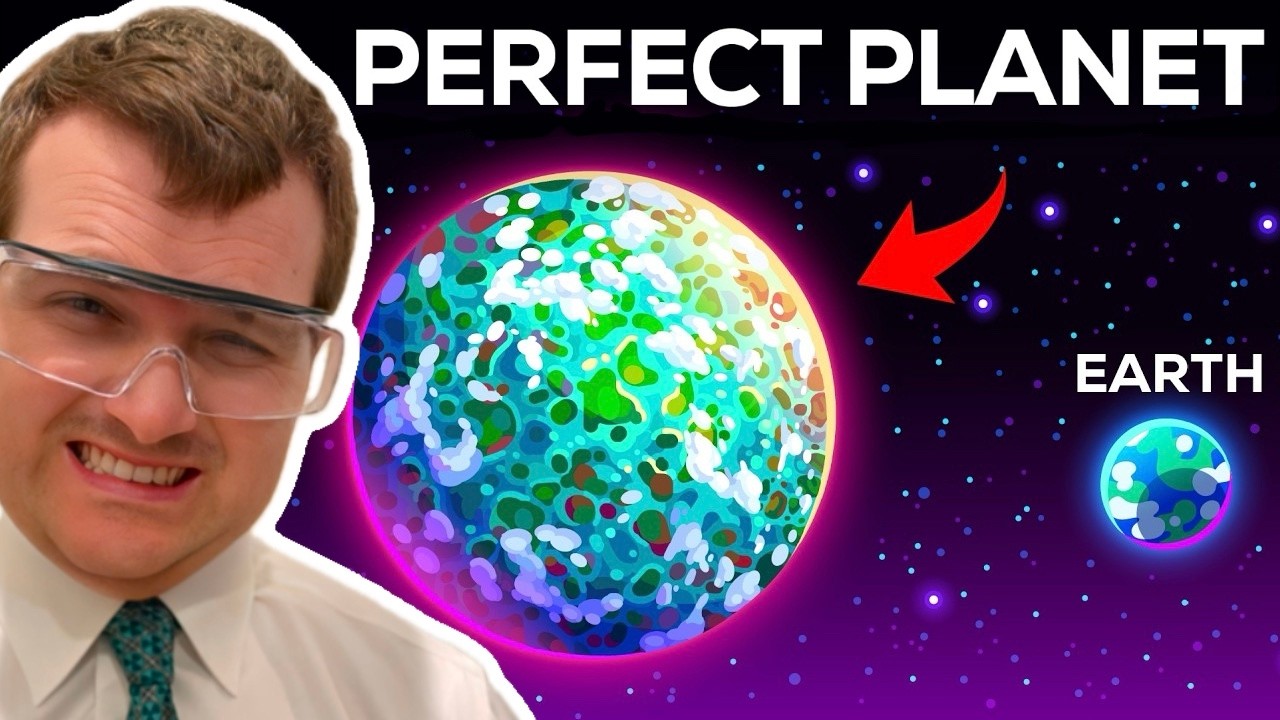
No, this Planet isn't Better than Earth - Nuclear Engineer Reacts to Kurzgesagt
Keywords
Summary
125 words
Critical Evaluation
Value of the Information & Strength of the Argument
The video’s value lies in its unique engineering perspective on planetary habitability, which is often overlooked in astrobiological discussions. The nuclear engineer provides concrete technical arguments, such as the impact of gravity on structural loads, the thermodynamic penalties of warmer oceans, and the corrosion risks of saltwater and oxygen-rich atmospheres. His argumentation is solid, as he systematically addresses each point from Kurzgesagt’s video and offers logical counterpoints. He uses analogies to nuclear reactor systems to explain planetary processes, making complex concepts accessible. However, the argumentation is one-sided, focusing almost exclusively on engineering challenges while downplaying the biological benefits. He also makes some speculative claims, such as the potential for multiple intelligent species, but these are clearly presented as hypotheticals. Overall, the video offers a valuable and well-reasoned engineering critique, though it lacks a balanced consideration of the biological advantages.
Scientific Rigor, Source Quality, Title Accuracy
The video demonstrates scientific rigor through the engineer’s technical knowledge and logical reasoning. He correctly applies principles of thermodynamics, materials science, and nuclear engineering to evaluate planetary conditions. However, he does not cite specific scientific sources, relying instead on his expertise and general knowledge. The title accurately reflects the content, as the engineer directly challenges Kurzgesagt’s claim that Earth is ‘mid’ and argues for Earth’s superiority from an engineering standpoint. The video is a reaction, so it is inherently subjective, but the arguments are grounded in scientific principles. The lack of formal citations is a minor weakness, but the engineer’s expertise lends credibility to his claims.
260 words
Title / Content Match
The title accurately reflects the content: a nuclear engineer reacts to Kurzgesagt's video on superhabitable planets, arguing that Earth is better from an engineering standpoint.
Quality & Reliability
8/10
The reactor is an expert nuclear engineer providing informed commentary on planetary habitability from an engineering perspective. He grounds his analysis in thermodynamic principles, materials science, and nuclear power plant design, offering a rigorous technical critique. While the video is a reaction and opinion-based, his arguments are logically sound and well-supported by scientific principles. The main limitation is the lack of formal citations, but his expertise lends credibility.
Key Moments
Markers derived by PSI from the transcript: the creator did not define chapters.
- Introduction: Nuclear engineer reacts to Kurzgesagt's video on superhabitable planets, setting up his engineering perspective.
- Discussion of the perfect star: orange dwarfs vs. red dwarfs and sun-like stars, with a comparison to reactor startups and longevity.
- Analysis of Hestia's size and gravity: challenges for construction, metallurgy, and space launches.
- Importance of magnetic field and plate tectonics, compared to reactor cooling systems and heat removal.
- Discussion of day length and moons: impacts on weather, thermal storage, and orbital stability.
- Archipelago world: engineering challenges of maritime infrastructure, submarine cables, and corrosion.
- Warmer temperatures and thicker atmosphere: effects on thermal efficiency, storms, and oxygen fire hazards.
- Dense atmosphere and flight: potential for nuclear-powered airships and upper atmosphere habitats.
- Shallow oceans and coastlines: tidal power potential, but also increased hurricane intensity.
- Possibility of multiple intelligent species and the implications for nuclear non-proliferation and civilization.
Cited Sources
- Kurzgesagt – The Perfect Planet — The original video being reacted to, which presents the concept of a superhabitable planet called Hestia.
Concurring Sources
- Superhabitable planets: A new class of potentially habitable worlds — A scientific article discussing the concept of superhabitable planets, which aligns with the video's topic.
Dissenting Sources
- Kurzgesagt – The Perfect Planet — Kurzgesagt presents Hestia as an ideal planet for life, while the nuclear engineer argues that Earth is better suited for industrial civilization.
Contribution & Novelties
This video provides a unique engineering perspective on the concept of superhabitable planets, challenging the astrobiological optimism with practical concerns about industrial civilization. It highlights the importance of considering infrastructure, power generation, and materials science when evaluating planetary habitability. The engineer’s analogies to nuclear reactor systems offer a novel way to understand planetary processes.
Pour aller plus loin :
- Superhabitable planet — Wikipedia article on the concept, providing background and scientific context.
- Kardashev scale — Wikipedia article on the scale used to measure a civilization’s energy consumption, relevant to the discussion of type II civilizations.
- Carnot heat engine — Wikipedia article on the thermodynamic cycle, relevant to the engineer’s discussion of thermal efficiency.
113 words
Radar Profile
The radar profile shows high scores in quantity and quality of information, reflecting the engineer's detailed technical analysis. The technical level is also high, indicating a specialized audience. The overall reliability is strong due to the engineer's expertise, though the lack of formal citations slightly reduces the score.
💬 Positive: The comments are overwhelmingly positive, with viewers praising the engineer's humor and technical insights. Many appreciate his unique perspective and the entertaining metaphors, while some engage with the scientific content.