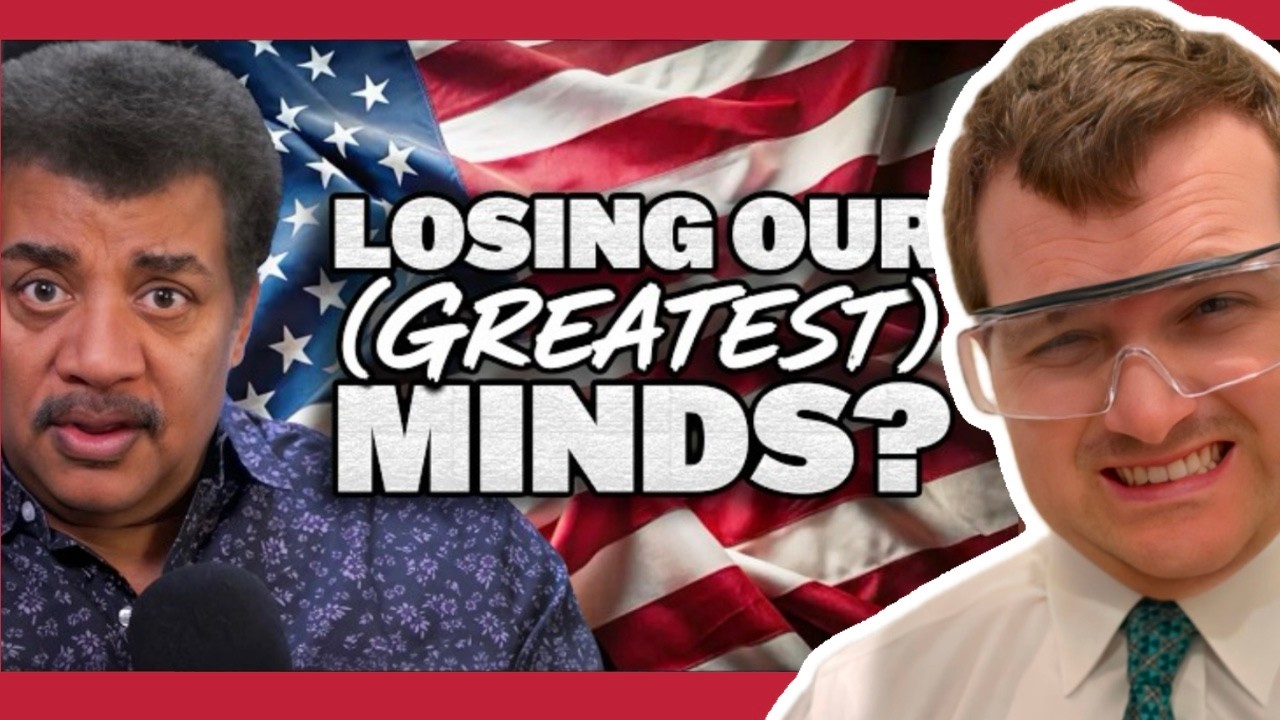
America's Scientists are Disappearing? - Nuclear Engineer Reacts to Startalk
Keywords
Summary
143 words
Critical Evaluation
Value of the Information & Strength of the Argument
The video provides valuable commentary by adding a nuclear engineer’s perspective to the discussion. The reactor offers concrete examples from his own field, such as the cross-pollination between regulators and industry, and the importance of curiosity-driven research in nuclear physics. He also provides a balanced argument, acknowledging the concerns raised by Tyson while also offering counterpoints, such as the global nature of science and the continued strength of US institutions. The argumentation is solid, as he distinguishes between different aspects of the issue (funding, efficiency, and deserving research) and avoids oversimplification.
Scientific Rigor, Source Quality, Title Accuracy
The video is a reaction, so the primary source is the original StarTalk episode, which is linked in the description. The reactor does not cite additional sources, but he does reference his own professional experience and general knowledge. The title accurately reflects the content. The commentary is well-reasoned and shows a good understanding of the scientific landscape, though it is not a rigorous academic analysis. The reactor’s points are logically presented and he does not make unsupported claims, instead offering a nuanced view.
189 words
Title / Content Match
The title accurately reflects the content, which discusses the potential decline of American scientists and scientific leadership, as reacted to by a nuclear engineer.
Quality & Reliability
7/10
The video is a reaction and commentary by a nuclear engineer on a StarTalk episode. It provides expert opinion and contextual analysis, but relies on the original source for data. The commentary is balanced, acknowledging both the concerns raised and the counterarguments, and includes personal professional experience. However, it lacks rigorous citation of specific studies or reports, and the 15,000 scientists figure is not independently verified.
Key Moments
Markers derived by PSI from the transcript: the creator did not define chapters.
- Introduction to the topic and the original StarTalk video.
- Discussion of the historical influx of international graduate students in US science programs.
- Commentary on the brain drain from other countries and the global nature of science.
- Discussion of NASA's science budget and the distinction between science and manned spaceflight.
- Commentary on the value of cross-pollination between academia, government, and industry.
- Discussion of the importance of curiosity-driven research, citing MRI and GLP-1 drugs as examples.
- Commentary on the loss of 15,000 federal scientists and reduced grant funding.
- Discussion of the global competition for scientific talent and the rise of China.
- Reaction to Tyson's warning about losing scientific leadership, with a balanced counterpoint.
- Final thoughts on the future of American science and the need for a balanced perspective.
Cited Sources
- StarTalk - America's Scientists are Disappearing? — Original video being reacted to, featuring Neil deGrasse Tyson.
Concurring Sources
- StarTalk - America's Scientists are Disappearing? — The original video provides the main arguments that the reactor agrees with, such as the importance of science funding and the brain drain.
Dissenting Sources
- No specific source — The reactor offers counterpoints to the doom-and-gloom narrative, but does not cite a specific source for these counterarguments.
Contribution & Novelties
The video adds a nuclear engineer’s perspective to the discussion, providing specific examples from the nuclear industry and a balanced view on the state of American science. It emphasizes the importance of curiosity-driven research and the interconnectedness of science globally.
Pour aller plus loin :
- Science policy — Provides background on how governments fund and support scientific research.
- Brain drain — Discusses the phenomenon of skilled professionals emigrating, relevant to the video’s theme.
- National Science Foundation — The US agency that funds fundamental research, mentioned in the video.
- Curiosity-driven research — Explains the concept of research motivated by curiosity rather than immediate application.
103 words
Radar Profile
The radar profile shows a balanced video with moderate scores across all dimensions. The highest scores are in information quantity and quality, reflecting the detailed commentary and examples provided. The technical level is moderate, suitable for a general audience. The reliability is good, but not exceptional, due to the lack of independent citations.