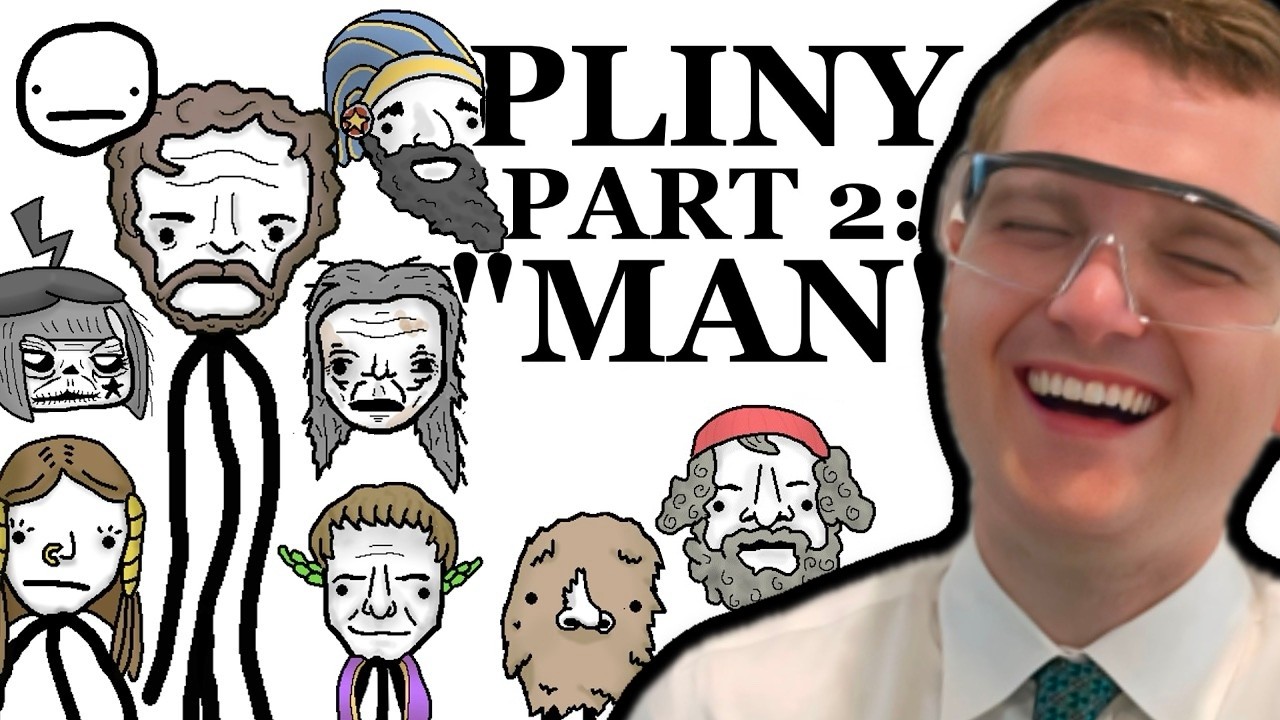
Pliny Explains it All: MAN - Nuclear Engineer Reacts to Sam O'Nella Academy
Keywords
Summary
156 words
Critical Evaluation
Value of the Information & Strength of the Argument
The video provides valuable insights by applying a nuclear engineer’s perspective to ancient texts, offering a unique lens for evaluating historical claims. The argumentation is solid, as the engineer consistently uses scientific principles like uncertainty propagation and root cause analysis to deconstruct Pliny’s accounts. He effectively demonstrates the importance of distinguishing between correlation and causation, using examples like the famine after a multiple birth and the ‘red socks’ lottery fallacy. The commentary is well-structured, following the order of Pliny’s text and providing clear, logical critiques. However, the value is somewhat limited by the reaction format, which relies on the original content’s structure, and the engineer’s expertise is more illustrative than deeply analytical in some segments.
Scientific Rigor, Source Quality, Title Accuracy
The video demonstrates scientific rigor by consistently applying critical thinking and source criticism to Pliny’s claims. The engineer acknowledges that Pliny is often the only source for certain historical events and appropriately flags claims as plausible or dubious. He uses analogies to nuclear engineering to explain concepts like uncertainty propagation and the importance of physical mechanisms, which strengthens the analysis. The title accurately reflects the content, as it is a reaction to Sam O’Nella Academy’s video on Pliny’s Natural History, with a focus on the book about man. The video does not cite external sources beyond the original video, but it effectively uses the engineer’s expertise to evaluate the material.
240 words
Title / Content Match
The title accurately reflects the content: a nuclear engineer reacts to Sam O'Nella Academy's video on Pliny's Natural History, focusing on the book about man.
Quality & Reliability
7/10
The video provides a critical analysis of Pliny's Natural History, using a nuclear engineering perspective to evaluate ancient claims. It demonstrates scientific reasoning and source criticism, though it is a reaction video with subjective commentary.
Key Moments
Markers derived by PSI from the transcript: the creator did not define chapters.
- Introduction and setup for the reaction video.
- Discussion of Pliny's books 3-6 and the challenge of documenting everything.
- Start of Book VII: Man, His Birth, His Organization, and the Invention of the Arts.
- Analysis of human vulnerability and the role of information transfer in civilization.
- Discussion of mythical races like the Arimaspi and the importance of source criticism.
- Analysis of the Barmon with backward feet and the concept of physical mechanisms.
- Discussion of the Sili tribe and the use of snakes for legitimacy tests.
- Analysis of the Atomi and the concept of energy balance.
- Discussion of the Pygmies and uncertainty propagation in ancient reports.
- Analysis of birth omens and post hoc reasoning.
Cited Sources
- Pliny Explains it All: MAN - Sam O'Nella Academy — The original video that this reaction is based on, covering Pliny's Natural History Book VII.
Concurring Sources
- Pliny the Elder — Provides background on Pliny and his work, supporting the video's context.
Dissenting Sources
- No discordant sources found — The video does not contradict any external sources; it only critiques Pliny's claims.
Contribution & Novelties
The video offers a novel perspective by applying nuclear engineering concepts to the analysis of ancient texts, providing a fresh framework for evaluating historical claims. It effectively demonstrates how scientific principles like uncertainty propagation and root cause analysis can be used to critically assess sources. The engineer’s commentary adds value by connecting ancient observations to modern scientific understanding, such as linking Pliny’s descriptions of human traits to genetics and physiology.
Pour aller plus loin :
- Pliny the Elder — Background on the author and his work.
- Natural History (Pliny) — Overview of the encyclopedic work.
- Source criticism — Methodology for evaluating historical sources.
- Correlation does not imply causation — Key concept used throughout the video.
115 words
Radar Profile
The radar profile shows high scores in information quantity and quality, reflecting the video's rich content and analytical depth. The technical level is moderate, suitable for a general audience, while reliability is strong due to the engineer's expertise. Overall, the video is well-rounded with a slight emphasis on information delivery.
💬 Sur les 0 commentaires analysés, aucune tendance n'est disponible.