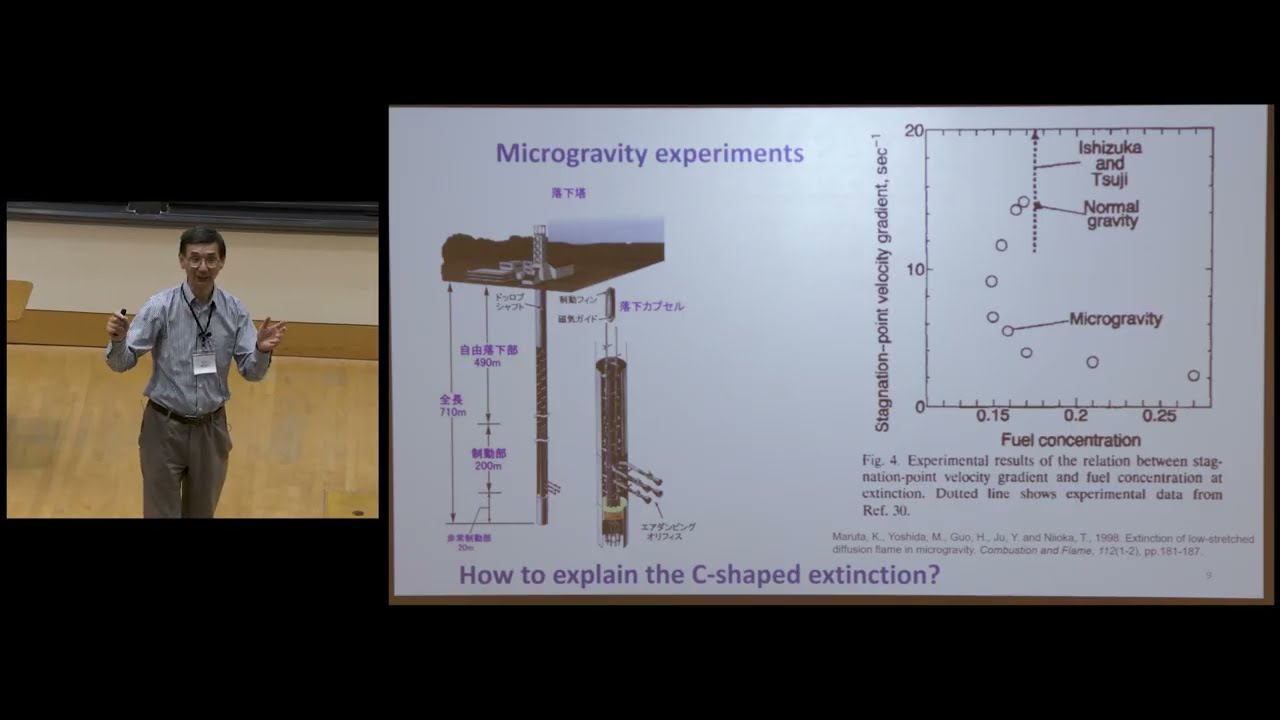
Combustion Physics and Beyond, Prof. Yiguang Ju, Day 3 Part 2
Keywords
Summary
149 words
Critical Evaluation
Value of the Information & Strength of the Argument
The lecture provides a comprehensive overview of diffusion flame theory, from fundamental concepts to advanced topics like flamelet modeling. The argumentation is solid, built on established combustion science and supported by experimental observations. Professor Ju effectively explains complex concepts using intuitive explanations and mathematical derivations. He also shares valuable insights into the research process, including the importance of generating data for funding in the US context. The value lies in the clear presentation of both theoretical foundations and practical research experiences.
Scientific Rigor, Source Quality, Title Accuracy
The scientific rigor is high, as the lecture is based on well-established combustion theory and the professor’s own research. However, specific sources are not cited within the talk, and the description does not provide references. The title accurately reflects the content, which is a continuation of a series on combustion physics. The informal style, including personal anecdotes, does not detract from the scientific content but may affect the perceived formality.
166 words
Title / Content Match
The title accurately reflects the content, which is a lecture on combustion physics, specifically diffusion flames and related topics.
Quality & Reliability
8/10
Lecture by a leading expert in combustion, presenting established theory and research insights. The content is scientifically rigorous, but the informal style and lack of detailed citations in the talk reduce the score slightly.
Key Moments
Markers derived by PSI from the transcript: the creator did not define chapters.
- Introduction to diffusion flames and their importance in engines.
- Explanation of diffusion flame structure and the role of Damköhler number.
- Discussion of two extinction limits: stretch and radiation.
- Derivation of thin-flame analytical solution using mixture fraction.
- Introduction to flamelet concept for turbulent combustion.
- Microgravity experiments on counterflow flames and extinction limits.
- Personal anecdotes about funding and academic career in the US.
- Development of radical index for fuel ranking and competition for MURI.
- Discussion of experimental techniques and future directions.
Contribution & Novelties
The lecture provides a clear and comprehensive overview of diffusion flame theory, including the classical analytical solution and the flamelet concept. It also offers personal insights into the research process and funding challenges, which are not typically found in textbooks. The discussion of extinction limits and the radical index for fuel ranking highlights the professor’s original contributions to the field.
Pour aller plus loin :
- Diffusion flame - Wikipedia — Provides a general overview of diffusion flames.
- Flamelet generated manifold - Wikipedia — Explains the flamelet concept in turbulent combustion.
- Damköhler number - Wikipedia — Defines the Damköhler number and its significance in combustion.
- Counterflow flame - Wikipedia — Describes the counterflow flame configuration used in experiments.
117 words
Radar Profile
The radar profile shows high scores across all dimensions, indicating a well-balanced and informative lecture. The high technical level and information quality are balanced by the informal presentation style, which may affect the perceived rigor.