Combustion Physics and Beyond, Prof. Yiguang Ju, Day 4 Part 3
Keywords
Summary
174 words
Critical Evaluation
Value of the Information & Strength of the Argument
The lecture provides a solid introduction to plasma physics, with clear derivations of key equations and concepts. The professor’s argumentation is logical and builds from fundamental principles to more complex phenomena, such as streamer propagation and glow discharge structure. He effectively connects plasma physics to combustion, highlighting practical applications like plasma-assisted ignition and ammonia synthesis. The value of the information is high for students or researchers new to the field, as it offers a comprehensive overview of plasma discharge mechanisms. However, the lecture is primarily theoretical and does not include experimental data or case studies, which could enhance its practical relevance.
Scientific Rigor, Source Quality, Title Accuracy
The lecture demonstrates scientific rigor through its systematic derivation of equations and reliance on established plasma physics principles. However, no specific sources are cited, and the content is presented as general knowledge. The title accurately reflects the content, which is a lecture on combustion physics with a focus on plasma. The lecture is part of a series, and the description provides context for the course structure. The lack of explicit references may limit the ability to verify specific claims, but the overall content aligns with standard textbooks and literature in the field.
208 words
Title / Content Match
The title accurately describes the content: a lecture on combustion physics, specifically focusing on plasma physics and its applications to combustion.
Quality & Reliability
8/10
The lecture is delivered by a recognized expert in combustion and plasma-assisted combustion, based on established physics and mathematical derivations. The content is consistent with standard plasma physics and combustion literature. However, the video is a recording of a lecture with no citations or references to specific sources, and the transcription contains some informal language and potential inaccuracies in transcription.
Key Moments
Markers derived by PSI from the transcript: the creator did not define chapters.
- Introduction to plasma properties and discharge regimes
- Derivation of Townsend ionization and self-sustaining condition
- Discussion of Paschen curve and breakdown voltage
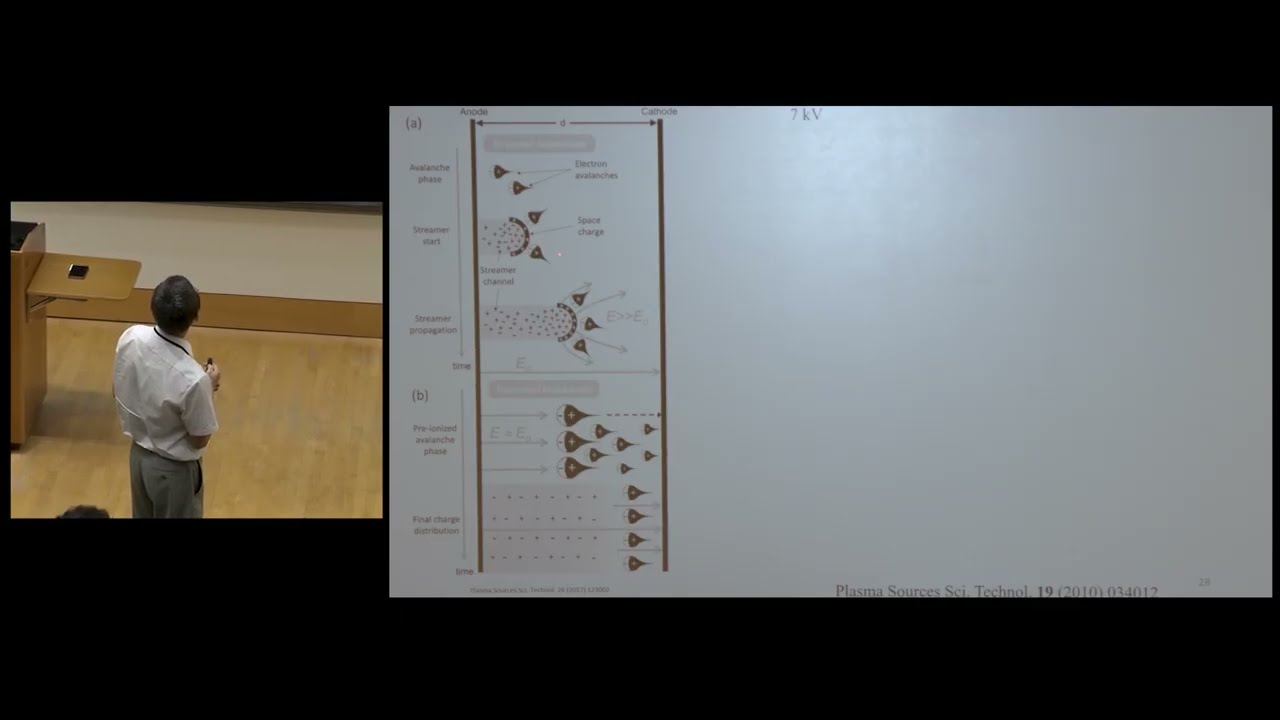
- Explanation of streamer propagation and role of photoionization
- Overview of corona and glow discharges
- Structure of glow discharge and cathode dark space
- Stability analysis of glow discharge and current-voltage characteristics
- Governing equations for plasma modeling
- CARS spectroscopy measurements in plasma
- Application to ammonia synthesis and plasma-assisted combustion
Contribution & Novelties
The lecture provides a comprehensive overview of plasma physics fundamentals as applied to combustion, emphasizing the importance of reduced electric field (E/N) and the Paschen curve. It bridges the gap between plasma physics and combustion science, highlighting potential applications such as plasma-assisted ignition and ammonia synthesis. The discussion on vibrational excitation of nitrogen and its role in overcoming energy barriers is particularly insightful.
Pour aller plus loin :
- Paschen’s law — Provides a detailed explanation of the Paschen curve and breakdown voltage.
- Townsend discharge — Describes the Townsend avalanche and ionization coefficient.
- Plasma-assisted combustion — Overview of plasma applications in combustion.
- CARS spectroscopy — Technique for measuring vibrational temperatures in gases.
111 words
Radar Profile
The radar profile shows high scores across all dimensions, indicating a well-balanced and informative lecture. The high technical level and information quality suggest it is suitable for an audience with some background in physics or engineering. The fiabilite_globale is also high, reflecting the expert delivery and logical structure.