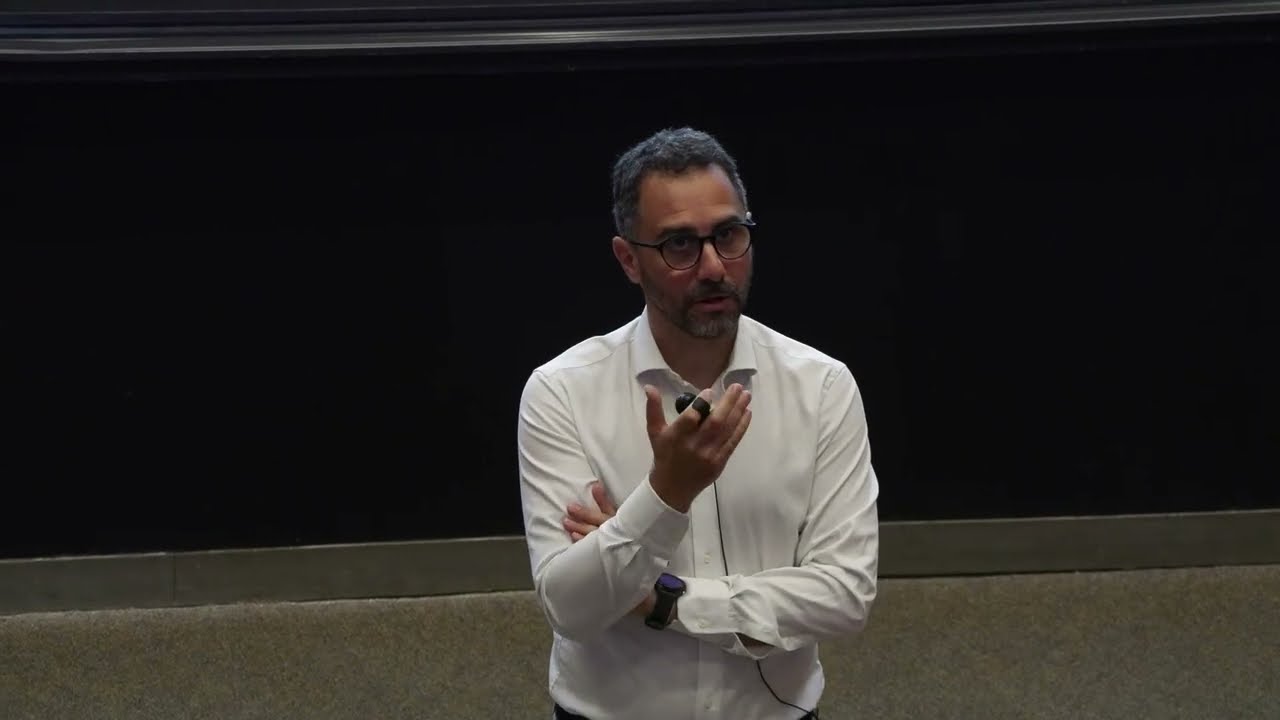
Turbulent Combustion-From Governing Principles to ML-Enhanced Combustion Modelling, Parente Day1 Pt1
Keywords
Summary
163 words
Critical Evaluation
Value of the Information & Strength of the Argument
The lecture provides valuable insights into the role of combustion in the energy transition, supported by quantitative examples (e.g., energy density calculations for Solar Impulse vs. Boeing 747). The argumentation is solid, building from historical context to current challenges and future solutions. The speaker effectively argues that combustion remains essential for high-temperature industrial processes and that machine learning offers a path to more efficient modeling. However, the lecture is introductory and does not delve into the technical details of ML models, which limits its depth for experts.
96 words
Title / Content Match
The title accurately reflects the content, which covers both fundamental combustion principles and the application of machine learning to combustion modeling.
Quality & Reliability
8/10
Lecture by a recognized expert in combustion and machine learning, with a strong historical and scientific grounding. The content is well-structured, references key scientific milestones, and provides quantitative examples. However, it is a lecture, not a peer-reviewed publication, and some claims are simplified for a general audience.
Key Moments
Markers derived by PSI from the transcript: the creator did not define chapters.
- Introduction of the speaker and topic.
- Historical overview of combustion, from Prometheus to modern times.
- Discussion on the role of combustion in the industrial revolution and its societal impact.
- Introduction of the energy transition challenge and the concept of defossilization.
- Analysis of the energy density gap using the Solar Impulse example.
- Discussion on the limitations of batteries and the need for high-density energy storage.
- Introduction to the governing equations for turbulent reacting flows.
- Explanation of LES and RANS closure problems.
- Introduction to machine learning for combustion modeling.
- Discussion on PCA, autoencoders, and physics-informed ML.
Cited Sources
- Paper by Andreas Riel et al. (2021) on industrial process temperatures — Referenced for the share of industrial processes according to temperature.
Concurring Sources
- IPCC Reports — Referenced for climate change evidence and the 400 ppm threshold.
Contribution & Novelties
The lecture provides a comprehensive overview of the role of combustion in the energy transition, emphasizing the importance of high-temperature heat and the potential of machine learning to accelerate modeling. It bridges historical context with modern computational challenges, offering a unique perspective on the future of combustion research.
Pour aller plus loin :
- Large Eddy Simulation — Relevant for understanding LES and its closure problems.
- Reynolds-averaged Navier–Stokes equations — Relevant for RANS modeling.
- Principal component analysis — Relevant for dimensionality reduction in ML-based combustion modeling.
- Autoencoder — Relevant for manifold learning techniques mentioned in the lecture.
- Physics-informed neural networks — Relevant for ensuring physical consistency in ML models.
108 words
Radar Profile
The radar profile shows high scores in information quantity, quality, and technical level, with a slightly lower but still strong score in global reliability. This indicates a well-balanced lecture that is both informative and technically sound, though not without minor simplifications.
💬 No comments were provided for analysis.