Combustion Chemistry, Prof. Philippe Dagaut, Day 4 Part 3
Keywords
Summary
148 words
Critical Evaluation
Value of the Information & Strength of the Argument
The lecture provides valuable insights into the practical aspects of combustion modeling, particularly the use of surrogate fuels and the importance of experimental data for validation. The argumentation is solid, based on the presenter’s extensive research and comparisons between experimental and simulated results. The speaker clearly explains the rationale behind surrogate selection and the limitations of simplified models. The discussion on sensitivity analysis and reaction pathways is well-structured, though it assumes a high level of familiarity with combustion chemistry.
Scientific Rigor, Source Quality, Title Accuracy
The scientific rigor is high, as the presenter is a leading expert and the content is based on peer-reviewed research. The sources cited are primarily the presenter’s own work and literature mentioned in the lecture, though specific references are not explicitly listed. The title accurately reflects the content, which is a detailed technical lecture. The lecture is part of a summer school, indicating a structured educational context. The adequacy between title and content is excellent.
169 words
Title / Content Match
The title accurately reflects the content, which is a detailed lecture on combustion chemistry, specifically focusing on surrogate fuels and their oxidation kinetics.
Quality & Reliability
8/10
Lecture by a recognized expert in combustion chemistry, presenting detailed experimental and modeling results. The methodology is sound, but the content is specialized and assumes prior knowledge.
Key Moments
Markers derived by PSI from the transcript: the creator did not define chapters.
- Introduction to the lecture and overview of surrogate fuel modeling.
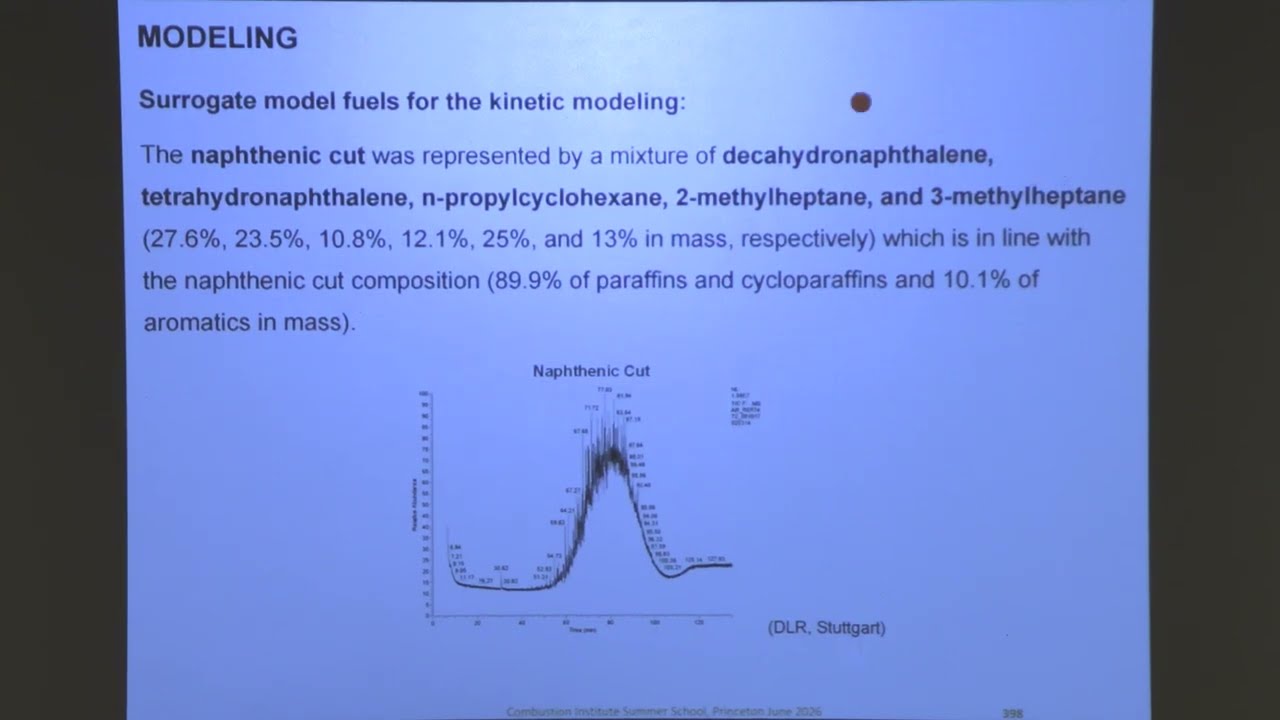
- Comparison of experimental and simulated species profiles for a GTL surrogate.
- Sensitivity analysis for CO2 production in GTL and CTL fuels.
- Discussion on ignition delay measurements for synthetic fuels.
- Introduction to biofuels and their importance since 2007.
- Composition of vegetable oils and biodiesel production.
- Modeling of rapeseed methyl ester oxidation using a simple surrogate.
- Comparison of experimental and simulated data for methyl esters.
- Q&A session on simulation methods and surrogate comprehensiveness.
Cited Sources
- Princeton University Combustion Summer School — Lecture video source.
Concurring Sources
- Princeton University Combustion Summer School — Primary source for the lecture.
Contribution & Novelties
The lecture provides a comprehensive overview of the challenges and methodologies in modeling complex fuels, particularly synthetic and biofuels. It highlights the importance of surrogate selection and the need for experimental validation. The presenter shares insights from his research, including the use of simple surrogates for complex fuels and the limitations of sensitivity analysis in such systems.
Pour aller plus loin :
- Chemical kinetic mechanisms — Background on chemical kinetics.
- Surrogate fuel — Overview of surrogate fuels.
- Biodiesel — Production and properties of biodiesel.
84 words
Radar Profile
The radar profile shows high scores in technical level and information quality, reflecting the advanced and detailed nature of the lecture. The moderate score in information quantity suggests that while the content is dense, it may not cover all aspects of combustion chemistry. Overall, the lecture is highly specialized and reliable.
💬 No comments were provided for analysis.