Turbulent Combustion-From Governing Principles to ML-Enhanced Combustion Modelling, Parente Day 3Pt2
Keywords
Summary
155 words
Critical Evaluation
Value of the Information & Strength of the Argument
The lecture provides a solid foundation in both the motivation and the mathematics of using PCA for combustion modeling. The speaker effectively argues for the value of simplicity in modeling, using Occam’s razor as a guiding principle, and contrasts it with the complexity of modern ML models. The argumentation is clear and logical, building from fundamental conservation laws to the need for closure models, and then to the potential of ML to address these challenges. The mathematical derivation of PCA is thorough and accessible, with a helpful graphical interpretation. The speaker also contextualizes PCA within the history of combustion modeling, citing seminal works like Maas and Pope’s ILDM, which strengthens the credibility of the approach. However, the lecture is primarily an introduction, and the speaker acknowledges that the field is rapidly evolving, which limits the depth of discussion on specific applications or results.
Scientific Rigor, Source Quality, Title Accuracy
The lecture demonstrates scientific rigor through its careful mathematical exposition and references to established literature. The speaker mentions key papers, such as Maas and Pope (1992) on ILDM, and recommends further reading. The title accurately reflects the content, which progresses from governing principles to ML-enhanced modeling. The lecture is part of a reputable summer school series, adding to its credibility. However, the speaker does not provide a comprehensive list of sources, and some references are mentioned only in passing. The content is well-structured and technically sound, with no apparent errors or misleading statements.
251 words
Title / Content Match
The title accurately reflects the content: a lecture on turbulent combustion modeling, from governing principles to ML-enhanced approaches, as part of a summer school series.
Quality & Reliability
8/10
Lecture by an academic expert (likely Prof. Alessandro Parente) at a prestigious summer school, covering established theory (PCA, manifold methods) and recent ML applications. Content is technically rigorous, with mathematical derivations and references to seminal papers. No obvious errors or misleading claims detected.
Key Moments
Markers derived by PSI from the transcript: the creator did not define chapters.
- Introduction to the lecture, discussing simplicity vs. complexity in modeling.
- Discussion on Occam's razor and the elegance of simple models like Navier-Stokes.
- Challenges in combustion modeling: high dimensionality, computational cost, and the role of ML.
- Introduction to unsupervised learning and dimensionality reduction, with historical context.
- Explanation of manifold methods in combustion, referencing Maas and Pope (1992).
- Formal definition of PCA and its mathematical foundation.
- Derivation of PCA using Lagrange multipliers and eigenvalue decomposition.
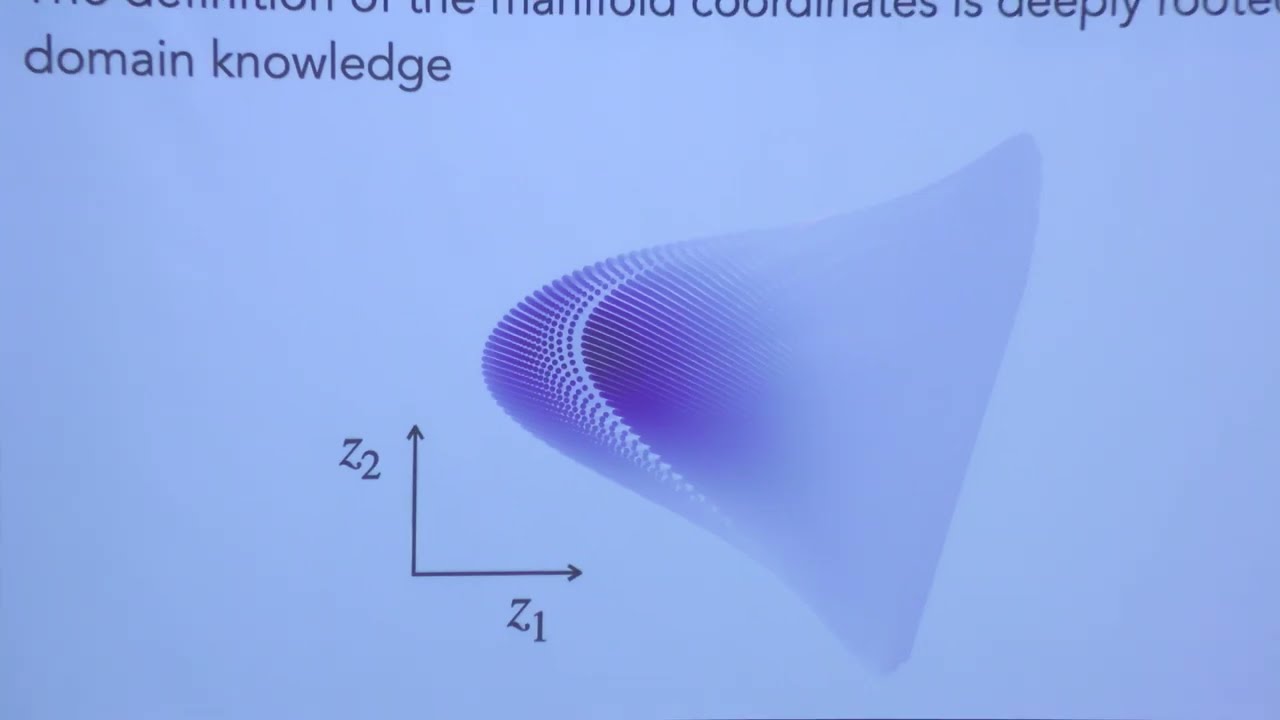
- Graphical interpretation of PCA, showing data projection and variance explained.
- Discussion on the trade-off between dimensionality reduction and information loss.
- Conclusion and outlook on ML-based combustion modeling.
Cited Sources
- Implementation of simplified chemical mechanisms based on intrinsic low-dimensional manifolds — Referenced as a seminal paper by Maas and Pope (1992) on manifold methods.
Concurring Sources
- Maas, U., & Pope, S. B. (1992). Implementation of simplified chemical mechanisms based on intrinsic low-dimensional manifolds. — Referenced in the lecture as the basis for manifold methods.
Contribution & Novelties
The lecture provides a clear and rigorous introduction to PCA as a tool for dimensionality reduction in combustion modeling, bridging classical manifold methods with modern ML approaches. It emphasizes the importance of simplicity and interpretability in model selection, a valuable perspective in the era of complex neural networks. The mathematical derivation is accessible and well-illustrated, making it a useful educational resource.
Pour aller plus loin :
- Principal Component Analysis (Wikipedia) — Overview of PCA, its mathematical foundations, and applications.
- Intrinsic Low-Dimensional Manifold method (ILDM) — Explanation of the ILDM approach for chemical kinetics reduction.
- Large Eddy Simulation (Wikipedia) — Context on LES, a key application area for combustion modeling.
109 words
Radar Profile
The radar profile shows a balanced lecture with high scores across all dimensions, indicating a comprehensive and technically rigorous presentation. The strongest aspects are the quality and quantity of information, while the level of technical detail is also high, making it suitable for an advanced audience.