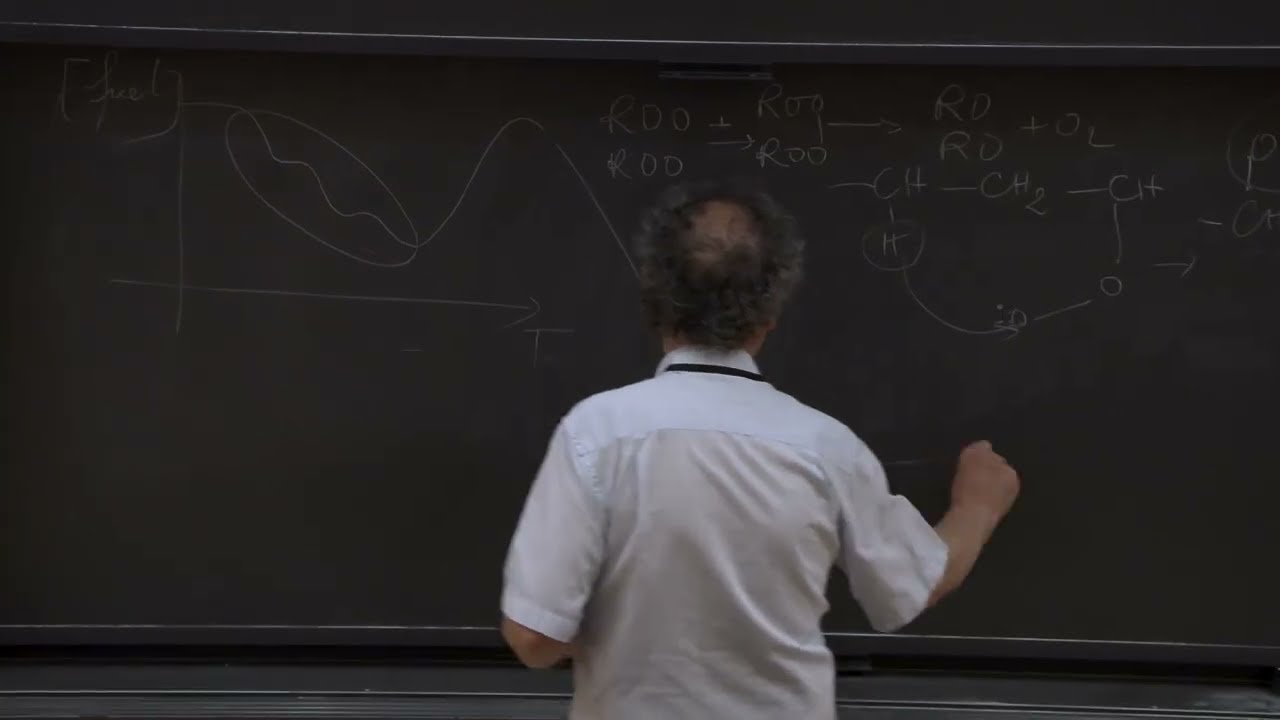
Combustion Chemistry, Prof. Philippe Dagaut, Day 3 Part 2
Keywords
Summary
162 words
Critical Evaluation
Value of the Information & Strength of the Argument
The lecture provides valuable insights into advanced combustion chemistry, particularly the complexity of low-temperature oxidation pathways and the formation of pollutants. The argumentation is solid, based on established mechanisms and experimental observations. The lecturer effectively explains how different pathways compete and how fuel composition influences reactivity. The use of examples like limonene and natural gas surrogates illustrates the concepts well. The discussion on NOx formation mechanisms is comprehensive and well-structured.
Scientific Rigor, Source Quality, Title Accuracy
The lecture demonstrates scientific rigor, referencing well-known mechanisms (e.g., Zeldovich, Fenimore) and recent computational studies. The sources are not explicitly cited in the video, but the content aligns with peer-reviewed literature. The title accurately reflects the content, which is a technical lecture on combustion chemistry. The lecture is part of a reputable summer school at Princeton University, adding to its credibility.
146 words
Title / Content Match
The title accurately reflects the content: a detailed lecture on combustion chemistry, specifically focusing on reaction mechanisms and pollutant formation.
Quality & Reliability
8/10
The lecture is given by a recognized expert in combustion chemistry, based on established scientific knowledge and published mechanisms. The content is technically accurate and consistent with current understanding, though it is a lecture and not peer-reviewed.
Key Moments
Markers derived by PSI from the transcript: the creator did not define chapters.
- Introduction to additional low-temperature reaction pathways, including the Koreek mechanism for acid formation.
- Discussion of the Waddington mechanism for alkene oxidation and its relevance to cool flames.
- Explanation of multiple O2 additions in low-temperature oxidation, using limonene as an example.
- Transition to high-temperature pyrolysis, discussing bond dissociation energies and fuel decomposition.
- Impact of fuel composition on reactivity, illustrated with natural gas surrogates.
- Overview of the hierarchical structure of reaction mechanisms, from H2/O2 to higher hydrocarbons.
- Introduction to NOx formation mechanisms, starting with thermal NO (Zeldovich).
- Discussion of prompt NO (Fenimore) and N2O mechanisms.
- Explanation of NNH mechanism and fuel-bound nitrogen pathways.
- Strategies for NOx reduction, including burner optimization.
Contribution & Novelties
The lecture provides a comprehensive overview of combustion chemistry, emphasizing the complexity of low-temperature oxidation and pollutant formation. It highlights recent mechanistic insights, such as the Koreek and Waddington mechanisms, and the role of multiple O2 additions. The discussion on NOx formation is thorough, covering all major pathways.
Pour aller plus loin :
- Koreek mechanism — Relevant to acid formation in lubricant oxidation.
- Waddington mechanism — Relevant to alkene oxidation in cool flames.
- Zeldovich mechanism — Thermal NO formation.
- Fenimore mechanism — Prompt NO formation.
- Low-temperature oxidation — Overview of cool flame chemistry.
93 words
Radar Profile
The radar profile shows high scores in technical level and information quality, reflecting the advanced and accurate content. The lower score in quantity of information is due to the lecture's focused scope, while the overall reliability is high given the expert presenter.