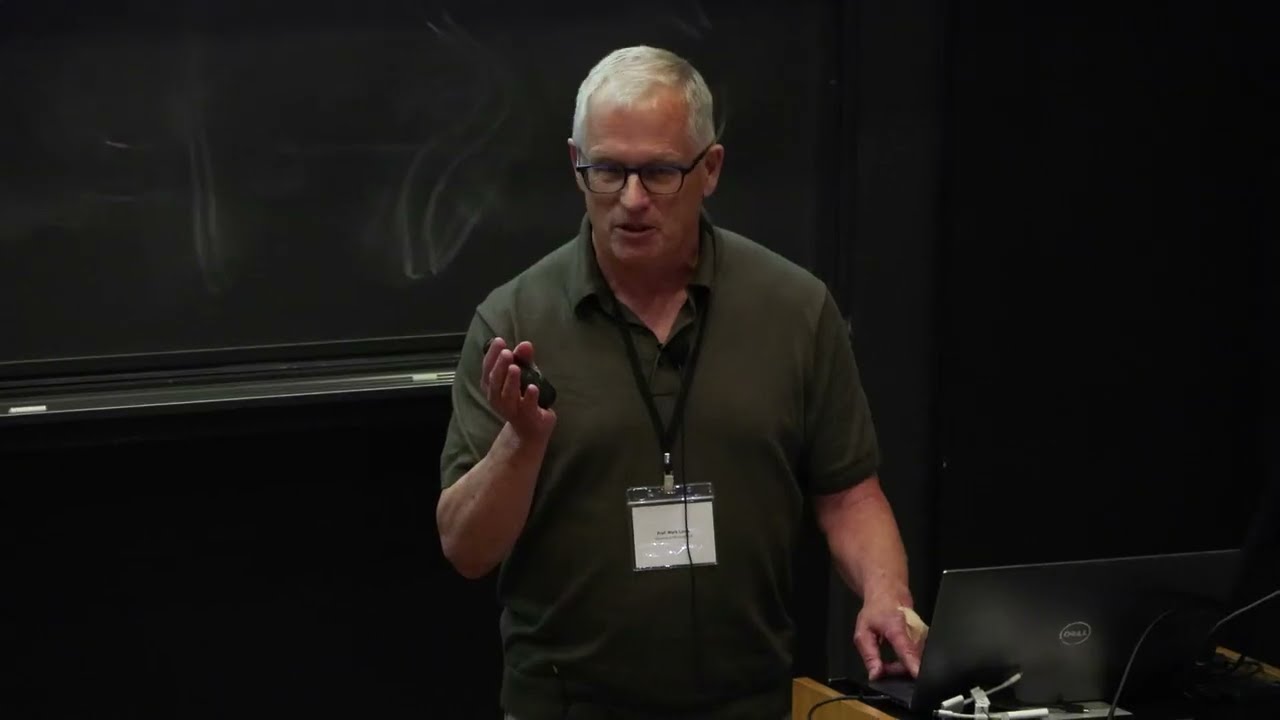
Advanced Laser Diagnostics for Chemically Reacting Flows, Prof. Linne, Day 1 Part 1
Keywords
Summary
137 words
Critical Evaluation
Value of the Information & Strength of the Argument
The lecture provides valuable insights into the field of laser diagnostics, emphasizing the importance of rigorous measurement techniques for combustion research. Linne’s argumentation is solid, as he supports his points with references to IPCC reports and his own extensive experience. He effectively communicates the challenges and opportunities in the field, making a compelling case for the continued relevance of combustion science in addressing climate change. The discussion on climate change is well-integrated, providing context for the technical content that follows.
Scientific Rigor, Source Quality, Title Accuracy
The lecture demonstrates high scientific rigor, with Linne referencing IPCC reports and his own published work. The sources cited are authoritative and relevant. The title accurately reflects the content, which focuses on advanced laser diagnostics for chemically reacting flows. The lecture is well-structured and provides a comprehensive overview of the topic, making it a valuable resource for students and researchers.
155 words
Title / Content Match
The title accurately reflects the content, which introduces advanced laser diagnostic techniques for chemically reacting flows.
Quality & Reliability
8/10
The lecture is delivered by an expert with extensive experience in laser diagnostics and combustion. It includes a critical discussion of climate change based on IPCC reports and emphasizes the importance of rigorous measurement techniques. The content is well-structured and references authoritative sources.
Key Moments
Markers derived by PSI from the transcript: the creator did not define chapters.
- Introduction by Allison Ferris, welcoming Professor Mark Linne.
- Linne discusses the relevance of combustion research in the context of climate change.
- Presentation of IPCC data on global temperature changes and the hockey stick curve.
- Discussion on the contributions of different sectors to greenhouse gas emissions.
- Examples of successful combustion research, including reduction of photochemical smog in Los Angeles.
- Introduction to laser diagnostics and why they are needed.
- Overview of different types of laser diagnostic techniques.
- Discussion on the challenges of applying laser diagnostics in high-pressure flames.
- Advice on when to use physical probes vs. laser diagnostics.
- Encouragement for student participation and questions.
Cited Sources
- IPCC Sixth Assessment Report — Referenced for climate change data and projections.
- Spectroscopic Measurement: An Introduction to the Fundamentals — Linne's book, mentioned as a resource for further study.
Concurring Sources
- IPCC Sixth Assessment Report — Supports the discussion on climate change.
Contribution & Novelties
The lecture provides a comprehensive introduction to advanced laser diagnostics for chemically reacting flows, emphasizing the importance of rigorous measurement techniques. It uniquely integrates a discussion on climate change, highlighting the role of combustion research in addressing global challenges. The lecture also offers practical advice on when to use laser diagnostics versus physical probes, making it a valuable resource for students and researchers.
Pour aller plus loin :
- Laser-induced fluorescence — A key technique discussed in the lecture.
- Coherent anti-Stokes Raman spectroscopy — Another important diagnostic method.
- IPCC Sixth Assessment Report — Provides detailed climate change data and projections.
99 words
Radar Profile
The radar profile shows high scores in information quantity, quality, and reliability, with a slightly lower technical level, indicating a lecture that is accessible yet rigorous.
💬 No comments were provided for analysis.