Probabilistic Tensor Decomposition
Keywords
Summary
156 words
Critical Evaluation
Value of the Information & Strength of the Argument
The presentation provides a clear and comprehensive overview of probabilistic tensor decomposition, with a strong emphasis on the conceptual differences between Bayesian and frequentist approaches. The speaker effectively argues for the advantages of Bayesian methods, particularly in terms of uncertainty quantification and robustness. He supports his claims with references to his own published work and demonstrates the practical implementation through the probabilistic tensor toolbox. The argumentation is logical and well-structured, progressing from basic concepts to more advanced topics.
Scientific Rigor, Source Quality, Title Accuracy
The speaker is a postdoc at DTU with expertise in Bayesian statistics and tensor methods, lending credibility to the content. He references several of his own papers, which are published in reputable venues. The title accurately reflects the content. The presentation is well-organized and technically rigorous, though it is a talk rather than a peer-reviewed publication, so the level of detail is appropriate for an expert audience.
160 words
Title / Content Match
The title accurately reflects the content, which focuses on probabilistic tensor decomposition methods.
Quality & Reliability
8/10
The presentation is by an expert in the field, with clear explanations and references to published work. The content is technically sound, though it is a talk rather than a peer-reviewed publication.
Key Moments
Markers derived by PSI from the transcript: the creator did not define chapters.
- Introduction and background of the speaker
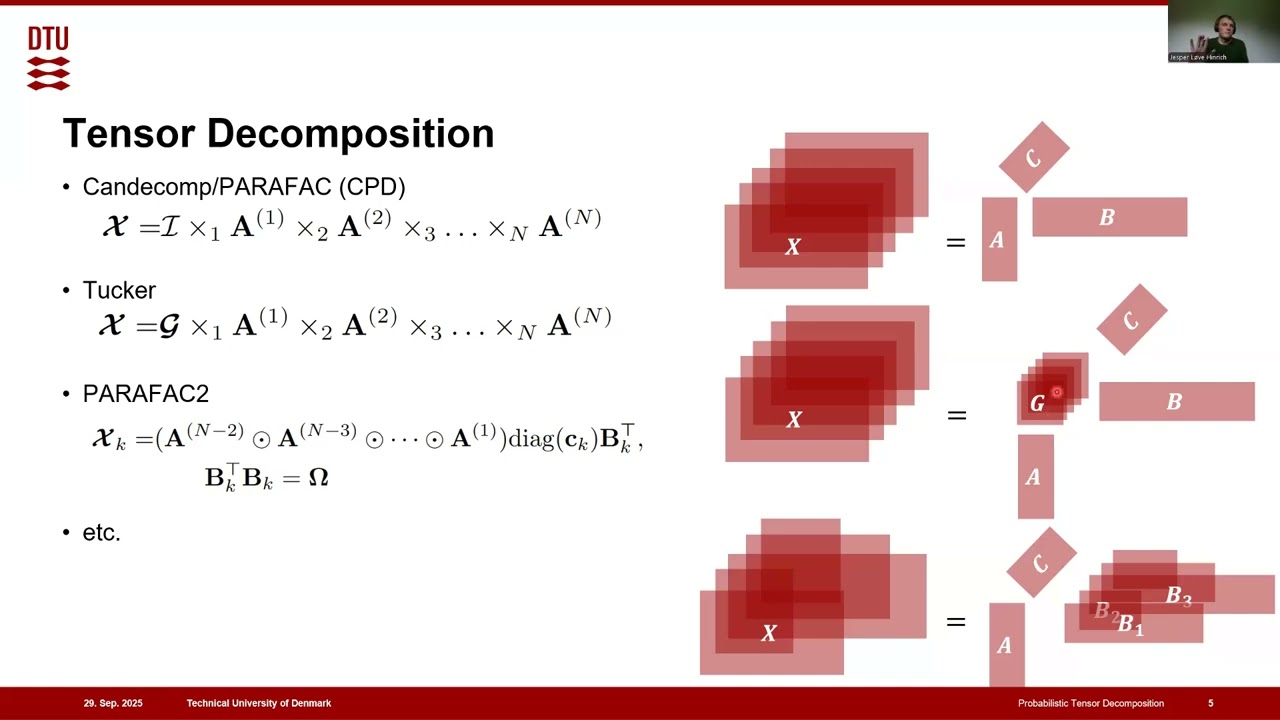
- Overview of matrix and tensor decompositions
- Introduction to Bayesian tensor decomposition
- Comparison of maximum likelihood and Bayesian approaches
- Explanation of posterior distribution and inference methods
- Detailed example of Bayesian CP decomposition
- Automatic relevance determination (ARD) priors
- Noise modeling and extensions
- Probabilistic tensor toolbox and references
Cited Sources
- Probabilistic Tensor Toolbox — The speaker mentions this toolbox as a freely available implementation of the methods discussed.
Concurring Sources
- Probabilistic Tensor Toolbox — The toolbox is referenced as a practical implementation of the methods discussed.
Contribution & Novelties
The presentation offers a clear and accessible introduction to probabilistic tensor decomposition, bridging the gap between theoretical Bayesian methods and practical implementation. It highlights the advantages of Bayesian approaches, such as uncertainty quantification and robustness, and provides concrete examples and code. The talk is particularly valuable for researchers in chemometrics and related fields who are familiar with traditional tensor methods but new to Bayesian inference.
Pour aller plus loin :
- Bayesian inference — Overview of Bayesian statistics.
- Tensor decomposition — General concepts and methods.
- Variational Bayesian methods — Explanation of variational inference.
92 words
Radar Profile
The radar profile shows high scores across all dimensions, indicating a well-balanced and informative presentation. The technical level is high, but the speaker's clear explanations make it accessible to a knowledgeable audience.
💬 Sur les 0 commentaires analysés, aucune tendance n'est disponible.