Crunching Numbers, Not Nerves: Making Stats Courtroom-Friendly
Keywords
Summary
113 words
Critical Evaluation
Value of the Information & Strength of the Argument
The presentation provides valuable insights into the practical application of chemometrics in forensic and legal settings. The speaker effectively argues for the use of UMAP over PCA for its ability to reveal subtle patterns and clusters, as demonstrated in the Hamilton Harbour case where UMAP identified a batch effect that PCA missed. The argumentation is solid, grounded in real case studies and the speaker’s extensive experience. He uses analogies (slushies, cookies, party balcony) to make complex concepts accessible, which strengthens the communication value. However, the presentation is largely anecdotal and lacks rigorous statistical validation or comparison with other methods. The speaker’s expertise lends credibility, but the lack of peer-reviewed references or quantitative performance metrics limits the scientific rigor.
Scientific Rigor, Source Quality, Title Accuracy
The speaker demonstrates a high level of scientific rigor in his approach, emphasizing the importance of defensibility and transparency in legal contexts. He uses established methods (UMAP, PCA) and references standard reference materials and protocols (NHANES). However, the presentation does not cite specific scientific literature or external sources, relying primarily on his own case studies. The title accurately reflects the content, focusing on making statistics accessible for courtroom use. The speaker’s credibility as a principal forensic chemist adds to the trustworthiness of the information, but the lack of citations and peer-reviewed backing is a limitation.
228 words
Title / Content Match
The title accurately reflects the content, focusing on making statistical methods accessible and defensible in legal settings.
Quality & Reliability
8/10
The speaker is a principal forensic chemist with extensive litigation experience. The presentation is based on real case studies and uses established statistical methods (UMAP, PCA). However, it is an expert opinion webinar without peer-reviewed references or detailed methodological validation.
Key Moments
Markers derived by PSI from the transcript: the creator did not define chapters.
- Introduction and inspiration from a movie about D-Day weather forecasting, highlighting the importance of science communication.
- Explanation of using constellation plots as a visual anchor for storytelling, inspired by memory techniques like mind palaces.
- Introduction to the speaker's role as a forensic chemist and the challenge of explaining chemical similarity to legal audiences.
- Analogy of slushies to explain environmental samples as mixtures of sources, leading to the need for dimensionality reduction.
- Explanation of UMAP using the party balcony analogy, emphasizing that similar samples cluster together.
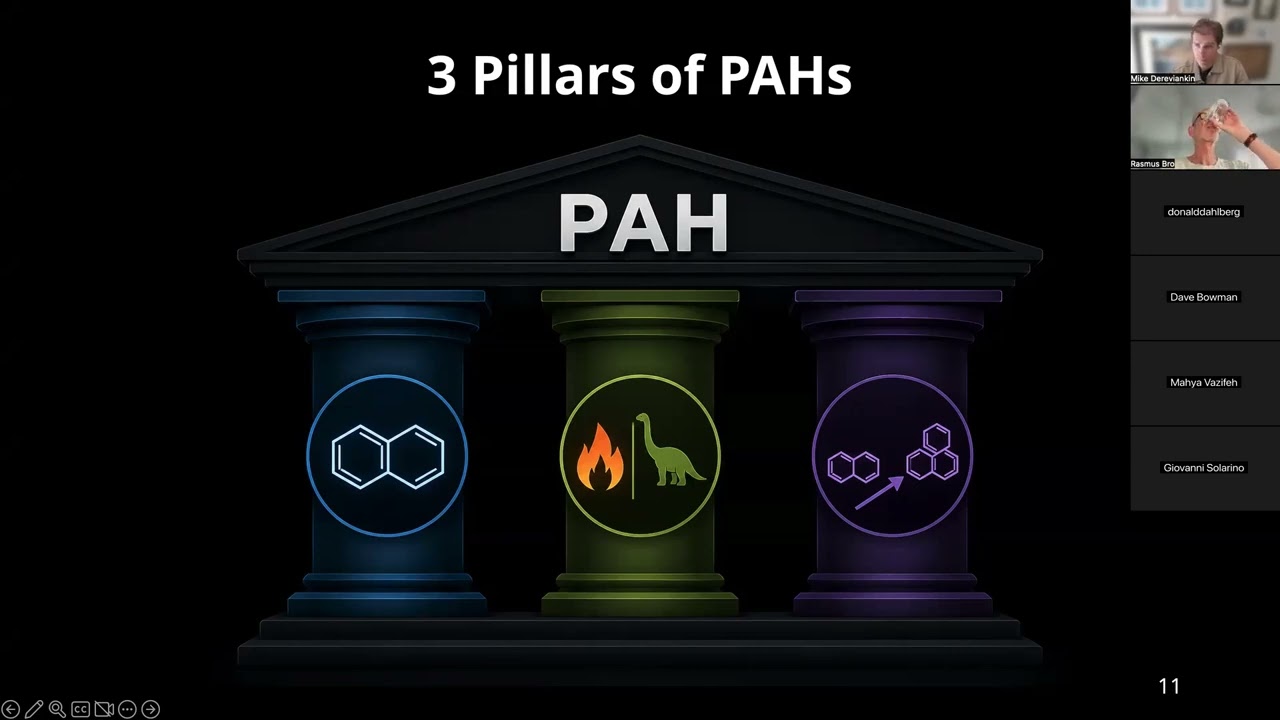
- Case study 1: Hamilton Harbour PAH contamination, with 128 sediment samples and 47 PAH species.
- Comparison of PCA and UMAP, highlighting UMAP's ability to reveal a distinct cluster (cluster 3) that PCA missed.
- Investigation of cluster 3 reveals a batch effect due to reanalysis in 2023, leading to exclusion of those samples.
- Case study 2: NHANES biomonitoring data for PCBs, with 1,896 samples and 35 PCB congeners.
- UMAP visualization shows age-related patterns in PCB fingerprints, with younger individuals having lighter PCBs and older individuals having heavier, more diverse patterns.
- Discussion of an anomalous cluster of young individuals with old-like PCB patterns, suggesting potential exposure sources.
- Conclusion: importance of transparent, interpretable methods and storytelling in forensic chemistry.
Cited Sources
- NHANES - National Health and Nutrition Examination Survey — Referenced as the protocol for biomonitoring data used in the second case study.
Concurring Sources
- UMAP: Uniform Manifold Approximation and Projection for Dimension Reduction — The method used in the presentation; the paper provides the theoretical foundation.
Contribution & Novelties
The webinar provides a unique perspective on applying UMAP in forensic chemistry for litigation support, emphasizing the importance of interpretability and storytelling. It demonstrates practical workflows for communicating complex chemical data to non-experts, with real case studies. The speaker’s approach of using analogies and visual anchors is innovative and effective.
Pour aller plus loin :
- UMAP: Uniform Manifold Approximation and Projection for Dimension Reduction — Original paper introducing UMAP, relevant for understanding the method’s foundations.
- Polycyclic Aromatic Hydrocarbons (PAHs) - EPA — Overview of PAHs, their sources, and health effects, useful for context.
- Polychlorinated Biphenyls (PCBs) - ATSDR — Information on PCBs, their health effects, and environmental fate, relevant to the second case study.
- Forensic Chemistry - Wikipedia — General overview of the field, providing background for the speaker’s role.
130 words
Radar Profile
The radar profile shows high scores in information quantity, quality, and reliability, with a slightly lower technical level. This indicates a well-balanced presentation that is both informative and credible, though not highly technical in depth.
💬 No comments were provided for analysis.