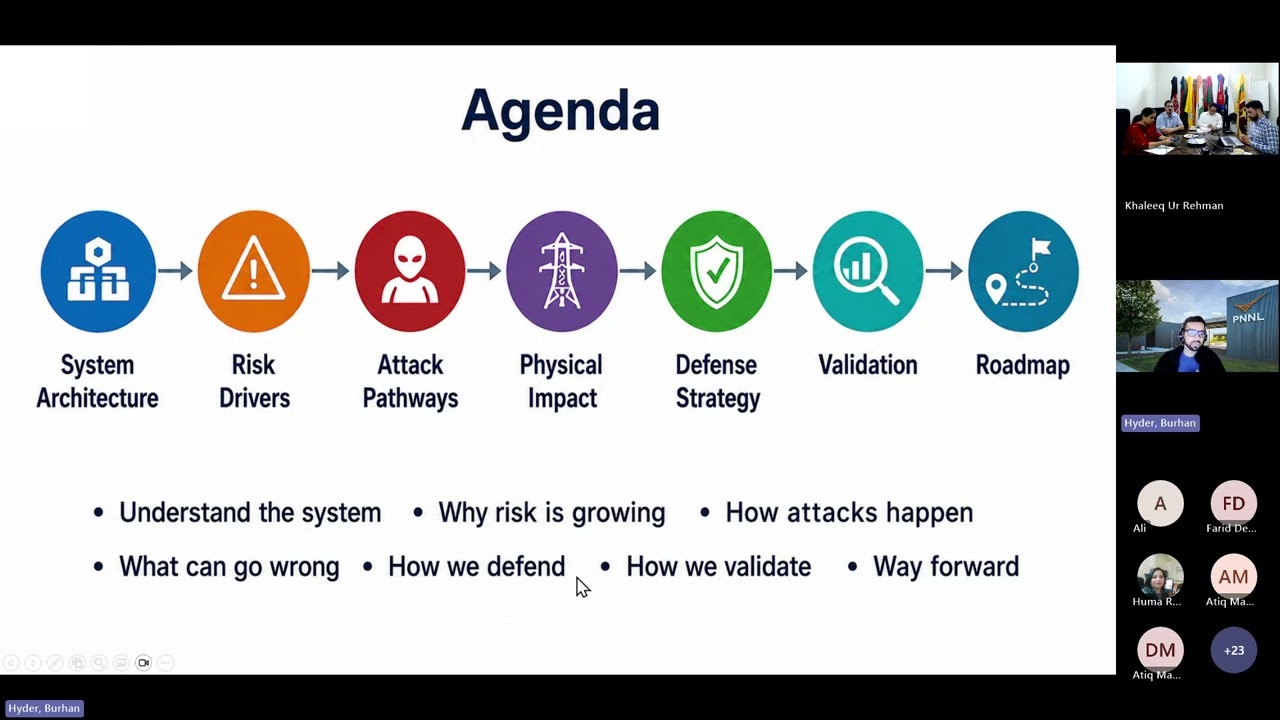
SAARC Webinar on “Cyber Security Training and Auditing for Smart Grid”
Keywords
Summary
137 words
Critical Evaluation
Value of the Information & Strength of the Argument
The webinar provides a valuable overview of smart grid cybersecurity, highlighting the importance of protecting critical infrastructure. The speaker effectively argues that digitalization introduces new vulnerabilities and that a proactive, layered defense is necessary. He uses real-world examples to illustrate the potential consequences of cyber attacks, which strengthens the argument. However, the presentation is somewhat high-level and lacks specific technical details or case studies. The argumentation is coherent but not deeply analytical, and the speaker occasionally digresses.
Scientific Rigor, Source Quality, Title Accuracy
The webinar is based on the speaker’s expertise and general knowledge, but it does not cite specific sources or references. The title accurately reflects the content, which focuses on cybersecurity training and auditing. The presentation is not rigorously structured, and the speaker sometimes rambles. The lack of citations and the informal style reduce the scientific rigor, but the information is generally accurate and relevant.
156 words
Title / Content Match
The title accurately reflects the content, which focuses on cybersecurity training and auditing for smart grids.
Quality & Reliability
6/10
The webinar provides a broad overview of smart grid cybersecurity, with practical examples and references to real incidents. However, it lacks in-depth technical detail and rigorous sourcing, and the presentation is somewhat unstructured.
Key Moments
Markers derived by PSI from the transcript: the creator did not define chapters.
- Introduction by moderator, Tanjin Jamso, on the importance of cybersecurity in smart grids.
- Dr. Bhan Haidider begins his presentation on smart grid cybersecurity.
- Discussion of the Purdue model and smart grid architecture.
- Explanation of attack vectors and real-world examples (Ukraine, Colonial Pipeline).
- Defense strategies: risk assessment, monitoring, and incident response.
- Q&A session begins.
Cited Sources
- SAARC Energy Centre — Official website of the organizing institution, providing further information on energy initiatives in the SAARC region.
Concurring Sources
- NIST Cybersecurity Framework — Provides guidelines for improving cybersecurity of critical infrastructure, aligning with the webinar's recommendations.
- IEC 62443 — International standards for industrial automation and control systems security, relevant to smart grid protection.
Contribution & Novelties
The webinar provides a comprehensive overview of smart grid cybersecurity, emphasizing the need for training and auditing. It highlights the unique challenges of OT systems and the importance of availability and integrity. The presentation is accessible to a broad audience, making it a useful introduction to the topic.
Pour aller plus loin :
- NIST Cybersecurity Framework — A widely used framework for improving cybersecurity of critical infrastructure.
- IEC 62443 — International standards for industrial automation and control systems security.
- Purdue Model — Reference architecture for industrial control systems, used to describe smart grid layers.
94 words
Radar Profile
The radar profile shows moderate scores across all dimensions, indicating a balanced but not exceptional presentation. The webinar offers a general overview with practical examples, but lacks depth and rigorous sourcing.