SAARC Webinar Series 2025 | Webinar on Opportunities and Challenges in New Markets for Offshore Wind
Keywords
Summary
223 words
Critical Evaluation
Value of the Information & Strength of the Argument
The webinar provides a comprehensive overview of offshore wind energy, particularly for South Asia, highlighting both opportunities and challenges. The speaker presents a balanced argument, acknowledging the high costs and technical difficulties while emphasizing the potential benefits. The argumentation is structured logically, moving from global context to regional potential, then to challenges, technological solutions, and policy recommendations. However, the presentation lacks depth in some areas, such as specific case studies or detailed economic analysis, and relies on general statistics rather than in-depth data. The speaker’s expertise is evident, but the argumentation could be strengthened with more concrete examples and citations.
Scientific Rigor, Source Quality, Title Accuracy
The webinar demonstrates moderate scientific rigor. The speaker cites global statistics from organizations like the World Wind Energy Association and mentions COP30 targets, but does not provide specific references or links to these sources. The presentation is based on the speaker’s expertise and general knowledge rather than a systematic literature review. The title accurately reflects the content, focusing on opportunities and challenges in new markets for offshore wind. The webinar is an expert opinion rather than a peer-reviewed study, which limits its scientific rigor. No comments were provided for analysis.
205 words
Title / Content Match
The title accurately reflects the content, which focuses on opportunities and challenges for offshore wind in new markets, particularly South Asia.
Quality & Reliability
7/10
The webinar is an expert presentation by a professor from IIT Kanpur, providing a broad overview of offshore wind opportunities and challenges in South Asia. It cites global statistics and trends but lacks detailed citations or peer-reviewed sources. The content is informative but not deeply technical, and the speaker's expertise lends credibility.
Key Moments
Markers derived by PSI from the transcript: the creator did not define chapters.
- Introduction by moderator, Dan Jamzo, welcoming participants and outlining the webinar's purpose.
- Opening speech by Director Abdul Rashid, highlighting renewable energy growth and COP30 goals.
- Prof. Vishwanath begins presentation, discussing global wind energy capacity and projections.
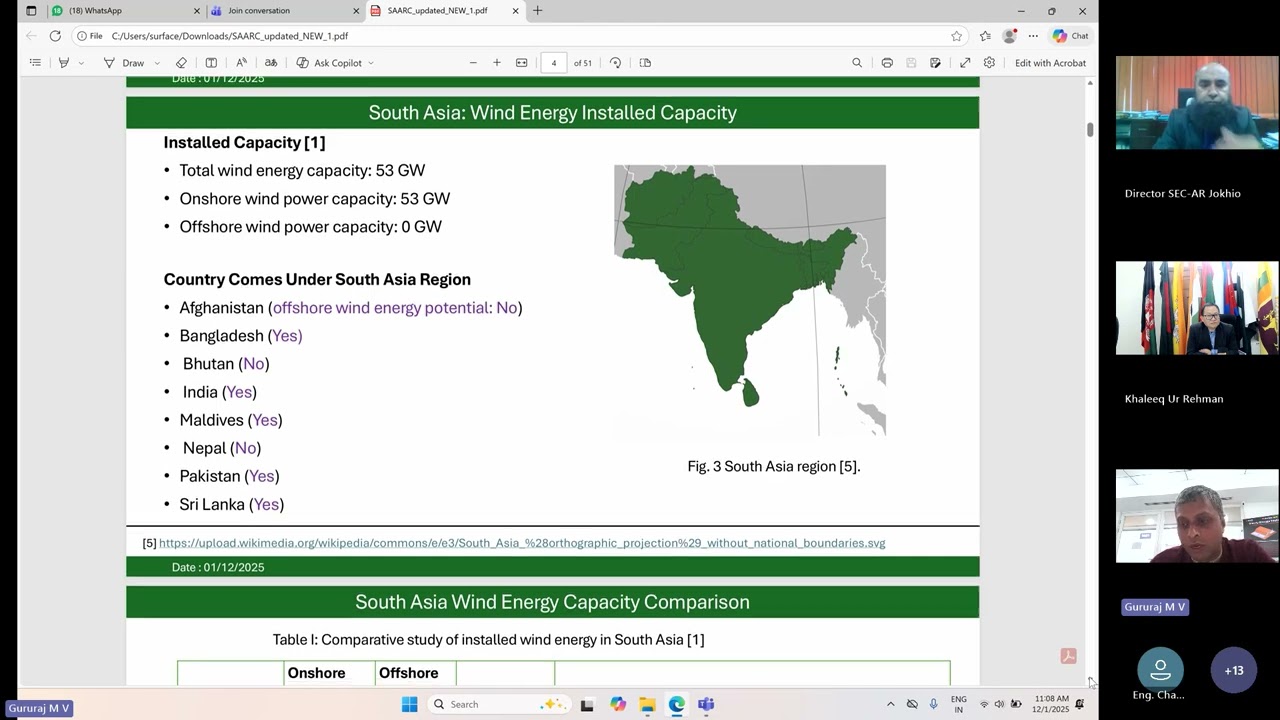
- Overview of offshore wind potential in South Asian countries, including India, Pakistan, Bangladesh, and Sri Lanka.
- Discussion of key challenges: harsh marine conditions, installation costs, and grid integration issues.
- Technological advancements: larger turbines, floating platforms, and multi-energy hubs.
- AI and digitalization for predictive maintenance and condition monitoring.
- Comparison of offshore wind with onshore wind and solar PV in terms of capacity factor and predictability.
- Policy recommendations and grid delivery models for offshore wind development.
- Explanation of wind turbine generator types and research activities at IIT Kanpur.
Cited Sources
- World Wind Energy Association 2025 Report — Cited for global wind capacity statistics (1.17 TW total, 83 GW offshore).
- IRENA Planned Energy Scenario — Cited for offshore wind capacity projections (275 GW by 2030, 1,200 GW by 2050).
- COP30 — Mentioned for renewable energy tripling goals.
Concurring Sources
- IRENA – Offshore Wind — IRENA provides data and analysis on offshore wind potential and deployment, aligning with the webinar's projections.
- Global Wind Report 2024 – GWEC — GWEC's report offers detailed statistics on global wind capacity, consistent with the webinar's figures.
Dissenting Sources
- No specific discordant sources identified — The webinar's claims are generally consistent with mainstream industry reports, though specific projections may vary.
Contribution & Novelties
The webinar provides a regional perspective on offshore wind development in South Asia, highlighting specific country potentials and challenges. It offers a balanced view of opportunities and obstacles, and suggests policy and technological pathways. The presentation is valuable for stakeholders in the region, but it does not introduce novel research findings.
Pour aller plus loin :
- Offshore wind power — Overview of offshore wind technology and global deployment.
- Floating wind turbine — Details on floating platforms for deep-water installations.
- High-voltage direct current — HVDC technology for long-distance transmission.
- SAARC Energy Centre — Official website of the organizing body.
98 words
Radar Profile
The radar profile shows moderate scores across all dimensions, with slightly higher scores in quantity of information and technical level, reflecting the webinar's broad coverage and expert presentation. The lower score in quality of information suggests a lack of deep analysis and citations.