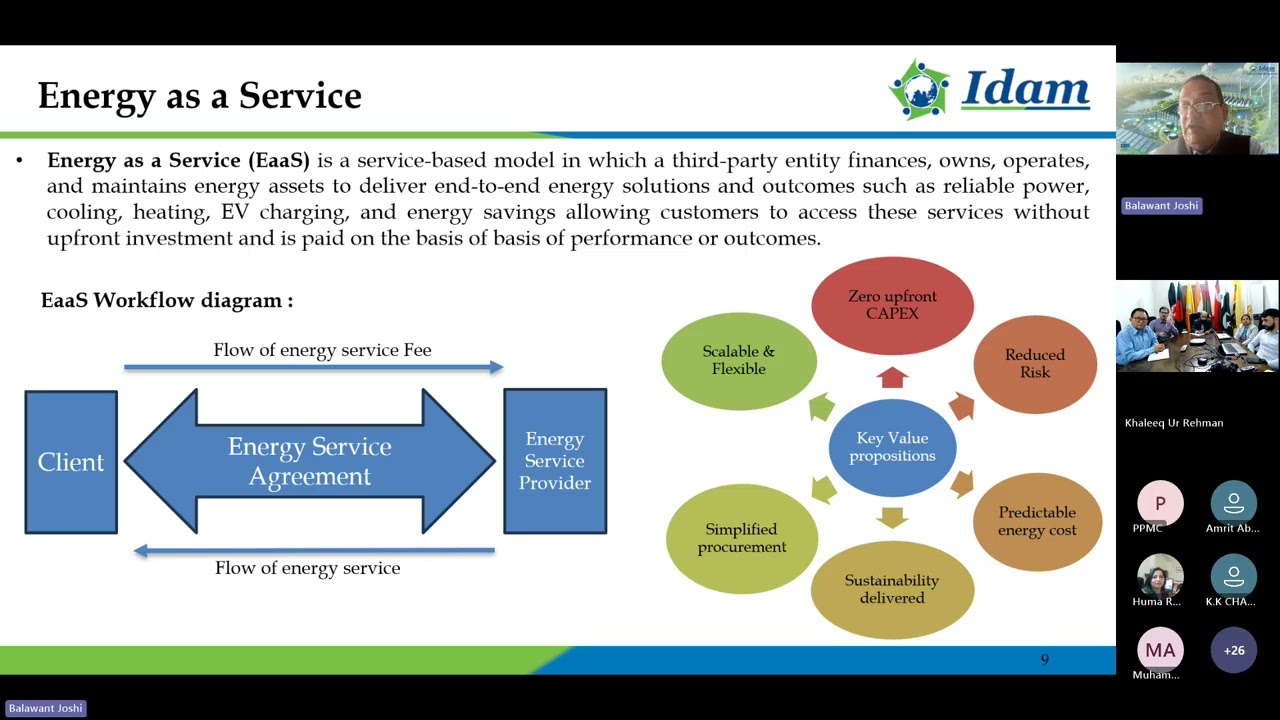
SAARC Webinar on “Market Strategies under Energy as a Service EaaS”
Keywords
Summary
176 words
Critical Evaluation
Value of the Information & Strength of the Argument
The webinar provides valuable insights into EaaS business models, drawing on the speaker’s extensive practical experience. Joshi effectively explains complex concepts with clear examples, such as solar rooftop PPAs and energy performance contracting. The argumentation is coherent and well-structured, systematically covering definitions, value propositions, limitations, and business models. However, the presentation is largely anecdotal, lacking empirical data or rigorous comparative analysis. While the speaker’s expertise lends credibility, the arguments would be strengthened by referencing specific case studies or quantitative evidence. The discussion of challenges and opportunities in the SAARC region is relevant but could benefit from more detailed policy analysis.
Scientific Rigor, Source Quality, Title Accuracy
The webinar is based on the speaker’s professional experience rather than formal citations. No specific sources are referenced, and the only link provided is to the SAARC Energy Centre website. The title accurately reflects the content, focusing on market strategies for EaaS. The presentation is scientifically sound in its practical orientation, but it lacks the rigor of a peer-reviewed review. The speaker’s credentials add credibility, but the absence of cited sources limits the verifiability of claims. The webinar appears to be a single presentation without audience comments, so no public feedback is available for analysis.
210 words
Title / Content Match
The title accurately reflects the content, which focuses on market strategies for Energy as a Service, with a regional perspective on South Asia.
Quality & Reliability
7/10
The webinar is an expert presentation by a seasoned professional with 25+ years in sustainable energy, providing practical insights and case studies. However, it is largely based on personal experience and lacks rigorous citations or peer-reviewed sources. The content is informative but not systematically evidence-based.
Key Moments
Markers derived by PSI from the transcript: the creator did not define chapters.
- Introduction by moderator and opening remarks by Dr. Kiran, Director of SAARC Energy Centre.
- Speaker introduction and overview of Idam Infrastructure Advisory.
- Definition of Energy as a Service (EaaS) and key value propositions.
- Comparison of traditional energy procurement vs. EaaS model.
- Discussion of EaaS limitations and challenges.
- Classification of EaaS business models based on consumer segment and service type.
- Detailed explanation of subscription/leasing and output/consumption-based models.
- Revenue/asset ownership and performance-based contracts.
- Examples of generation as a service and energy performance contracting.
- Q&A session begins (transcript cuts off).
Cited Sources
- SAARC Energy Centre — Organizer of the webinar and source of information on SAARC energy initiatives.
Concurring Sources
- SAARC Energy Centre — The webinar is hosted by this organization, which promotes energy cooperation in South Asia.
Contribution & Novelties
The webinar provides a practical overview of EaaS business models tailored to the SAARC region, drawing on the speaker’s extensive experience. It highlights the potential of EaaS to overcome financial barriers to clean energy adoption. The presentation offers a structured classification of business models and discusses regional challenges and opportunities. While not groundbreaking, it serves as a useful primer for stakeholders.
Pour aller plus loin :
- Energy Service Company (ESCO) — Provides background on ESCO models and energy performance contracting.
- Energy Performance Contracting — Explains the mechanism of performance-based contracts.
- Distributed Energy Resources — Relevant to the integration of distributed generation in EaaS models.
- Virtual Power Plant — Concept mentioned in revenue-sharing models.
113 words
Radar Profile
The radar profile shows high scores in quantity of information and reliability, reflecting the speaker's expertise and comprehensive coverage. The technical level is moderate, making it accessible to a broad audience. The quality of information is good but not exceptional, as it relies on practical experience rather than rigorous research.