Regional experience in the Energy Sector Restructuring and Reforms
Keywords
Summary
163 words
Critical Evaluation
Value of the Information & Strength of the Argument
The value of the information lies in the firsthand accounts and practical insights from senior officials who have directly shaped energy reforms in their countries. The arguments are based on real-world experience and specific examples, such as Nepal’s gradual unbundling and Pakistan’s regulatory evolution. However, the discussion is largely descriptive and lacks critical analysis of failures or alternative approaches. The speakers advocate for their own models without thoroughly addressing potential drawbacks or comparative effectiveness. The argumentation is persuasive but not rigorously evidence-based, relying more on narrative than systematic data.
Scientific Rigor, Source Quality, Title Accuracy
The scientific rigor is moderate. The speakers cite specific policies, laws, and institutional changes, but they do not provide references to academic studies or official reports. The sources are primarily their own professional experiences and the institutional frameworks they helped create. The title accurately reflects the content, which is a regional comparison of energy sector reforms. The webinar is not a formal academic presentation but a policy discussion, so the lack of citations is expected. The adéquation between title and content is strong, as the discussion directly addresses restructuring and reforms in the region.
198 words
Title / Content Match
The title accurately reflects the content, which focuses on regional experiences in energy sector restructuring and reforms, primarily from Nepal and Pakistan.
Quality & Reliability
7/10
The webinar features two senior experts with decades of experience in energy policy and regulation in Nepal and Pakistan. Their insights are based on direct involvement in reforms, but the discussion is largely anecdotal and lacks rigorous data or peer-reviewed sources. The content is informative but not systematically evidence-based.
Key Moments
Markers derived by PSI from the transcript: the creator did not define chapters.
- Introduction by moderator and overview of webinar objectives.
- Anup Kumar Upadhyay begins presentation on Nepal's energy sector.
- Historical background of Nepal's hydropower development and institutional fragmentation.
- Discussion of the 1992 reforms and opening to private producers.
- Nepal's load shedding crisis and the 2017 plan to address it.
- Nepal's unique unbundling model and creation of the Power Grid Company.
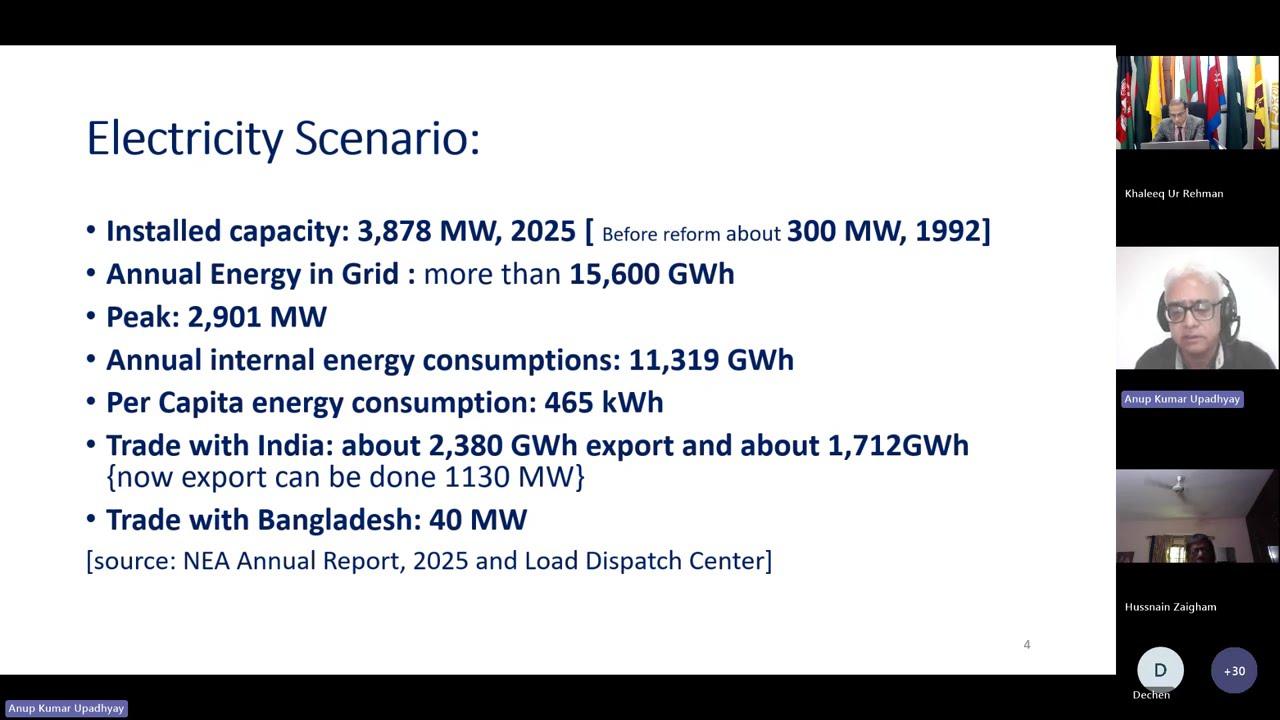
- Establishment of the Electricity Regulatory Commission and cross-border trade.
- Hussain Zaighm Alvi presents Pakistan's power sector reforms.
- Discussion of tariff reforms, circular debt, and capacity payments in Pakistan.
- Q&A session with audience questions.
Cited Sources
- SAARC Energy Centre — Organizer of the webinar and source of information on regional energy cooperation.
Concurring Sources
- SAARC Energy Centre — The webinar is hosted by this organization, which promotes regional energy cooperation.
Contribution & Novelties
The webinar provides unique insights into the practical implementation of energy sector reforms in Nepal and Pakistan, highlighting the importance of context-specific approaches. It offers a comparative perspective on how two South Asian countries have navigated similar challenges with different strategies. The discussion on Nepal’s gradual unbundling model and Pakistan’s regulatory evolution adds valuable lessons for other developing economies.
Pour aller plus loin :
- Electricity Regulatory Commission Nepal — Official website of Nepal’s electricity regulator, providing details on its mandate and functions.
- National Electric Power Regulatory Authority (NEPRA) — Official website of Pakistan’s power regulator, offering information on its regulatory framework and decisions.
- SAARC Framework Agreement for Energy Cooperation — Regional agreement promoting energy trade and cooperation in South Asia.
- World Bank on Power Sector Reform — Overview of power sector reform principles and case studies from developing countries.
139 words
Radar Profile
The radar profile shows high scores in quantity of information and fiabilité, reflecting the extensive experience of the speakers. The niveau technique is moderate, indicating that the content is accessible to a general audience but still includes technical details. The quality of information is good, but the lack of rigorous citations slightly lowers the overall score.
💬 No comments were provided for analysis.