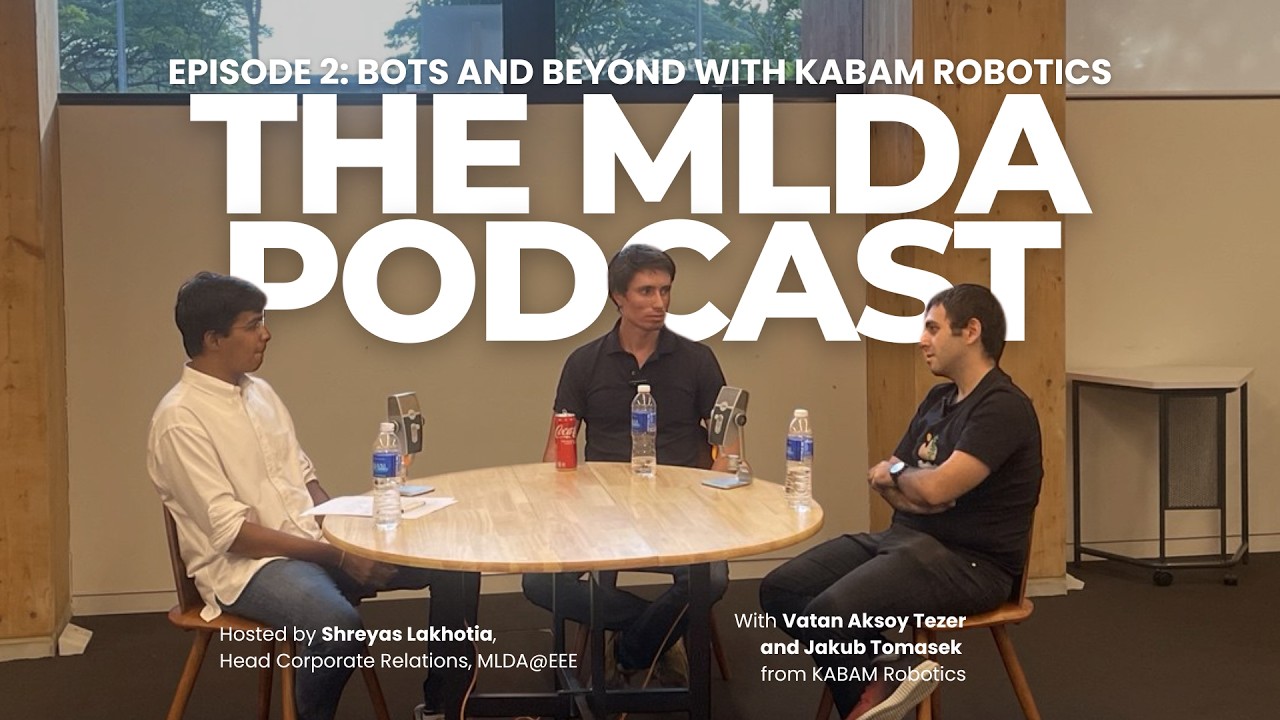
Bots and Beyond with Kabam Robotics | The MLDA Podcast Episode 2
Keywords
Summary
158 words
Critical Evaluation
Value of the Information & Strength of the Argument
The value of the information lies in the firsthand experiences of two engineers who have worked in various robotics domains, including space, security, and service robots. They provide practical insights into the product development cycle, from adopting academic research to scaling it to production readiness. The argumentation is coherent and grounded in their professional experiences, though it is largely anecdotal and lacks empirical data. They effectively argue for the importance of robustness and reliability in robotics, and the need for human-in-the-loop solutions to ensure usability. The discussion on Singapore’s robotics ecosystem is insightful, highlighting the role of government support and the multicultural environment in fostering innovation. However, the arguments are not rigorously supported by external evidence, and some claims, such as the comparison between Japan and Singapore, are subjective.
Scientific Rigor, Source Quality, Title Accuracy
The scientific rigor is moderate; the speakers are experienced professionals, but the content is based on personal opinions and experiences rather than peer-reviewed research. The sources cited are limited to the podcast’s own links and a previous episode, with no external references to academic papers or industry reports. The title accurately reflects the content, which is a discussion about robotics and KABAM Robotics, though it is more of a career and industry conversation than a technical deep dive. The podcast does not provide formal citations, but the speakers’ credentials lend some credibility. The adéquation between the title and content is good, as it promises a discussion with robotics engineers and delivers that, though the focus is more on general insights than technical details.
267 words
Title / Content Match
The title accurately reflects the content, which discusses robotics and the work of KABAM Robotics, though it is more of a general career and industry discussion than a technical deep dive.
Quality & Reliability
7/10
The podcast features two experienced robotics engineers from KABAM Robotics, providing credible insights into robotics development, startup scaling, and career paths. The information is based on personal experience and industry knowledge, but lacks formal citations or peer-reviewed sources. The discussion is largely anecdotal and opinion-based, with no quantitative data or rigorous scientific evidence presented.
Key Moments
Markers derived by PSI from the transcript: the creator did not define chapters.
- Introduction of guests and their backgrounds.
- Discussion on why Singapore is a hub for robotics.
- Comparison of robotics innovation in Japan vs Singapore.
- Role of government programs like NRP in robotics.
- How KABAM uses academic research and open source.
- Challenges of deploying robots in unstructured environments.
- Human-robot interaction and the future of robotics.
- Advice for aspiring roboticists and entrepreneurs.
Cited Sources
- MLDA LinkedIn — Mentioned as a way to learn more about MLDA.
- MLDA Website — Mentioned as a way to learn more about MLDA.
- Robotics & Embodied AI with Jiafei Duan — Referenced as a previous MLDA podcast episode.
Concurring Sources
- Robotics & Embodied AI with Jiafei Duan — Previous MLDA podcast episode on similar topics, providing additional context.
Contribution & Novelties
The podcast provides unique insights into the practical challenges of deploying robotics in real-world environments, particularly in Singapore. It offers a behind-the-scenes look at the product development cycle, from research to production, and emphasizes the importance of robustness and human-in-the-loop solutions. The discussion on the role of government programs and the multicultural ecosystem in fostering innovation is valuable for understanding the robotics landscape in Asia.
Pour aller plus loin :
- Technology readiness level — The concept of TRL is central to the discussion on scaling research to production.
- Embodied intelligence — The podcast discusses embodied intelligence in robotics; this concept is relevant.
- ROS (Robot Operating System) — Open-source robotics framework often used in development; relevant to the discussion on open source.
- National Robotics Programme (Singapore) — The government program mentioned in the podcast; official website.
135 words
Radar Profile
The radar profile shows moderate scores across all dimensions, with slightly higher scores in quantity of information and reliability, reflecting the experienced guests and practical insights. The lower technical level score indicates the content is accessible to a general audience rather than deeply technical.