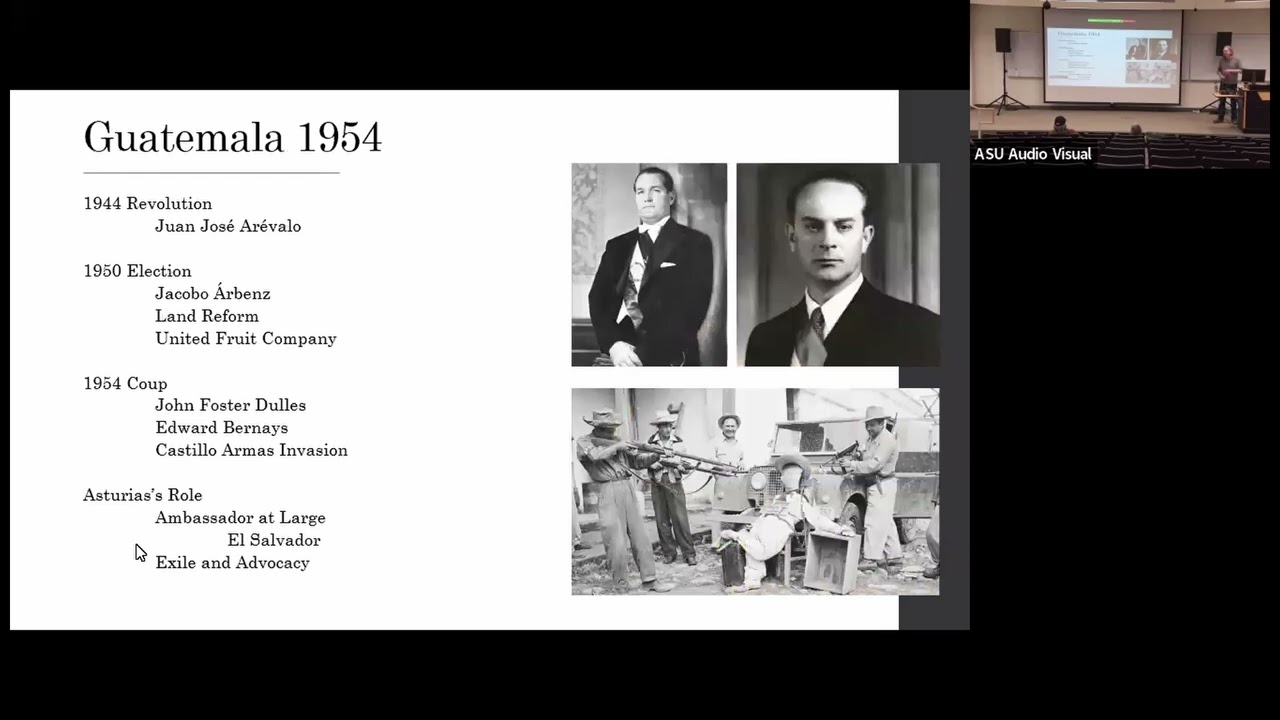
Faculty Lecture Series: Stranger Than Fiction: Miguel Angel Asturias and Guatemala’s History
Keywords
Summary
195 words
Critical Evaluation
Value of the Information & Strength of the Argument
The lecture provides valuable insights into the intersection of literature and history, arguing that Asturias’s fiction offers a more nuanced and accurate account of the 1954 coup than traditional historiography. Lee’s argument is well-structured, moving from general theories of fiction in history to specific analysis of Asturias’s work and historical events. He supports his claims with references to key historians and primary sources, and he addresses counterarguments, such as Asturias’s controversial political choices. The discussion of why the book remained untranslated is particularly insightful, highlighting the political and cultural barriers to its reception. The lecture’s strength lies in its interdisciplinary approach, combining literary analysis with historical context, and its clear, engaging presentation.
Scientific Rigor, Source Quality, Title Accuracy
The lecture demonstrates strong scholarly rigor, drawing on established historiography such as Richard Immerman’s ‘The CIA in Guatemala’ and more recent works like Aaron Coy Moulton’s ‘Caribbean Crucible’. Lee, as a historian and translator, brings expertise and access to primary sources, including the original text. The title accurately reflects the content, focusing on Asturias’s fiction as a lens for understanding Guatemala’s history. The lecture is well-organized and cites sources appropriately, though it is a single presentation without formal citations. The audience questions, while limited, show engagement and curiosity, but no significant trends can be discerned from the small sample.
226 words
Title / Content Match
The title accurately reflects the content, focusing on Asturias's fiction as a lens for understanding Guatemala's history.
Quality & Reliability
8/10
The lecture is given by a historian specializing in US-Guatemalan relations, with a forthcoming translation of the discussed work. It draws on established historiography and primary sources, though it is a single academic presentation without peer review.
Key Moments
Markers derived by PSI from the transcript: the creator did not define chapters.
- Introduction of Dr. Lee and his work on translating 'Weekend in Guatemala'.
- Discussion on the role of fiction in history, citing examples like Uncle Tom's Cabin.
- Introduction of Miguel Angel Asturias and his major works, including 'El Señor Presidente'.
- Overview of the 1954 coup and the role of the United Fruit Company and the CIA.
- Explanation of why Asturias chose fiction to represent the events, with epigraphs.
- Analysis of the story 'Sergeant Harkins' and its portrayal of an American imperialist.
- Discussion of the story 'Assault 33' and the massacre, highlighting the role of fiction.
- Reasons for the book's lack of English translation, including Cold War politics.
- Conclusion on the importance of fiction for historical understanding and contemporary relevance.
Cited Sources
- Weekend in Guatemala (original work) — The short story collection by Miguel Angel Asturias that Dr. Lee is translating and analyzing.
- The CIA in Guatemala: The Foreign Policy of Intervention — Book by Richard Immerman, cited as a classic text on the 1954 coup.
- Caribbean Crucible: Blood, Paths, and the Making of the Modern Caribbean — Recent book by Aaron Coy Moulton, mentioned as newer historiography.
- Foundational Fictions: The National Romances of Latin America — Book by Doris Sommer, referenced in the discussion of novels as historical actors.
Concurring Sources
- The CIA in Guatemala: The Foreign Policy of Intervention — Supports the historical account of the coup and the role of the CIA.
- Caribbean Crucible: Blood, Paths, and the Making of the Modern Caribbean — Recent scholarship that aligns with the lecture's interpretation of the coup's consequences.
Dissenting Sources
- Asturias's early sociological thesis — The lecture acknowledges that this text is racist and not representative, which could be seen as discordant with his later anti-imperialist stance.
Contribution & Novelties
The lecture offers a fresh perspective on the 1954 Guatemalan coup by foregrounding Asturias’s fiction as a historical document. It argues that the absurdity of the events necessitated a fictional form to convey their truth, a point often overlooked in traditional historiography. The discussion of why the book remained untranslated in English for decades adds new insight into Cold War publishing politics. The lecture also highlights the moral complexity of Asturias’s work, challenging simplistic anti-imperialist narratives.
Pour aller plus loin :
- Miguel Angel Asturias — Biographical and literary context.
- 1954 Guatemalan coup d’état — Historical overview.
- United Fruit Company — Corporate role in the coup.
- Magical realism — Literary movement associated with Asturias.
113 words
Radar Profile
The radar profile shows high scores in information quantity, quality, and technical level, with a slightly lower but still strong reliability score. This indicates a well-researched and informative lecture that is both accessible and scholarly.
💬 No comments were provided for analysis.