Related Rates of Change | Calculus I A Lecture 8 | Nge Kie Seng 20251024
Keywords
Summary
182 words
Critical Evaluation
Value of the Information & Strength of the Argument
The lecture provides solid value by reinforcing key calculus concepts through worked examples and addressing common pitfalls. The instructor’s emphasis on domain restrictions and proper notation is valuable for students. The argumentation is logical and clear, with step-by-step derivations. He also connects the material to real-world applications, motivating the relevance of calculus. The discussion on limits involving e is particularly instructive, showing how to manipulate expressions to apply known formulas. The related rates example is well-explained, distinguishing between displacement and distance, and clarifying the conditions for speeding up/slowing down. The instructor encourages student participation and questions, enhancing understanding.
Scientific Rigor, Source Quality, Title Accuracy
The lecture demonstrates scientific rigor through careful mathematical reasoning and correction of errors. The instructor emphasizes the importance of domain restrictions and proper limit notation, avoiding common misconceptions. The content is based on standard calculus curriculum, though no external sources are cited. The title accurately reflects the content, as the lecture indeed covers related rates of change. The instructor’s approach is methodical, and he encourages students to verify calculations, promoting critical thinking. No comments were provided for analysis.
191 words
Title / Content Match
The title accurately reflects the content: a lecture on related rates of change, part of a Calculus I series.
Quality & Reliability
7/10
The lecture is a formal university calculus course, with rigorous mathematical derivations and emphasis on correct notation and domain considerations. The instructor corrects a previous mistake and encourages students to verify calculations. However, the content is not peer-reviewed and is based on standard textbook material.
Key Moments
Markers derived by PSI from the transcript: the creator did not define chapters.
- Introduction and discussion of quiz results.
- Correction of domain error from previous lecture.
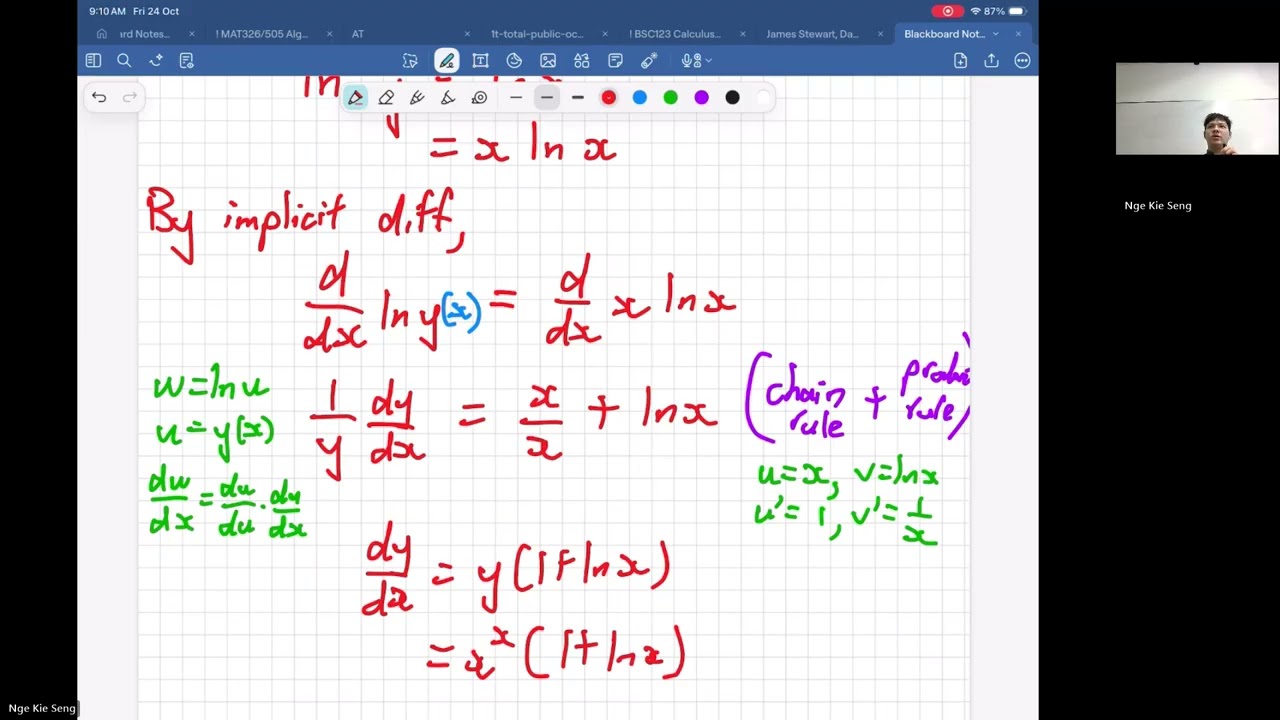
- Example: differentiate y = x^x using logarithmic differentiation.
- Discussion on when logarithmic differentiation is applicable.
- Derivation of limits involving e: lim (1 + 1/n)^n and variations.
- Application: particle motion, finding velocity and acceleration.
- Explanation of total distance vs displacement.
- Discussion on speeding up and slowing down conditions.
- Conclusion and Q&A.
Contribution & Novelties
The lecture provides a clear pedagogical approach to related rates, emphasizing domain restrictions and proper limit manipulation. It corrects common misconceptions and offers practical examples. The instructor’s method of deriving limits involving e is particularly instructive.
Pour aller plus loin :
- Logarithmic differentiation — Useful for understanding the technique’s scope.
- Related rates — Standard application of derivatives.
- Limit of (1 + 1/n)^n — Background on the constant e.
68 words
Radar Profile
The radar profile shows high scores in information quantity, quality, and technical level, with slightly lower reliability due to lack of external sources. This indicates a content-rich lecture with strong educational value, though it relies on the instructor's expertise rather than cited references.