The Existence of Primitive Roots | Elementary Number Theory Lec 8 | Nge Kie Seng 250311
Keywords
Summary
177 words
Critical Evaluation
Value of the Information & Strength of the Argument
The lecture provides a rigorous and detailed treatment of the existence of primitive roots, which is a fundamental topic in number theory. The instructor presents two key proofs: one for lifting primitive roots from modulo p to p^2, and another for lifting to 2p^k. The arguments are well-structured, using binomial expansion, order properties, and the Chinese Remainder Theorem. The instructor also clarifies the role of Euler’s totient function and the multiplicative property of φ. The argumentation is solid, with clear assumptions and logical steps, and the instructor explicitly addresses potential pitfalls, such as the need for contradiction proofs. The value lies in the deep understanding of the structure of the multiplicative group modulo n and the techniques used to prove such results.
Scientific Rigor, Source Quality, Title Accuracy
The lecture is mathematically rigorous, with proofs presented in a clear and logical manner. The instructor does not cite external sources, but the content is standard number theory, and the proofs are self-contained. The title accurately reflects the content, as the lecture is indeed about the existence of primitive roots. The instructor also mentions that some proofs are omitted and refers to notes, indicating a structured course. The lecture is part of a series, and the instructor references previous lectures, providing continuity. Overall, the scientific rigor is high, though the lack of external references is typical for a lecture.
236 words
Title / Content Match
The title accurately reflects the content: the lecture focuses on the existence and construction of primitive roots, with detailed proofs for prime powers and twice prime powers.
Quality & Reliability
8/10
The lecture is a formal proof-based exposition of primitive roots in elementary number theory. The instructor presents rigorous proofs, including a binomial expansion argument and a Chinese Remainder Theorem argument, and clearly states assumptions and conclusions. The content is mathematically sound, though it is a lecture and not peer-reviewed. The instructor acknowledges skipped proofs and encourages questions, indicating a pedagogical approach.
Key Moments
Markers derived by PSI from the transcript: the creator did not define chapters.
- Introduction and administrative announcements
- Summary of how to find primitive roots modulo p
- Classification of integers with primitive roots (2, 4, p^k, 2p^k)
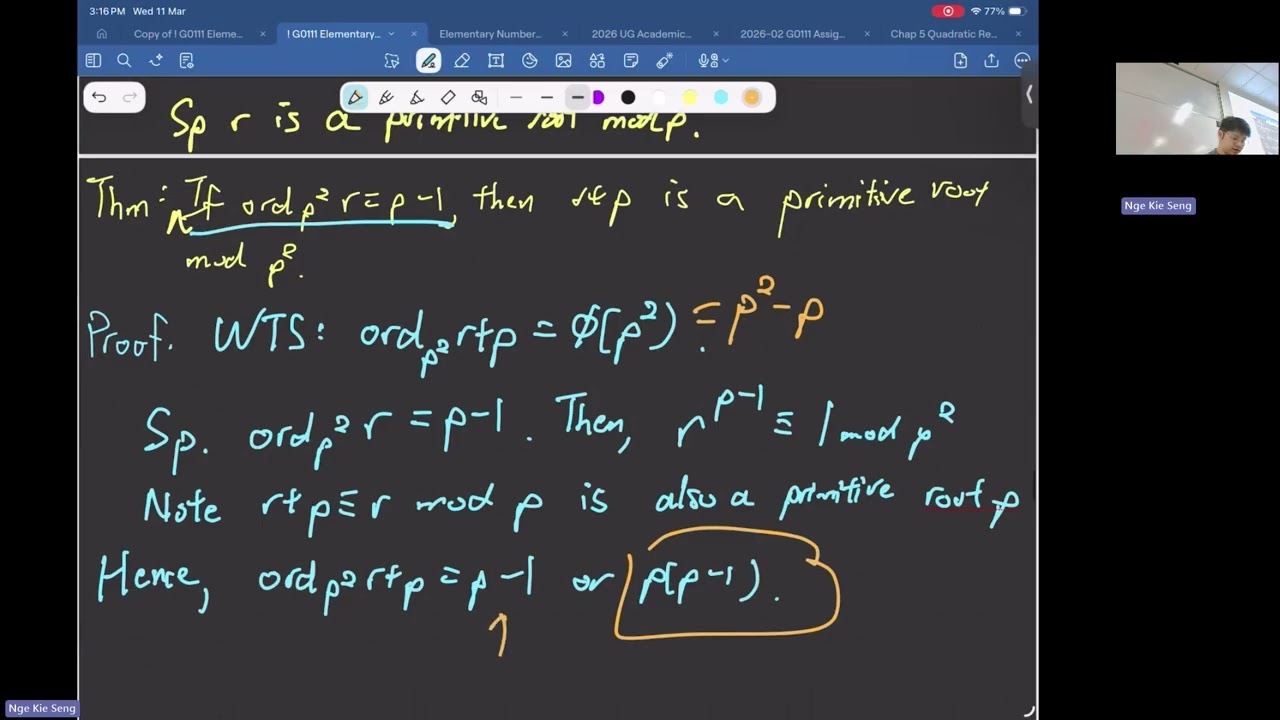
- Proof that if r is primitive mod p, then r or r+p is primitive mod p^2
- Proof using binomial expansion and contradiction
- Proof for 2p^k case using Chinese Remainder Theorem
- Discussion on the importance of communication in mathematics
- Introduction to index arithmetic and analogy with logarithms
Contribution & Novelties
The lecture provides a clear and rigorous exposition of the existence of primitive roots, with detailed proofs for the lifting theorems. It emphasizes proof techniques such as contradiction and the use of the Chinese Remainder Theorem, which are valuable for students. The instructor also connects the concept of primitive roots to index arithmetic, analogous to logarithms, which aids understanding.
Pour aller plus loin :
- Primitive root modulo n — Provides an overview and examples.
- Euler’s totient function — Essential for understanding the order of elements.
- Chinese remainder theorem — Used in the proof for 2p^k case.
96 words
Radar Profile
The radar profile shows high scores across all dimensions, indicating a technically rigorous and information-dense lecture. The balance between quantity and quality of information is strong, with a high level of technical depth. The overall reliability is high, consistent with a formal mathematical lecture.