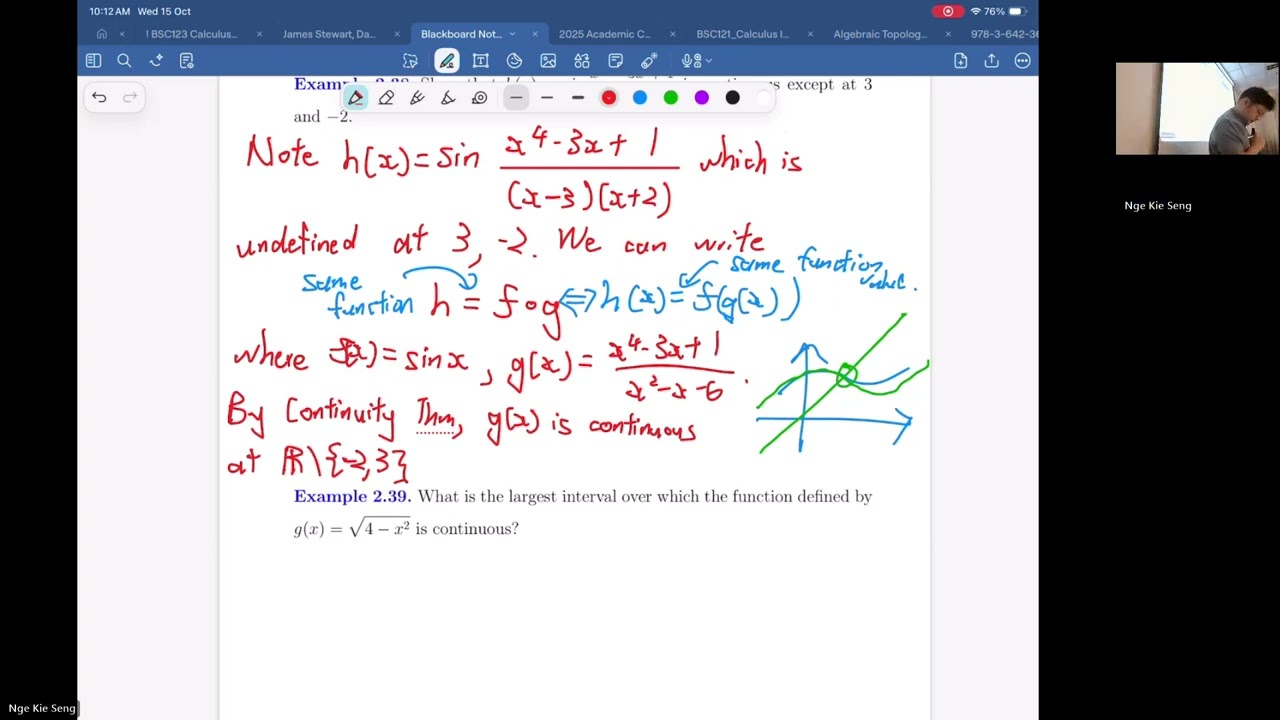
Differentiability of Real-Valued Functions | Calculus I A Lecture 5 | Nge Kie Seng 20251015
Keywords
Summary
141 words
Critical Evaluation
Value of the Information & Strength of the Argument
The lecture provides a solid foundation in the concepts of continuity and differentiability, with clear explanations and worked examples. The argumentation is logically structured, building from limit laws to continuity theorems and then to the intermediate value theorem. The instructor emphasizes the conditions and hypotheses of each theorem, which is crucial for rigorous application. The value of the information is high for students learning calculus, as it clarifies subtle points such as the difference between function equality and pointwise equality, and the importance of checking continuity before applying the intermediate value theorem. The presentation is interactive, with the instructor addressing potential misconceptions and encouraging questions. However, the lecture does not introduce novel or advanced material, and the informal tone may not suit all learners.
Scientific Rigor, Source Quality, Title Accuracy
The lecture demonstrates scientific rigor in its mathematical reasoning, with careful attention to hypotheses and logical steps. The instructor uses standard theorems and definitions, and the examples are well-chosen to illustrate key points. However, no external sources are cited, and the lecture relies on the instructor’s expertise and the course materials. The title accurately reflects the content, which is a lecture on differentiability within a Calculus I course. The presentation is consistent with the title, and the content is appropriately scoped for the course level. No comments were provided for analysis.
230 words
Title / Content Match
The title accurately reflects the content, which is a lecture on differentiability of real-valued functions in a Calculus I course.
Quality & Reliability
7/10
The lecture is a formal mathematics course, presenting definitions, theorems, and proofs in a structured manner. The content is standard and aligns with established calculus curriculum. The instructor emphasizes understanding and provides rigorous arguments, though the presentation is informal and lacks citations to external sources.
Key Moments
Markers derived by PSI from the transcript: the creator did not define chapters.
- Introduction and review of composite function limit theorem.
- Discussion on the conditions for interchanging limits and function evaluation.
- Example: proving continuity of a rational function using factorization.
- Continuation of the example, applying the composite function theorem.
- Introduction to the intermediate value theorem with graphical intuition.
- Application of the intermediate value theorem to show existence of a solution.
- Discussion on the importance of checking hypotheses before applying theorems.
- Transition to limits at infinity, with graphical examples.
- Explanation of the definition of limits at infinity and possible behaviors.
- Further discussion on limits at infinity and horizontal asymptotes.
Contribution & Novelties
The lecture provides a clear and rigorous exposition of fundamental calculus concepts, particularly the conditions under which limits can be interchanged with function evaluation and the application of the intermediate value theorem. It emphasizes the importance of checking hypotheses, which is crucial for correct mathematical reasoning. The lecture does not introduce new research but serves as an educational resource.
Pour aller plus loin :
- Intermediate value theorem - Wikipedia — Provides a comprehensive overview and formal statement of the theorem.
- Limit of a function - Wikipedia — Explains the formal definition of limits, including limits at infinity.
- Continuous function - Wikipedia — Discusses the definition and properties of continuous functions, relevant to the lecture’s content.
115 words
Radar Profile
The radar profile shows a balanced performance across all dimensions, with slightly higher scores in quantity of information and technical level, indicating a comprehensive and technically sound lecture. The lower score in quality of information and global reliability suggests that while the content is accurate, it lacks external validation and depth in certain areas.