Functoriality of Induced Homorphism on pi_1 | Algebraic Topology Lecture 4 | Nge Kie Seng 251008
Keywords
Summary
131 words
Critical Evaluation
Value of the Information & Strength of the Argument
The lecture provides a rigorous and detailed exposition of key theorems in algebraic topology. The proofs are well-structured and emphasize the use of covering spaces and the fundamental group. The instructor carefully explains the intuition behind each step, such as the role of lifts in distinguishing loops and the construction of retractions. The argumentation is solid, with clear logical flow and attention to technical details. The interactive format allows for clarification of student doubts, enhancing the pedagogical value. The content is valuable for students learning algebraic topology, as it bridges abstract concepts with concrete applications.
Scientific Rigor, Source Quality, Title Accuracy
The lecture is mathematically rigorous, with proofs based on standard results in algebraic topology. The instructor references Hatcher’s ‘Algebraic Topology’ as a primary source, which is a well-regarded textbook. The title accurately describes the content, focusing on functoriality of induced homomorphisms on fundamental groups. The lecture also covers related topics such as retractions and fixed point theorems. The sources cited are appropriate and reliable. The lecture is a recording of a live class, so there are some informal moments, but the mathematical content is precise.
195 words
Title / Content Match
The title accurately reflects the content: the lecture focuses on the functoriality of induced homomorphisms on fundamental groups, as part of an algebraic topology course.
Quality & Reliability
8/10
Lecture by a mathematics instructor, likely at university level, covering standard algebraic topology topics (fundamental group, covering spaces, retractions, Brouwer fixed point theorem, Borsuk-Ulam theorem). The content is rigorous and follows standard references like Hatcher's 'Algebraic Topology'. The presentation is interactive with student questions and a quiz, indicating a classroom setting. The video is a recording of a live lecture, so there are some technical issues (e.g., handwriting, audio) but the mathematical content is sound.
Key Moments
Markers derived by PSI from the transcript: the creator did not define chapters.
- Introduction and discussion on why loops with different winding numbers are not homotopic, using covering spaces.
- Explanation of the covering space R over S^1 and how it records location and time.
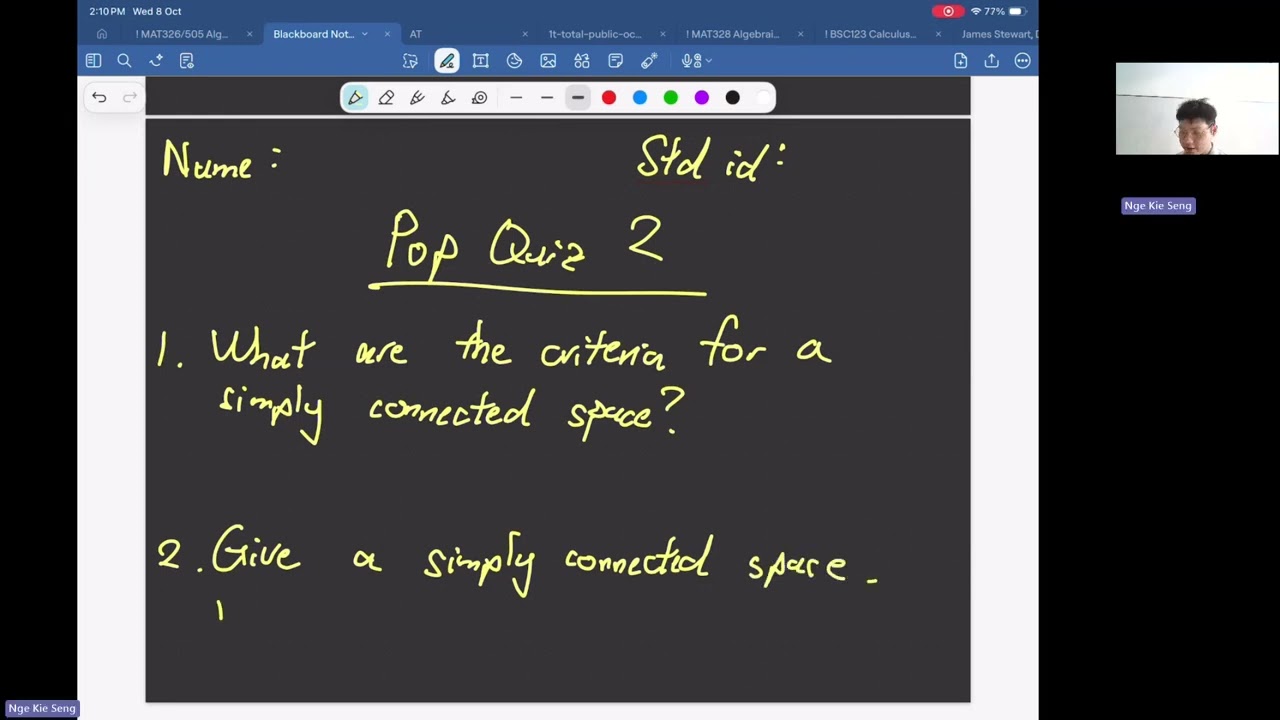
- Quiz on simply connected spaces; students exchange and grade papers.
- Discussion of quiz answers and grading criteria.
- Definition of retraction and statement of Brouwer fixed point theorem in 2D.
- Proof of Brouwer fixed point theorem using retraction and fundamental group.
- Break and informal discussion.
- Statement of Borsuk-Ulam theorem for S^2 and its real-life application.
- Proof of Borsuk-Ulam theorem using covering spaces and fundamental group.
- Conclusion and wrap-up of the lecture.
Cited Sources
- Algebraic Topology by Allen Hatcher — Referenced as the main textbook for the course, particularly for covering spaces and fundamental group.
Concurring Sources
- Algebraic Topology by Allen Hatcher — The lecture follows Hatcher's treatment of covering spaces and fundamental group, and the proofs of Brouwer and Borsuk-Ulam theorems align with standard presentations.
Contribution & Novelties
The lecture provides a clear and detailed exposition of fundamental group applications, particularly the Brouwer fixed point theorem and Borsuk-Ulam theorem, using covering space theory. The instructor’s interactive teaching style and step-by-step proofs enhance understanding. The lecture also includes a quiz and discussion, which reinforces learning.
Pour aller plus loin :
- Covering space — Provides background on covering spaces and their role in algebraic topology.
- Fundamental group — Essential concept for understanding the lecture.
- Brouwer fixed-point theorem — General statement and proof ideas.
- Borsuk–Ulam theorem — General statement and applications.
90 words
Radar Profile
The radar profile shows high scores in all dimensions, indicating a lecture that is information-dense, technically rigorous, and reliable. The balance between quantity and quality of information is strong, with a slight emphasis on technical depth.
💬 No comments were provided for analysis.