Chain Complexes of Modules | Graduate Algebra I Lecture 15 | Nge Kie Seng 260522
Keywords
Summary
178 words
Critical Evaluation
Value of the Information & Strength of the Argument
The lecture provides a solid introduction to chain complexes and homology, building on prior knowledge of exact sequences. The instructor carefully defines concepts and provides proofs for key results, such as the equivalence between splitting and the existence of left/right inverses. The argumentation is rigorous, relying on commutative diagrams and categorical language. The value lies in the clear exposition of abstract algebraic concepts, though the poor audio quality and occasional digressions may hinder comprehension.
Scientific Rigor, Source Quality, Title Accuracy
The lecture appears to be based on a standard graduate algebra textbook, but no specific sources are cited. The instructor mentions ’textbook’ but does not name it. The title accurately reflects the content. The mathematical rigor is high, with precise definitions and proofs. However, the lack of explicit references and the informal teaching style may reduce the perceived reliability for an external viewer.
152 words
Title / Content Match
The title accurately describes the content: a graduate algebra lecture on chain complexes of modules.
Quality & Reliability
8/10
Lecture by a university instructor, likely based on a standard graduate algebra textbook. The content is mathematically rigorous, with definitions, proofs, and exercises. However, the recording quality is poor (inaudible segments, unclear board work), and there are no external references provided.
Key Moments
Markers derived by PSI from the transcript: the creator did not define chapters.
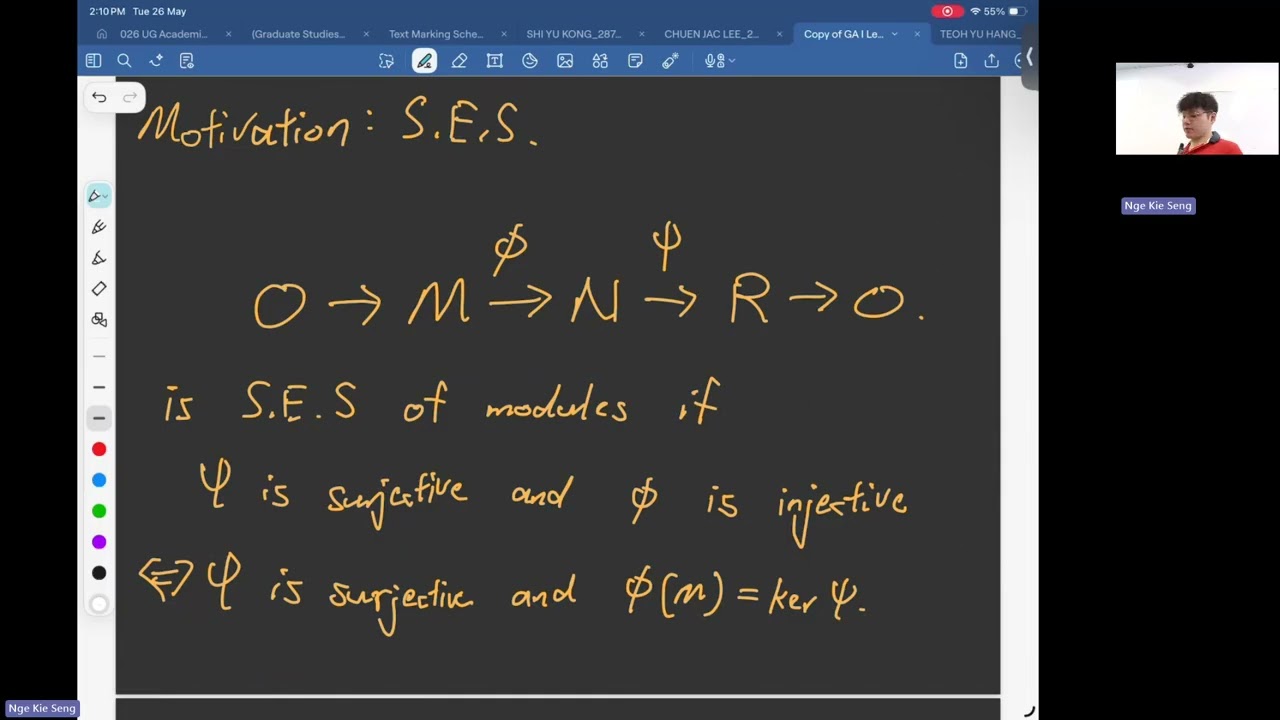
- Introduction and motivation from short exact sequences.
- Definition of chain complex and boundary maps.
- Definition of homology and exactness.
- Rephrasing short exact sequences in terms of chain complexes.
- Canonical decomposition of a module homomorphism.
- Discussion of splitting and commutative diagrams.
- Proof that splitting implies existence of left/right inverses.
- Converse proof: left/right inverse implies splitting.
- Emphasis on commutative diagrams and categorical thinking.
Contribution & Novelties
The lecture offers a clear pedagogical introduction to chain complexes and homology, emphasizing the categorical perspective and the importance of commutative diagrams. It connects abstract algebra with algebraic topology, providing motivation for the concepts. The instructor’s interactive style and step-by-step proofs make the material accessible, though the lack of references limits the novelty.
Pour aller plus loin :
- Chain complex (Wikipedia) — Provides a comprehensive overview of chain complexes and homology.
- Exact sequence (Wikipedia) — Explains exact sequences and their role in algebra.
- Homology (mathematics) (Wikipedia) — Discusses homology in various contexts, including algebraic topology.
- Split exact sequence (Wikipedia) — Details the splitting of exact sequences and related concepts.
- Abelian category (Wikipedia) — Introduces the categorical framework mentioned in the lecture.
121 words
Radar Profile
The radar profile shows high scores in technical level and information quality, reflecting the advanced mathematical content and rigorous treatment. The quantity of information is moderate, as the lecture covers a focused topic. The overall reliability is high, though the lack of external references and poor audio quality slightly reduce the score.