Cell Complexes | Algebraic Topology Lecture 7 | Nge Kie Seng 251022
Keywords
Summary
155 words
Critical Evaluation
Value of the Information & Strength of the Argument
The lecture provides a solid introduction to cell complexes, a fundamental concept in algebraic topology. The instructor’s explanations are clear and intuitive, using analogies like ‘skeleton’ and ‘flesh’ to convey the idea of building spaces from cells. He carefully defines attaching maps and characteristic maps, and illustrates with concrete examples (RP^n, CP^n) that help solidify understanding. The argumentation is logically structured, moving from definitions to constructions and properties. The instructor also addresses potential confusions, such as the difference between open and closed cells, and emphasizes the importance of the weak topology. The interactive format allows for immediate clarification of doubts, enhancing the value of the content. However, the lecture is informal and occasionally digresses, which might reduce its efficiency for self-study. Overall, the information is valuable for students learning algebraic topology, providing both theoretical foundations and practical insights.
Scientific Rigor, Source Quality, Title Accuracy
The lecture is mathematically rigorous, adhering to standard definitions and constructions in algebraic topology. The instructor references the course notes and mentions an appendix in Hatcher’s textbook, indicating reliance on established sources. The content is presented with precision, and the instructor encourages students to verify details and communicate with him. The title accurately reflects the content, as the lecture focuses on cell complexes. The video is a raw recording of a live lecture, so the production quality is low, but the mathematical content is reliable. No external sources are cited in the description, but the lecture itself references standard references in the field. The adequacy between title and content is high, as the lecture directly addresses the topic of cell complexes.
274 words
Title / Content Match
The title accurately reflects the content: the lecture focuses on cell complexes (CW complexes) as part of an algebraic topology course.
Quality & Reliability
8/10
Lecture by a university instructor, likely for a course in algebraic topology. The content is mathematically rigorous, with definitions, examples, and constructions presented in a formal manner. The instructor demonstrates deep knowledge and provides intuitive explanations. However, the video is a raw lecture with no editing, and the audio quality and occasional digressions may affect clarity. The mathematical content is standard and reliable.
Key Moments
Markers derived by PSI from the transcript: the creator did not define chapters.
- Introduction and administrative announcements about midterm schedule.
- Definition of cell complexes: zero cells, one cells, n-cells, and skeletons.
- Discussion of attaching maps and characteristic maps.
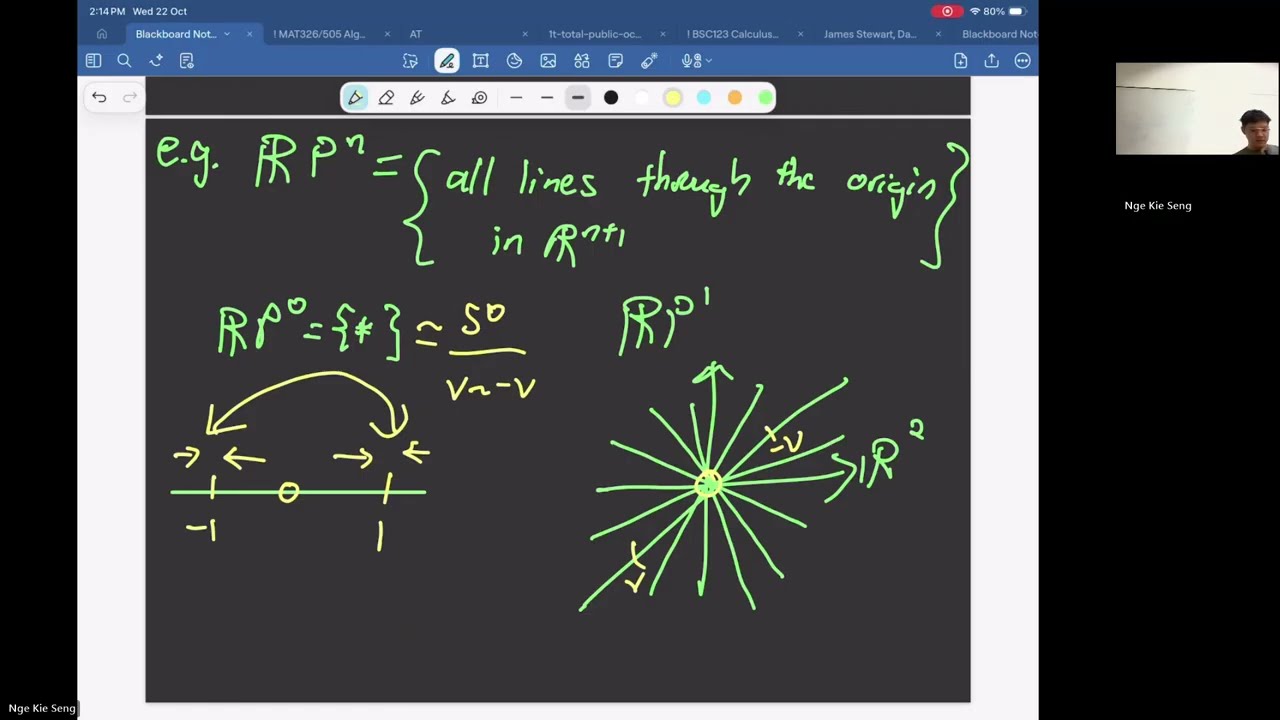
- Examples of RP^n and CP^n as cell complexes.
- Definition of subcomplexes and properties of CW complexes.
- Introduction to products and quotients of cell complexes.
- Construction of suspension and cone.
- Definition of join and examples.
- Further discussion on attaching and building spaces.
- Wrap-up and reminders about assignments.
Cited Sources
- Algebraic Topology (textbook) — Referenced as 'Hatcher' in the lecture, likely for the appendix on CW complexes.
Concurring Sources
- CW complex - Wikipedia — Provides definitions and properties of CW complexes, consistent with the lecture.
Contribution & Novelties
The lecture provides a clear and intuitive introduction to cell complexes, a fundamental concept in algebraic topology. It emphasizes the construction of spaces from cells and the importance of attaching maps. The instructor’s use of examples like RP^n and CP^n helps illustrate abstract concepts. The lecture also covers important constructions such as suspension, cone, and join, which are essential for building new spaces. The interactive format allows for immediate clarification of doubts, enhancing understanding.
Pour aller plus loin :
- CW complex - Wikipedia — Provides a comprehensive overview of CW complexes, including definitions and examples.
- Cell complex - nLab — A more advanced reference on cell complexes in category theory.
- Hatcher’s Algebraic Topology — The standard textbook for algebraic topology, with a detailed appendix on CW complexes.
127 words
Radar Profile
The radar profile shows high scores in technical level and information quality, indicating a mathematically rigorous lecture. The quantity of information is also high, but the fiabilite_globale is slightly lower due to the informal nature of the recording. Overall, the lecture is well-suited for advanced students.