Peano Axioms | Mathematical Analysis 1 Lecture 3 | Nge Kie Seng 260410
Keywords
Summary
143 words
Critical Evaluation
Value of the Information & Strength of the Argument
The lecture provides a solid introduction to the Peano axioms and their application in proving fundamental properties of natural numbers. The instructor carefully guides students through the proof of associativity, emphasizing the structure of a mathematical proof and the use of induction. The argumentation is clear and logical, with explicit attention to the distinction between assumptions and goals. The value lies in its pedagogical approach, breaking down complex ideas into manageable steps and encouraging active participation. However, the lecture is not a comprehensive treatment of the topic, and some steps are left as exercises, which may require additional resources for full understanding.
Scientific Rigor, Source Quality, Title Accuracy
The lecture is rigorous in its mathematical content, adhering to standard definitions and proofs. However, no external sources are cited, and the instructor relies on his own lecture notes and the textbook. The title accurately reflects the content, as the lecture is indeed about Peano axioms. The recording quality is poor, with audio issues and interruptions, which may affect clarity but not the mathematical rigor. The instructor mentions using Gemini for an example, but this is not a formal source. Overall, the scientific rigor is high, but the lack of citations and poor production quality slightly reduce the overall reliability.
217 words
Title / Content Match
The title accurately reflects the content: a lecture on Peano axioms in a Mathematical Analysis course.
Quality & Reliability
7/10
Lecture by a university instructor, likely based on standard mathematical curriculum. The content is rigorous and follows logical progression, but the recording quality is poor with frequent interruptions and unclear audio. No external sources are cited, and the video is not peer-reviewed.
Key Moments
Markers derived by PSI from the transcript: the creator did not define chapters.
- Introduction and administrative announcements about attendance and assignments.
- Discussion on the meaning of 'unless' in logic and daily language.
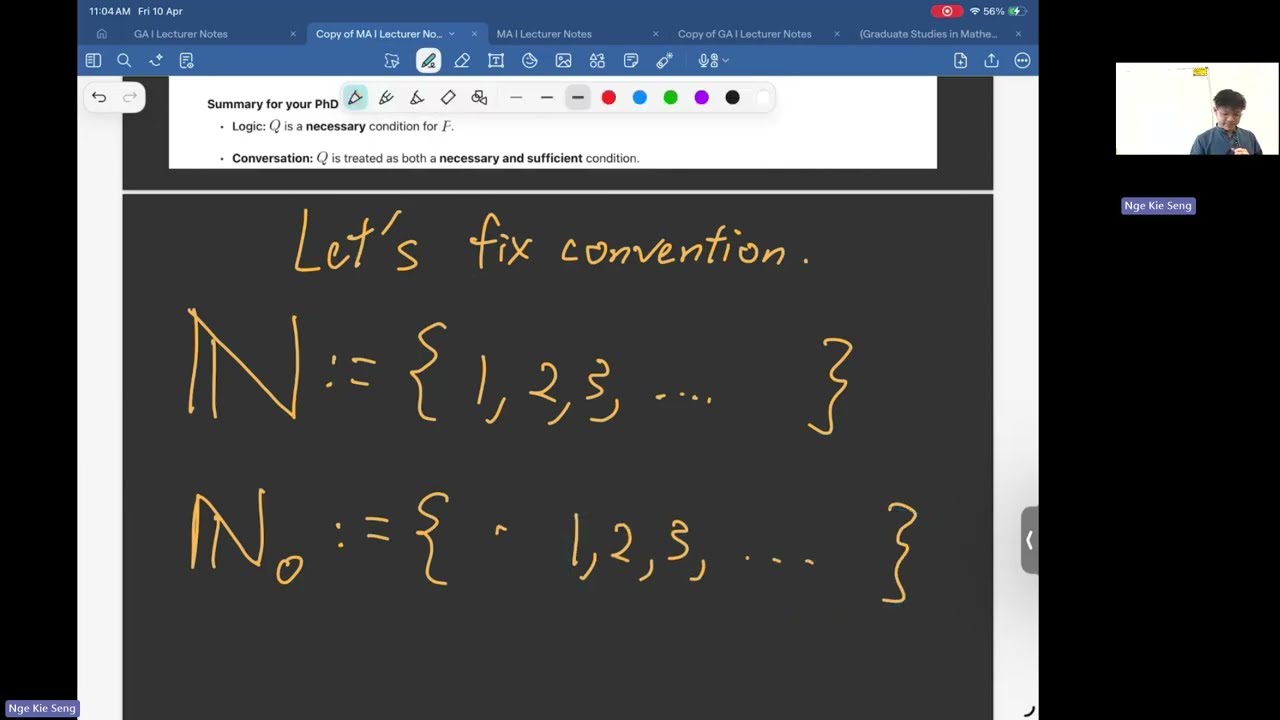
- Convention for natural numbers: starting from 1, with subscript zero for including zero.
- Review of Peano axioms: successor function, injectivity, and induction principle.
- Introduction of addition and multiplication axioms.
- Proof of general associativity of addition using mathematical induction.
- Discussion on the lemma of closure under addition and assignment of proof as exercise.
- Encouragement for students to attempt proofs and check solutions in notes.
Contribution & Novelties
The lecture provides a clear pedagogical exposition of the Peano axioms and their use in proving fundamental properties of natural numbers. It emphasizes the structure of mathematical proofs, particularly the use of mathematical induction. The instructor’s approach of guiding students through the proof of associativity is valuable for beginners. The lecture also highlights the importance of distinguishing between assumptions and goals in proofs.
Pour aller plus loin :
- Peano axioms - Wikipedia — Provides a comprehensive overview of the axioms and their history.
- Mathematical induction - Wikipedia — Explains the principle of induction and its applications.
- Associative property - Wikipedia — Discusses associativity in various algebraic structures.
107 words
Radar Profile
The radar profile shows high scores in quality of information and technical level, indicating a rigorous and detailed lecture. The quantity of information is moderate, and the overall reliability is good, though the lack of external sources and poor recording quality slightly lower the score.