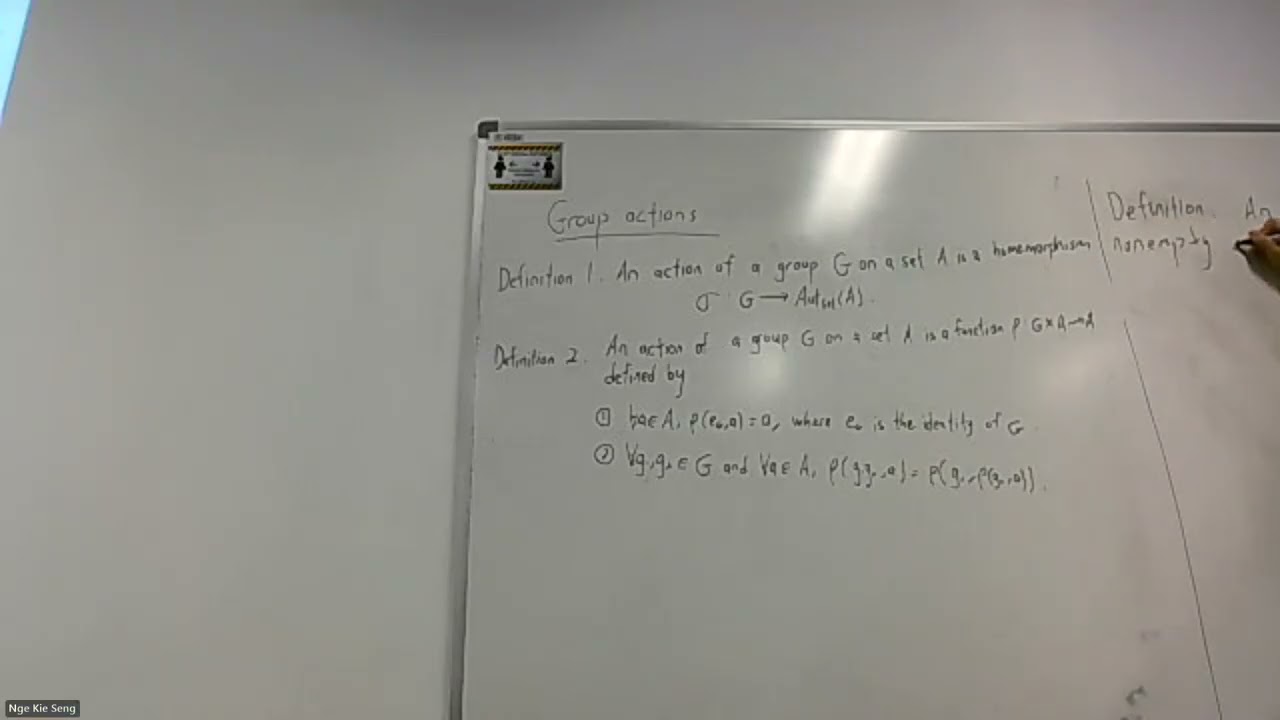
Group Action | Graduate Algebra I Lecture 6 | Teoh Yu Hang 260424
Keywords
Summary
196 words
Critical Evaluation
Value of the Information & Strength of the Argument
The lecture provides a thorough and rigorous treatment of group actions, building from definitions to important theorems. The proofs are detailed and well-structured, with the instructor often explaining the intuition behind the steps. The argumentation is solid, with clear logical progression. The value lies in the comprehensive coverage of fundamental concepts and the demonstration of their interconnections, such as the equivalence of definitions and the orbit-stabilizer theorem. The instructor also engages with student questions, clarifying potential confusions, which enhances the learning experience.
Scientific Rigor, Source Quality, Title Accuracy
The lecture is mathematically rigorous, with definitions and proofs presented clearly. The instructor references a textbook (likely ‘Algebra’ by Artin) for some results, but the proofs are often developed from scratch. The title accurately reflects the content, which is a graduate-level algebra lecture on group actions. The video quality is occasionally poor due to technical issues, but this does not affect the mathematical content. The instructor’s notation is sometimes inconsistent, but he acknowledges and corrects these mistakes, showing attention to rigor.
178 words
Title / Content Match
The title accurately reflects the content: a graduate algebra lecture on group actions.
Quality & Reliability
7/10
The lecture is mathematically rigorous, with proofs and definitions presented clearly. However, there are occasional notational inconsistencies and informal remarks, and the video quality is suboptimal (camera issues). The content is standard graduate algebra, and the instructor demonstrates a solid grasp of the material.
Key Moments
Markers derived by PSI from the transcript: the creator did not define chapters.
- Introduction and recap of previous lecture
- Proof of equivalence of two definitions of group action
- Example: left multiplication action
- Definition of faithful action and Cayley's theorem
- Definition of transitive action and examples
- Definition of orbit and stabilizer
- Introduction to the category of G-sets
- Proposition: transitive action isomorphic to action on cosets
- Orbit-stabilizer theorem and example
- Group objects in a category
Contribution & Novelties
The lecture provides a clear and detailed exposition of group actions, emphasizing the categorical perspective and the equivalence of definitions. It offers a rigorous proof of Cayley’s theorem and the orbit-stabilizer theorem, with a nice example illustrating the latter. The discussion of group objects in a category is a valuable extension, connecting group theory to category theory.
Pour aller plus loin :
- Group action (Wikipedia) — Provides a comprehensive overview of group actions, including definitions, examples, and properties.
- Orbit-stabilizer theorem (Wikipedia) — Explains the theorem and its proof, with applications.
- Cayley’s theorem (Wikipedia) — Details the theorem and its significance.
- Category theory (Wikipedia) — Introduces the foundational concepts used in the discussion of G-sets and group objects.
117 words
Radar Profile
The radar chart shows a strong profile with high scores in all dimensions, particularly in technical level and information quality, reflecting the advanced and rigorous nature of the lecture. The lower score in information quantity is due to the focused scope of the lecture, which covers a specific topic in depth rather than a broad overview.