Ideals and Quotient RIngs | Graduate Algebra I Lecture 10 | Lee Chuen Jac 260509
Keywords
Summary
178 words
Critical Evaluation
Value of the Information & Strength of the Argument
The lecture provides a solid introduction to core concepts in ring theory, with definitions, proofs, and examples. The argumentation is generally rigorous, but the presentation is sometimes unclear due to informal language and digressions. The instructor emphasizes important points, such as the distinction between ideals and subrings, and the well-definedness of quotient ring operations. The use of examples, such as Z/nZ and polynomial rings, helps illustrate abstract concepts. However, some proofs are only sketched or skipped, and the discussion occasionally lacks precision.
Scientific Rigor, Source Quality, Title Accuracy
The mathematical content is standard and accurate, but no external sources are cited. The lecture appears to follow a textbook, but the specific reference is not mentioned. The title accurately describes the content. The informal teaching style may reduce the perceived rigor, but the underlying mathematics is sound.
145 words
Title / Content Match
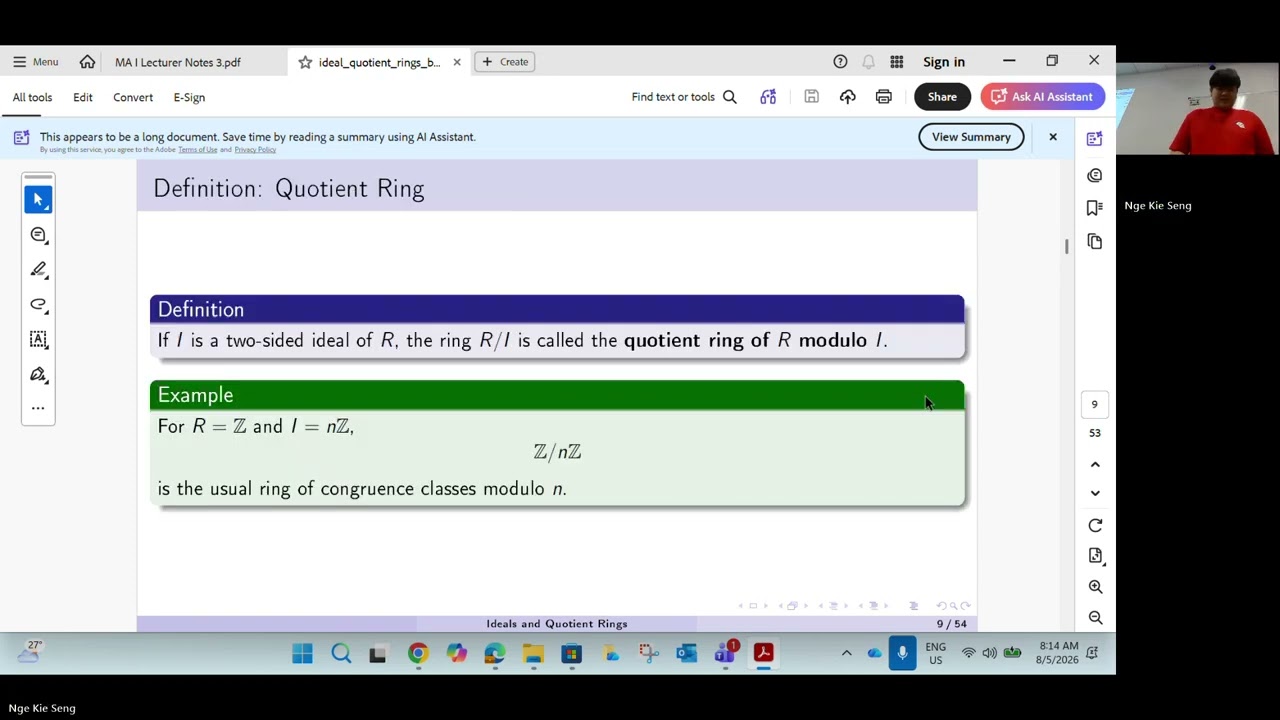
The title accurately reflects the content, which covers ideals and quotient rings, including prime and maximal ideals.
Quality & Reliability
7/10
The lecture is a formal graduate algebra course, covering standard topics in ring theory. The mathematical content is accurate and rigorous, but the presentation is informal and contains some digressions and unclear explanations. The lecturer is an instructor, but no credentials are provided in the video.
Key Moments
Markers derived by PSI from the transcript: the creator did not define chapters.
- Introduction and definition of left, right, and two-sided ideals
- Kernel of a ring homomorphism is a two-sided ideal
- Construction of quotient ring R/I and well-definedness
- Universal property of quotient rings and first isomorphism theorem
- Ideals of quotient rings and third isomorphism theorem
- Principal ideals and ideals generated by multiple elements
- Sums, intersections, and products of ideals
- Polynomial rings and quotient rings by monic polynomials
- Prime and maximal ideals, and their relationship
Contribution & Novelties
The lecture provides a clear and structured introduction to ideals and quotient rings, with a focus on the universal property and isomorphism theorems. It connects abstract concepts to concrete examples, such as Z/nZ and polynomial rings. The discussion of prime and maximal ideals, including the spectrum of a ring, offers a foundation for further study in algebraic geometry and commutative algebra.
Pour aller plus loin :
- Ring theory — Provides a broad overview of ring theory, including ideals and quotient rings.
- Ideal (ring theory) — Detailed definitions and properties of ideals.
- Quotient ring — Explains the construction and properties of quotient rings.
- Prime ideal — Definition and examples of prime ideals.
- Maximal ideal — Definition and properties of maximal ideals.
- Isomorphism theorems — General statement of the isomorphism theorems for rings.
131 words
Radar Profile
The radar profile shows high scores in quantity of information, technical level, and global reliability, indicating a dense and rigorous lecture. The quality of information is slightly lower, possibly due to the informal presentation style. The overall balance suggests a solid academic resource for graduate-level algebra.