The Classification of Finite Abelian Groups | Graduate Algebra I Presentation | Lee Pei Yi 260710
Keywords
Summary
174 words
Critical Evaluation
Value of the Information & Strength of the Argument
The video provides a valuable overview of the classification theorem for finite abelian groups, a fundamental result in algebra. The argumentation is structured around a clear proof strategy, using Sylow theory and direct sum decompositions. However, the presentation lacks full rigor: many proofs are only sketched, and the speaker often relies on intuitive explanations rather than detailed derivations. The value lies in the conceptual outline, which can help viewers understand the main ideas, but it is not a substitute for a textbook treatment. The argumentation is solid in its logical flow, but the informal delivery and frequent interruptions reduce its effectiveness.
Scientific Rigor, Source Quality, Title Accuracy
The scientific rigor is moderate: the content is mathematically correct, but the presentation is not fully rigorous, with many steps glossed over. No external sources are cited in the video or description, so the quality of sources cannot be assessed. The title accurately reflects the content, which is a presentation on the classification of finite abelian groups. The video appears to be a student project, so it is not peer-reviewed. The informal style and lack of citations lower the overall reliability.
197 words
Title / Content Match
The title accurately reflects the content, which is a presentation on the classification of finite abelian groups.
Quality & Reliability
6/10
The presentation is a student project, likely for a graduate algebra course. It covers the classification theorem of finite abelian groups, but the delivery is informal and contains numerous verbal slips and incomplete sentences, making it hard to follow. The mathematical content appears correct, but the presentation lacks rigor in exposition and does not provide full proofs, only outlines. The video is not peer-reviewed and is a student presentation, so reliability is moderate.
Key Moments
Markers derived by PSI from the transcript: the creator did not define chapters.
- Introduction and outline of the presentation.
- Discussion of the history of the classification theorem.
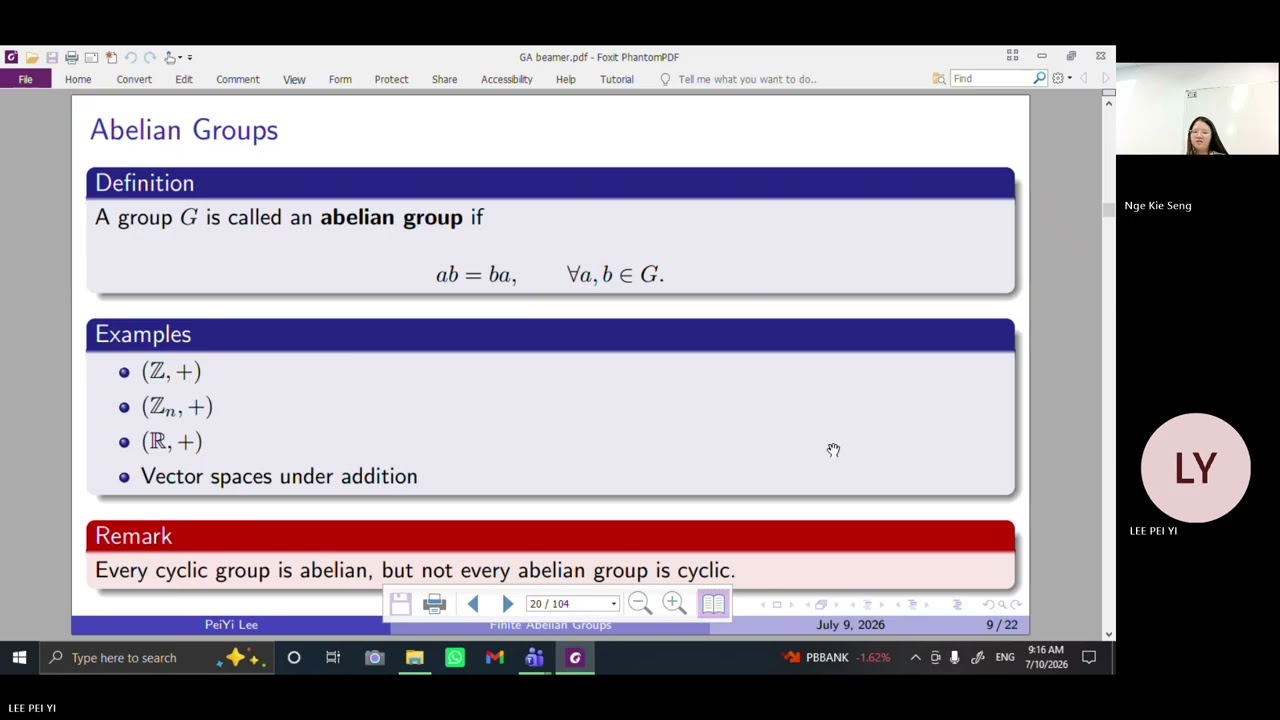
- Introduction of preliminary concepts: groups, abelian groups, order, subgroups, direct sum.
- Presentation of preliminary theorems: Cauchy's theorem and Sylow theorems.
- Lemma 5.1: direct sum of relatively prime subgroups.
- Corollary: every finite abelian group is a direct sum of its Sylow subgroups.
- Lemma 5.2: non-cyclic finite abelian p-group has a subgroup of order p.
- Lemma 5.3: exact sequence and decomposition of finite abelian p-groups.
- Corollary: every finite abelian p-group is a direct sum of cyclic groups.
- Statement and proof summary of the classification theorem.
- Presentation of the elementary divisor form and invariant factor form.
- Application: every finite subgroup of the multiplicative group of a field is cyclic.
- Conclusion and summary.
Contribution & Novelties
The video offers a concise overview of the classification theorem for finite abelian groups, which is a standard result in algebra. Its novelty is limited as it is a student presentation, but it provides a clear outline of the proof strategy using Sylow theorems and direct sum decompositions. For viewers unfamiliar with the topic, it can serve as an introductory guide.
Pour aller plus loin :
- Fundamental theorem of finite abelian groups — This Wikipedia article provides a comprehensive overview of the classification theorem, including both forms and examples.
- Sylow theorems — These theorems are central to the proof strategy presented in the video.
- Direct sum of groups — This concept is used throughout the presentation to decompose groups into simpler components.
122 words
Radar Profile
The radar profile shows moderate scores across all dimensions, with a slightly higher level of technicality. This indicates that the video is technically dense but lacks in quantity of information and reliability, likely due to its informal presentation and lack of citations.