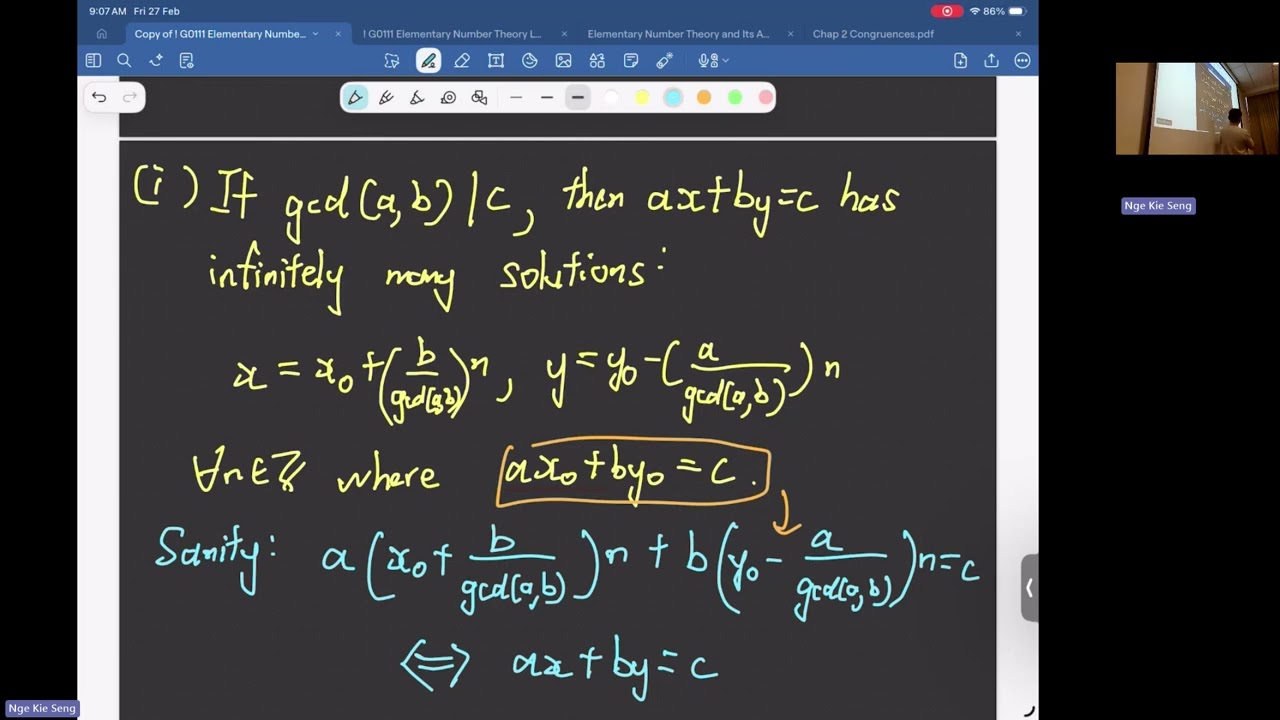
Linear Congruence | Elementary Number Theory Lecture 3 | Nge Kie Seng 250228
Keywords
Summary
118 words
Critical Evaluation
Value of the Information & Strength of the Argument
The lecture provides a solid introduction to linear congruences, building on previous knowledge of divisibility and Diophantine equations. The instructor emphasizes understanding over rote learning, explaining the rationale behind definitions and theorems. The argumentation is clear and logical, with proofs given for key properties. The use of examples and student interaction reinforces the concepts. The lecture is valuable for students seeking a rigorous foundation in number theory, though it assumes some prior knowledge.
Scientific Rigor, Source Quality, Title Accuracy
The lecture is mathematically rigorous, with definitions and theorems stated precisely and proofs provided. The instructor uses standard notation and explains concepts thoroughly. The title accurately reflects the content, as the lecture focuses on linear congruences. No external sources are cited, but the content is based on established mathematical principles. The lecture is a primary educational resource, not a research presentation, so the lack of citations is appropriate.
156 words
Title / Content Match
The title accurately reflects the content, as the lecture covers linear congruences and related topics in elementary number theory.
Quality & Reliability
8/10
The lecture is a formal university course on elementary number theory, presenting definitions, theorems, and proofs with mathematical rigor. The instructor explains concepts clearly and provides examples, but the video is a raw recording with some audio issues and digressions. The content is accurate and well-structured, though not peer-reviewed.
Key Moments
Markers derived by PSI from the transcript: the creator did not define chapters.
- Introduction and review of Diophantine equations
- Discussion of GCD and conditions for integer solutions
- Introduction to congruence modulo m
- Definition of congruence classes and complete residue systems
- Properties of congruences: addition, subtraction, multiplication
- Examples and student interaction on residue systems
- Break and informal discussion
- Further examples and proofs of congruence properties
- Introduction to linear congruences and solving them
- Conclusion and assignment hints
Contribution & Novelties
The lecture provides a clear and pedagogical introduction to linear congruences, emphasizing the underlying concepts and proofs. It is particularly useful for students new to number theory, as it connects congruence to divisibility and builds intuition through examples. The instructor’s teaching style encourages active learning.
Pour aller plus loin :
- Modular arithmetic - Wikipedia — Provides a comprehensive overview of modular arithmetic, including congruence and residue systems.
- Linear congruence theorem - Wikipedia — Directly relevant to the lecture’s topic, explaining conditions for solvability.
- Number theory - Khan Academy — Offers interactive lessons on modular arithmetic for further practice.
98 words
Radar Profile
The radar profile shows high scores in quantity and quality of information, indicating a content-rich lecture. The technical level is moderate, suitable for an introductory university course. The overall reliability is high, reflecting the mathematical rigor and clear explanations.