Periodic Continued Fractions, Pythagorean Triple | Elementary Number TheoryLec12|Nge Kie Seng 250324
Keywords
Summary
155 words
Critical Evaluation
Value of the Information & Strength of the Argument
The lecture provides a solid introduction to periodic continued fractions and quadratic irrationals, with clear derivations and worked examples. The instructor explains the reasoning behind each step, such as why the conjugate is used to rationalize denominators. The argumentation is mathematically sound, though the informal style and occasional errors (e.g., a calculation mistake) may require careful attention. The value lies in the pedagogical approach, making advanced topics accessible to students.
Scientific Rigor, Source Quality, Title Accuracy
The lecture does not cite external sources; it relies on standard mathematical knowledge. The instructor mentions using AI tools for checking solutions, but this is not a formal source. The title accurately describes the content, which is appropriate for a course lecture. The mathematical rigor is high, but the lack of formal references and the informal presentation may reduce the perceived reliability for a general audience.
151 words
Title / Content Match
The title accurately reflects the content: the lecture covers periodic continued fractions and Pythagorean triples, as part of an elementary number theory course.
Quality & Reliability
7/10
Lecture by a university instructor, likely for a course in elementary number theory. The content is mathematically rigorous, with proofs and derivations, but the video is a raw classroom recording with informal asides and no structured presentation. The instructor demonstrates methods and works through examples, but there is no formal citation of sources. The mathematical content appears correct, but the presentation is informal and may contain minor errors (e.g., a calculation mistake corrected during the lecture).
Key Moments
Markers derived by PSI from the transcript: the creator did not define chapters.
- Introduction and administrative announcements.
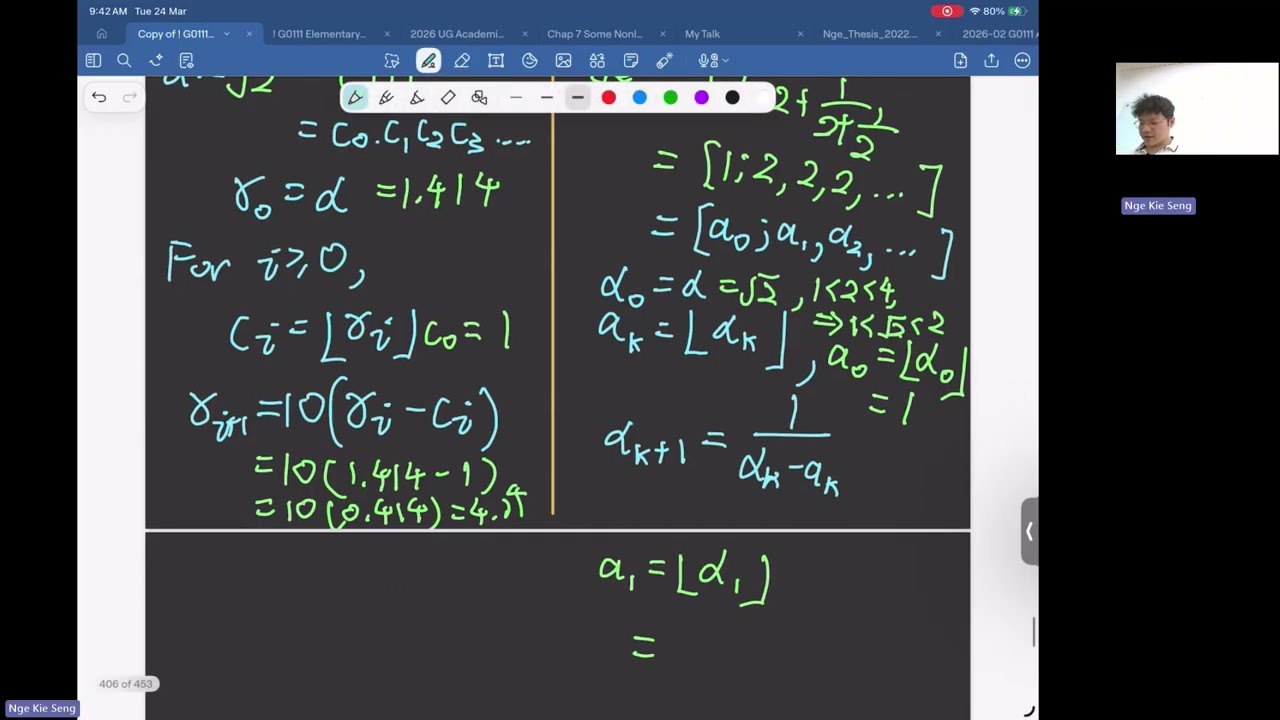
- Recap of decimal expansion and continued fractions, with examples.
- Introduction to periodic continued fractions and evaluation via quadratic equations.
- Definition of quadratic irrationals and theorem characterization.
- Worked examples: reciprocal and sum of quadratic irrationals.
- Evaluation of a periodic continued fraction with a correction.
- Discussion on using AI tools for checking solutions.
- Transition to Pythagorean triples (transcription cuts off).
Contribution & Novelties
The lecture provides a clear pedagogical exposition of periodic continued fractions and quadratic irrationals, with step-by-step derivations. It also offers practical advice on using AI tools for verification. The content is standard in number theory, but the presentation is tailored for students.
Pour aller plus loin :
- Continued fraction — General reference on continued fractions.
- Quadratic irrational — Definition and properties.
- Pythagorean triple — Overview of Pythagorean triples.
68 words
Radar Profile
The radar profile shows high scores in technical level and information quality, indicating a mathematically rigorous lecture. The moderate scores in quantity and reliability reflect the informal presentation and lack of external sources.