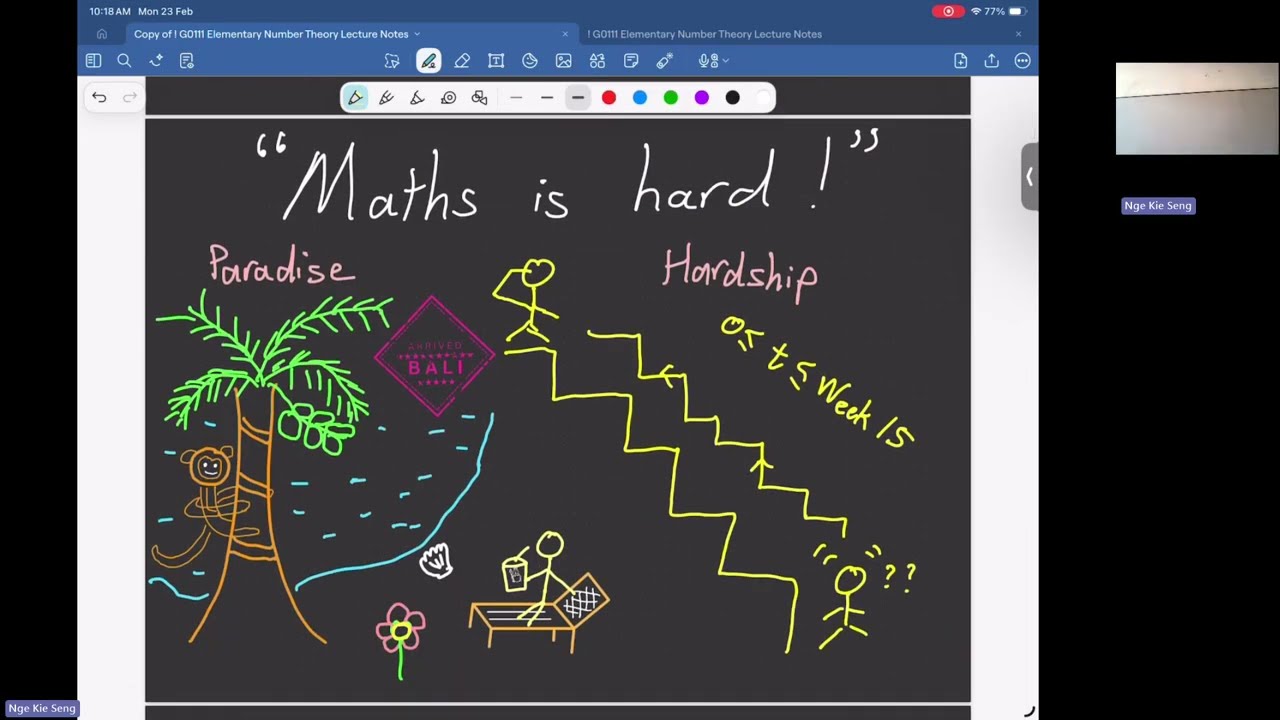
Primes, Divisibility, GCD | Elementary Number Theory Lecture 1 | Nge Kie Seng 250223
Keywords
Summary
137 words
Critical Evaluation
Value of the Information & Strength of the Argument
The lecture provides a solid foundation in elementary number theory, clearly defining key concepts such as divisibility, primes, and GCD. The lecturer’s argumentation is logical and builds from basic definitions, using examples to illustrate each concept. He emphasizes the importance of understanding the ‘why’ behind mathematical results, not just the ‘how’. The value lies in its pedagogical clarity and the emphasis on calculation, which is appropriate for a general education course. The lecturer also connects the material to real-world applications like cryptography, enhancing its relevance.
Scientific Rigor, Source Quality, Title Accuracy
The lecture is scientifically rigorous, with precise definitions and correct mathematical statements. The lecturer refers to a standard textbook (Rosen) and other suggested readings, providing a reliable basis for the course. The title accurately reflects the content, as the lecture indeed covers primes, divisibility, and GCD. The presentation is well-structured, and the lecturer’s explanations are clear and accurate. The video is a live recording, so there are some informal moments and technical difficulties, but these do not detract from the scientific quality.
182 words
Title / Content Match
The title accurately reflects the content: the lecture introduces primes, divisibility, and GCD, and is the first lecture in an elementary number theory course.
Quality & Reliability
8/10
The lecture is a formal university course on elementary number theory, delivered by a lecturer with a clear pedagogical structure. The content is mathematically sound, definitions are precise, and the presentation is rigorous. The lecturer emphasizes understanding over rote learning, and the course is based on a standard textbook (Rosen). The video is a recording of a live class, so there are some technical issues and informal asides, but these do not affect the mathematical accuracy.
Key Moments
Markers derived by PSI from the transcript: the creator did not define chapters.
- Introduction and administrative details
- Discussion on course structure and assessment
- Introduction to sets and number systems
- Definition of natural numbers, integers, rationals, and reals
- Importance of number theory and applications
- Introduction to divisibility and prime numbers
- Definition and examples of GCD
- Further examples and exercises on GCD
- Discussion on Euclidean algorithm
- Wrap-up and preview of next lecture
Cited Sources
- Elementary Number Theory (Rosen) — Main textbook for the course
- Number Theory (Vtonstein) — Suggested reading
- Number Theory (Jones) — Suggested reading
Concurring Sources
- Elementary Number Theory (Rosen) — Standard textbook covering the same topics in a similar manner.
Contribution & Novelties
This lecture provides a clear and accessible introduction to elementary number theory, focusing on calculation and intuitive understanding. It is particularly valuable for students from non-mathematical backgrounds, as it builds concepts from basic definitions and emphasizes practical applications. The lecturer’s approach of combining definitions with examples and encouraging questions makes the material approachable.
Pour aller plus loin :
- Prime number — Wikipedia article on prime numbers, covering definitions, properties, and applications.
- Divisibility — Wikipedia article on divisibility, including rules and properties.
- Greatest common divisor — Wikipedia article on GCD, including the Euclidean algorithm.
- Euclidean algorithm — Wikipedia article on the Euclidean algorithm for computing GCD.
- Fundamental theorem of arithmetic — Wikipedia article on the unique prime factorization of integers.
119 words
Radar Profile
The radar profile shows high scores in quality of information and reliability, reflecting the lecture's solid mathematical content and clear presentation. The quantity of information is also high, as the lecture covers multiple topics in depth. The technical level is moderate, appropriate for a general education course, but still rigorous. Overall, the lecture is well-balanced and effective for its intended audience.