Taylor Polynomial | Mathematical Analysis 1 Lecture 28 | Nge Kie Seng 260708
Keywords
Summary
160 words
Critical Evaluation
Value of the Information & Strength of the Argument
The lecture provides a solid theoretical foundation for understanding power series and Taylor polynomials. The instructor carefully proves the key lemma and uses it to derive the radius of convergence, emphasizing the importance of checking endpoints. The argumentation is rigorous and logical, with clear explanations of why certain series converge or diverge. The use of examples, such as the alternating harmonic series and the geometric series, helps illustrate the concepts. However, the delivery is somewhat informal and includes digressions, which may reduce the clarity for some viewers. The value lies in the depth of the mathematical reasoning and the step-by-step approach to proving theorems.
Scientific Rigor, Source Quality, Title Accuracy
The lecture is mathematically rigorous, with proofs and logical deductions. The instructor does not cite external sources, but the content is standard in mathematical analysis and appears to be based on a well-established curriculum. The title accurately describes the content, though the focus is more on power series and radius of convergence than on Taylor polynomials specifically. The lecture is self-contained, and the mathematical arguments are internally consistent. No external sources are mentioned, so the quality of sources cannot be assessed, but the internal rigor is high.
206 words
Title / Content Match
The title accurately reflects the content: a lecture on Taylor polynomials, though the specific lecture number and date are included.
Quality & Reliability
8/10
Lecture by a university instructor, likely based on standard mathematical analysis curriculum. The content is rigorous and follows a logical progression, but the recording quality and informal delivery may affect clarity. No external sources cited, but the mathematical arguments are internally consistent.
Key Moments
Markers derived by PSI from the transcript: the creator did not define chapters.
- Introduction and recall of the lemma on power series convergence.
- Application of the lemma to the alternating harmonic series.
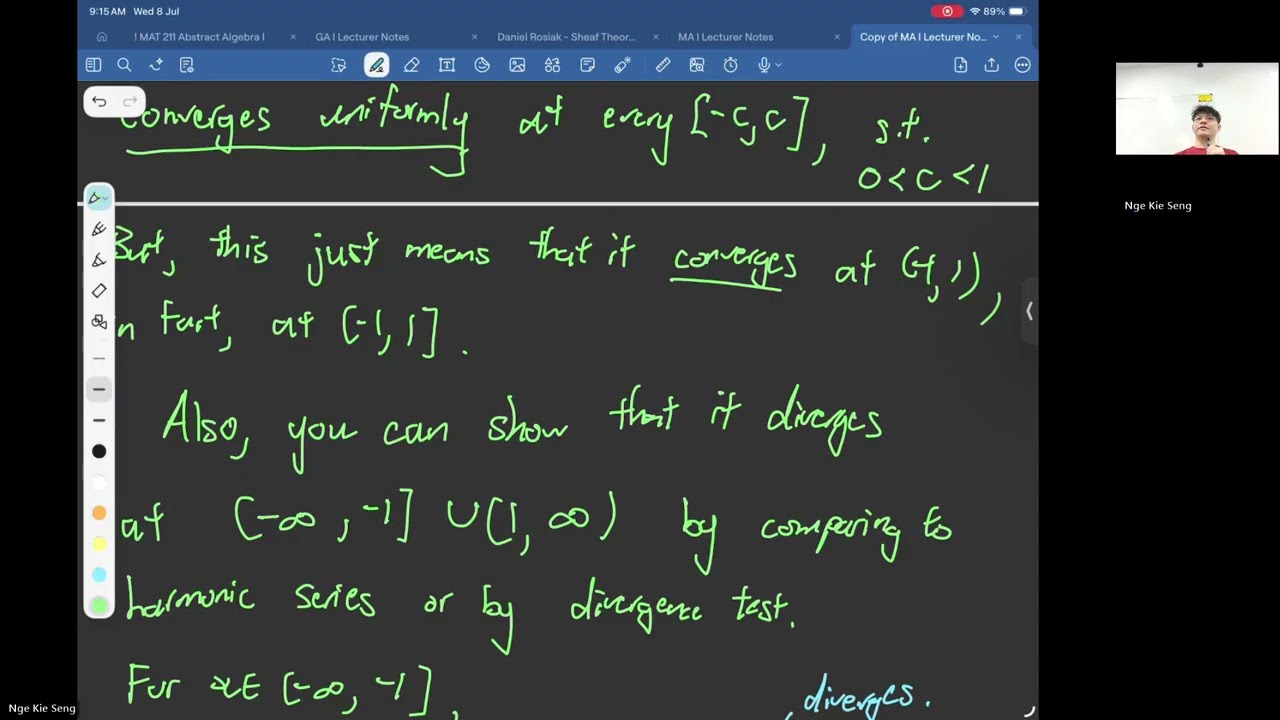
- Proof of divergence for x outside the interval of convergence.
- Definition of radius of convergence and theorem on the set of convergence.
- Examples: geometric series and exponential series.
- Remark on uniform convergence on closed subintervals vs. entire interval.
- Administrative announcements and break.
Contribution & Novelties
The lecture provides a clear and rigorous exposition of the theory of power series, particularly the lemma that a power series converging at a point converges uniformly on any closed subinterval within the radius of convergence. This lemma is used to prove the theorem on the possible sets of convergence. The lecture also highlights the subtlety that uniform convergence on closed subintervals does not imply uniform convergence on the entire interval of convergence, a point often overlooked. This is a valuable contribution for students learning mathematical analysis.
Pour aller plus loin :
- Taylor’s theorem — Provides the theoretical basis for Taylor polynomials and their error bounds.
- Power series — General overview of power series, including convergence properties.
- Uniform convergence — Definition and properties of uniform convergence, relevant to the lecture’s discussion.
131 words
Radar Profile
The radar profile shows high scores in quantity and quality of information, technical level, and global reliability, indicating a dense and rigorous lecture. The uniform shape suggests a well-balanced presentation of theoretical content.