Examples of Functions | Calculus I A Lecture 2 | Nge Kie Seng 20251003
Keywords
Summary
142 words
Critical Evaluation
Value of the Information & Strength of the Argument
The lecture provides solid foundational knowledge on functions, with clear step-by-step examples that illustrate key concepts. The instructor’s explanations are logical and build upon prior knowledge, making the material accessible. He emphasizes understanding over memorization, for instance, by explaining why the square root of a negative number is not real. The argumentation is sound, as he consistently justifies each step, such as using factorization to find the domain of a rational function. The use of the vertical line test and graphical representations strengthens the intuitive understanding. The lecture also connects concepts to real-world applications through mathematical modeling, which adds value. However, the lecture is introductory and does not delve into advanced or nuanced aspects of functions.
Scientific Rigor, Source Quality, Title Accuracy
The lecture is mathematically rigorous, with correct definitions and procedures. The instructor is careful about notation and explains potential pitfalls, such as the importance of open circles in piecewise graphs. No external sources are cited, which is typical for a lecture; the content is based on standard calculus curriculum. The title accurately describes the content, as it is indeed a lecture on examples of functions. The lecture is well-structured, moving from basic definitions to more complex topics. The instructor’s teaching style is interactive, but the lack of citations means that for further verification, students would need to consult standard textbooks.
231 words
Title / Content Match
The title accurately reflects the content: a lecture on examples of functions in a Calculus I course.
Quality & Reliability
8/10
Lecture by a university instructor covering standard calculus topics with clear explanations and examples. The content is mathematically sound, though it is a lecture rather than peer-reviewed research. The instructor provides context and encourages questions, but no external sources are cited.
Key Moments
Markers derived by PSI from the transcript: the creator did not define chapters.
- Introduction and overview of lecture goals.
- Review of function definition: domain, codomain, range.
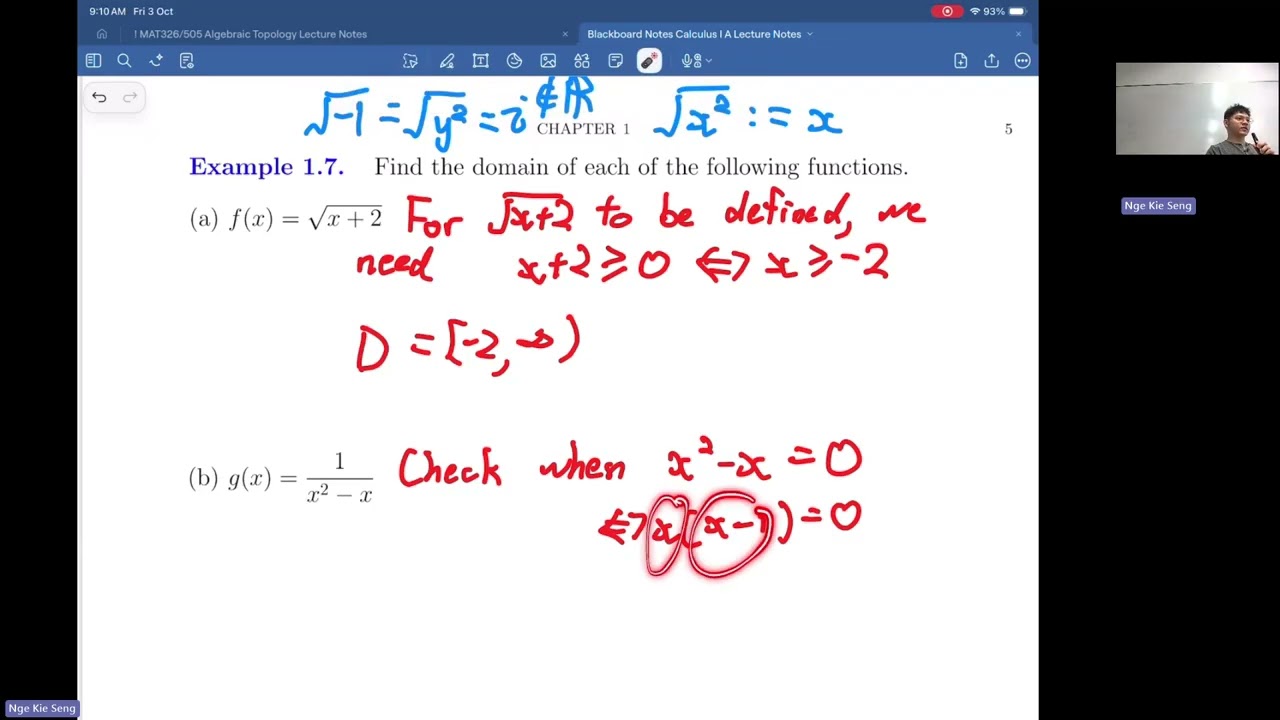
- Example: finding domain of f(x)=sqrt(x+2).
- Example: finding domain of g(x)=1/(x^2-x).
- Vertical line test explained.
- Piecewise function example and graphing.
- Absolute value function definition and graph.
- Properties of absolute value, including triangle inequality.
- Even and odd functions: definitions and examples.
- Increasing and decreasing functions, monotonicity.
- Introduction to mathematical modeling with linear functions.
Contribution & Novelties
This lecture provides a clear and thorough introduction to functions, with a focus on examples and graphical intuition. It is particularly useful for students new to calculus. The instructor’s approach of explaining the ‘why’ behind each rule enhances understanding. The lecture does not present new research but serves as an educational resource.
Pour aller plus loin :
- Function (mathematics) — Provides a comprehensive overview of functions, including formal definitions and types.
- Absolute value — Detailed explanation of the absolute value function and its properties.
- Even and odd functions — Further reading on symmetry in functions.
- Monotonic function — Explores increasing and decreasing functions in more depth.
106 words
Radar Profile
The radar profile shows high scores in quantity, quality, and reliability, with a slightly lower technical level. This indicates a lecture that is informative and accurate, but not highly advanced, suitable for an introductory calculus course.