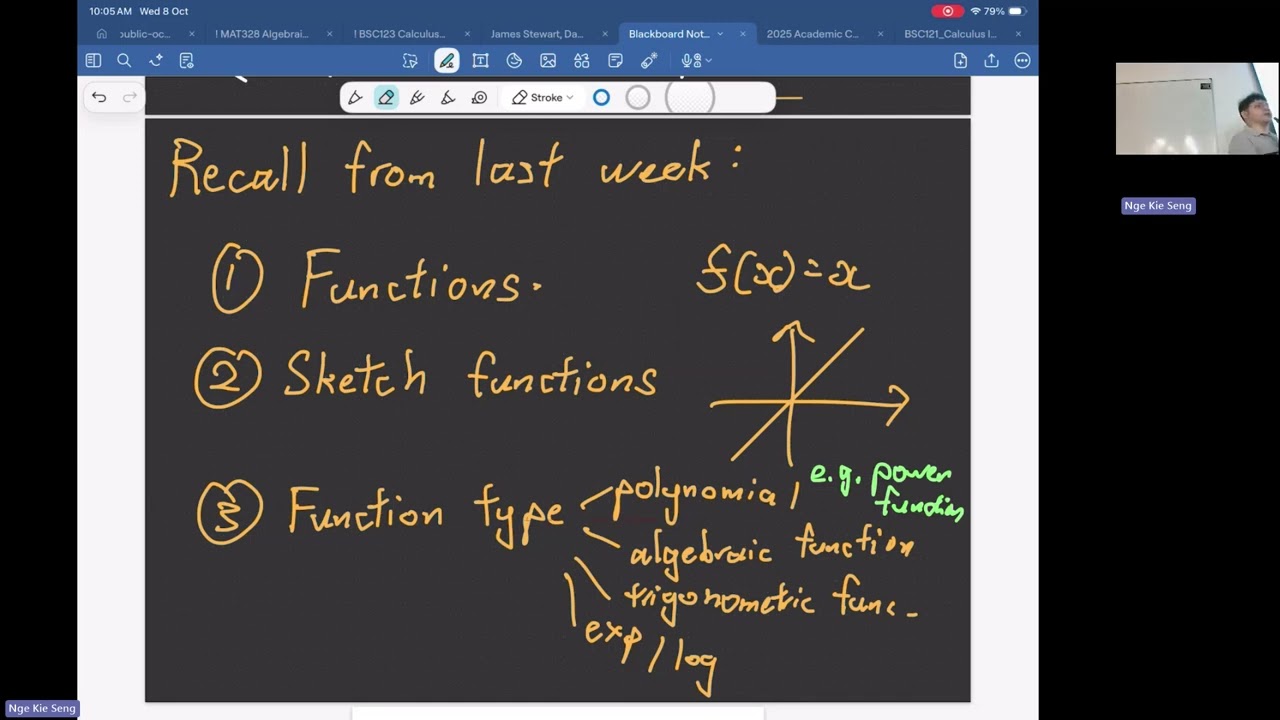
Limits of Real-Valued Functions of One Variable | Calculus I A Lecture 3 | Nge Kie Seng 20251008
Keywords
Summary
189 words
Critical Evaluation
Value of the Information & Strength of the Argument
The lecture provides a solid foundation for understanding limits, a fundamental concept in calculus. The instructor uses multiple representations—algebraic, graphical, and numerical—to build intuition. He emphasizes the key idea that limits are about behavior near a point, not at the point, which is crucial for later topics. The argumentation is clear and logical, with examples that illustrate both existence and non-existence of limits. The use of tables and graphs helps students visualize the concepts. The instructor also addresses common misconceptions, such as the difference between the limit and the function value at a point. The presentation is engaging and interactive, with questions posed to the class. However, the lecture relies on intuitive explanations rather than formal epsilon-delta proofs, which is appropriate for an introductory course but may not satisfy advanced students seeking rigorous justification.
Scientific Rigor, Source Quality, Title Accuracy
The lecture is mathematically rigorous in its presentation of standard calculus concepts. The instructor correctly defines one-sided limits and the theorem relating them to the two-sided limit. He uses appropriate notation and provides clear examples. The sources cited are not explicitly mentioned, but the content aligns with standard calculus textbooks. The title accurately reflects the content, and the lecture is well-structured. The instructor’s use of GeoGebra as a tool is appropriate and enhances understanding. No external sources are cited, but the lecture is self-contained and relies on established mathematical principles. The adequacy between title and content is excellent.
247 words
Title / Content Match
The title accurately reflects the content: a lecture on limits of real-valued functions of one variable, part of a Calculus I course.
Quality & Reliability
8/10
The lecture is a formal university calculus course, delivered by an instructor with clear pedagogical structure. The mathematical content is standard and accurate, with appropriate use of examples and graphical illustrations. The presentation is rigorous, though it relies on intuitive explanations rather than formal epsilon-delta proofs, which is typical for an introductory course.
Key Moments
Markers derived by PSI from the transcript: the creator did not define chapters.
- Introduction and announcements about math center and office hours.
- Review of function types and inverse functions.
- Motivation for limits using tangent and inverse tangent functions.
- Introduction to the concept of limit with a table of values for f(x)=x^2-x+2 as x approaches 2.
- Definition of limit and discussion of the idea that it does not depend on the function value at the point.
- Examples of limits: f(x)=4x-5, f(x)=(x^2-x-6)/(x-3), and f(x)=x^3-3x^2+9.
- Introduction to one-sided limits and the theorem relating them to the two-sided limit.
- Example of a piecewise function and the Heaviside step function.
- Discussion of a function that oscillates infinitely near zero, showing that its limit does not exist.
- Conclusion and preview of future topics.
Contribution & Novelties
This lecture provides a clear and accessible introduction to limits, a foundational concept in calculus. The instructor’s use of multiple representations (algebraic, graphical, and numerical) helps students develop intuition. The emphasis on the distinction between the limit and the function value at a point is crucial for understanding continuity and differentiability. The lecture also introduces the Heaviside step function, which is important in engineering and physics. The use of GeoGebra as a teaching tool is a modern approach that aids visualization.
Pour aller plus loin :
- Limit (mathematics) — Provides a comprehensive overview of limits in various contexts.
- One-sided limit — Explains the concept of left and right limits.
- Heaviside step function — Details the step function and its applications.
120 words
Radar Profile
The radar profile shows high scores in quantity and quality of information, indicating a content-rich and accurate lecture. The technical level is moderate, suitable for an introductory calculus course. The overall reliability is high, reflecting the standard nature of the material.