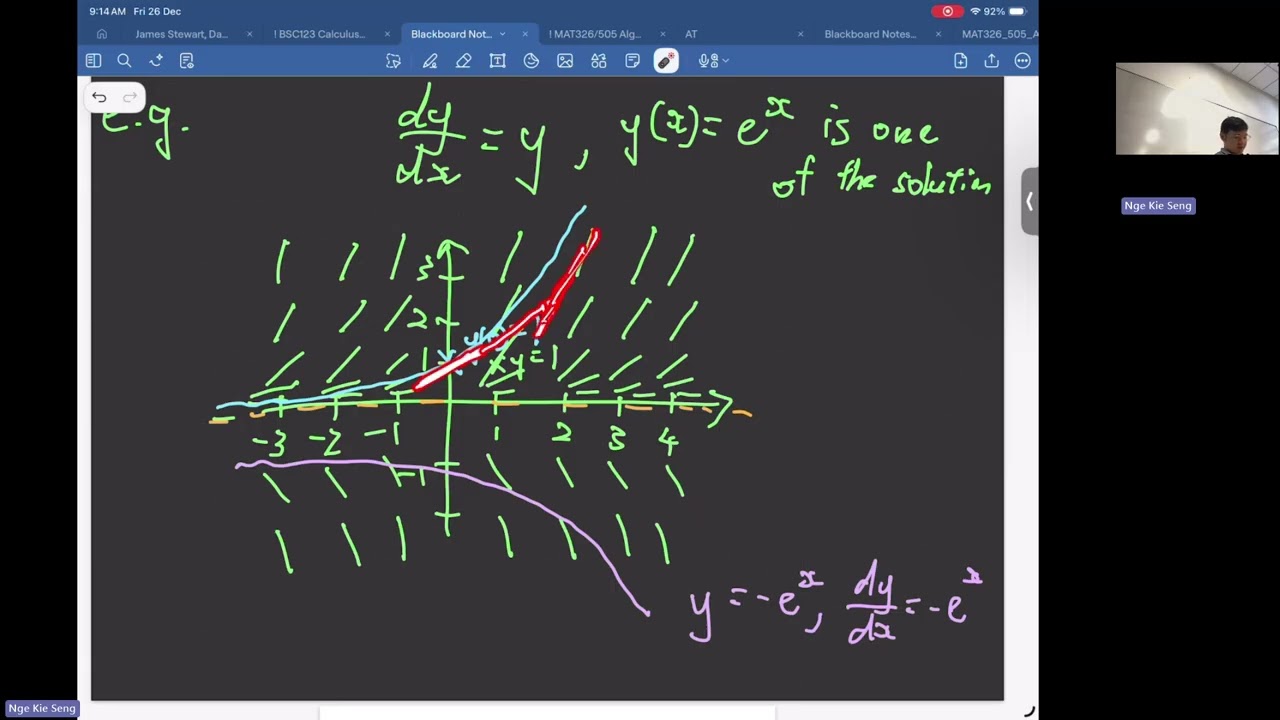
Separable Equations | Calculus I A Lecture 25 | Nge Kie Seng 20251227
Keywords
Summary
113 words
Critical Evaluation
Value of the Information & Strength of the Argument
The lecture provides a solid introduction to separable differential equations, with clear step-by-step derivations and multiple worked examples. The instructor explains the rationale behind the method, including why treating dy/dx as a fraction works in this context. He also addresses potential pitfalls, such as the handling of absolute values and the need for initial conditions. The argumentation is logical and builds on previously learned concepts like implicit differentiation and integration. The interactive format allows for immediate clarification of student questions, enhancing understanding.
Scientific Rigor, Source Quality, Title Accuracy
The lecture is mathematically rigorous, with careful attention to conditions and edge cases. The instructor uses standard notation and follows conventional methods. No external sources are cited, but the content is based on established mathematical principles. The title accurately describes the content, and the lecture is well-structured. The instructor’s willingness to revisit and correct steps demonstrates a commitment to accuracy. The discussion of the mixing problem shows critical thinking about the validity of solutions.
171 words
Title / Content Match
The title accurately reflects the content: a lecture on separable differential equations in a Calculus I course.
Quality & Reliability
8/10
The lecture is a formal mathematics course, presenting standard techniques with derivations and examples. The instructor demonstrates rigor by checking steps, addressing absolute values, and discussing conditions. However, it is a single lecture without external sources or peer review, and some parts are interactive with student input.
Key Moments
Markers derived by PSI from the transcript: the creator did not define chapters.
- Introduction and administrative reminders about quiz and midterm.
- Review of direction fields and Euler's method.
- Introduction to separable equations and first example.
- Second example: solving a separable equation with initial condition.
- Third example: solving a differential equation with substitution.
- Discussion of absolute values and exponential form.
- Introduction to orthogonal trajectories and example.
- Break and administrative announcements.
- Mixing problem: setting up the differential equation.
- Solving the mixing problem and discussing the solution.
- Discussion of the validity of the solution and potential issues.
Contribution & Novelties
The lecture provides a clear pedagogical approach to separable differential equations, emphasizing the separation of variables and integration techniques. It also introduces orthogonal trajectories, which is a useful application. The discussion of the mixing problem highlights the importance of checking solutions and understanding the physical context.
Pour aller plus loin :
- Separation of variables — Provides a general overview of the technique.
- Differential equation — Background on differential equations.
- Orthogonal trajectory — Further reading on orthogonal trajectories.
77 words
Radar Profile
The radar profile shows high scores in quantity and quality of information, with a moderate technical level. The lecture is well-structured and provides thorough explanations, but the technical depth is appropriate for an introductory calculus course. The reliability is high due to the formal nature of the content.