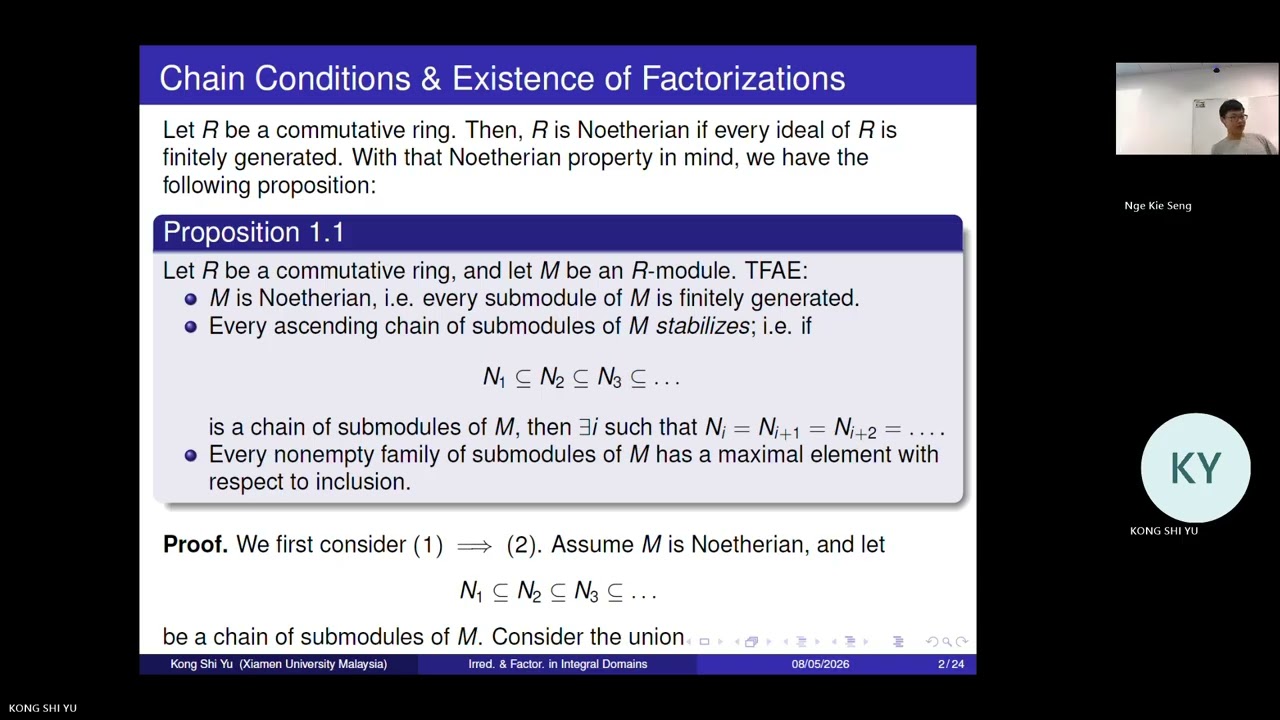
Irreducibles, Prime, PID, Euclidean domain, UFD | Graduate Algebra I Lec 10.5 | Kong Shi Yu 260509
Keywords
Summary
200 words
Critical Evaluation
Value of the Information & Strength of the Argument
The lecture provides a solid introduction to key concepts in commutative algebra, with definitions and proofs that are mostly correct. The argumentation is logical, following a clear progression from Noetherian conditions to factorization properties. However, the presentation is informal, with some digressions and incomplete justifications (e.g., relying on previous results without full proof). The value lies in its comprehensive coverage of the hierarchy of integral domains, which is essential for understanding algebraic number theory and algebraic geometry.
Scientific Rigor, Source Quality, Title Accuracy
The lecture is mathematically rigorous in its definitions and proofs, though the informal style may obscure some details. No external sources are cited; the content is based on standard algebra textbooks. The title accurately describes the content, which covers the specified topics. The lecture is part of a series, so it assumes prior knowledge from previous lectures.
149 words
Title / Content Match
The title accurately reflects the content, which covers irreducibles, primes, PIDs, Euclidean domains, and UFDs.
Quality & Reliability
7/10
Lecture covers standard algebra topics with definitions, propositions, and proofs. The reasoning is generally sound, but the presentation is informal with some digressions and incomplete justifications (e.g., reliance on prior corollaries).
Key Moments
Markers derived by PSI from the transcript: the creator did not define chapters.
- Introduction and overview of the lecture topics.
- Definition of Noetherian rings and modules.
- Proof of equivalent conditions for Noetherian modules.
- Hilbert basis theorem: polynomial ring over Noetherian ring is Noetherian.
- Definition of associates, prime, and irreducible elements.
- Introduction to unique factorization domains (UFDs).
- Theorem: UFD iff ACC on principal ideals and irreducibles are prime.
- Proof that every PID is a UFD.
- Definition of Euclidean domains and proof that they are PIDs.
- Euclidean algorithm for computing GCDs.
Contribution & Novelties
The lecture provides a clear and systematic exposition of the hierarchy of integral domains, which is a fundamental topic in algebra. It offers a concise proof of the Hilbert basis theorem and the equivalence between UFDs and the ACC on principal ideals. The use of multisets to describe factorization is a nice touch.
Pour aller plus loin :
- Unique factorization domain — Overview of UFDs and examples.
- Principal ideal domain — Definition and properties.
- Euclidean domain — Definition and examples.
- Noetherian ring — Definition and properties.
86 words
Radar Profile
The radar profile shows high scores in quantity of information, technical level, and reliability, with a slightly lower score in quality of information due to the informal presentation. This indicates a content-rich lecture that is technically sound but could benefit from more polished delivery.