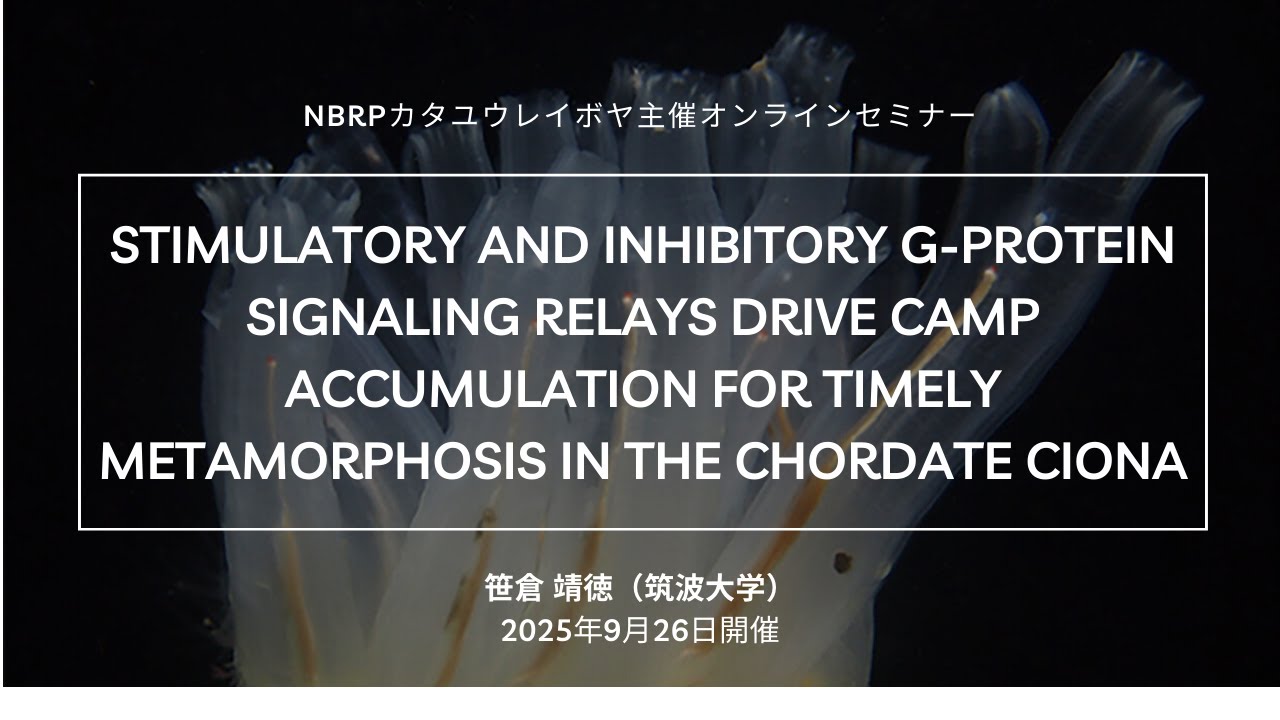
NBRP Ciona intestinalis Paper Online Seminar 2025 September: Author's own explanation of the paper (https://doi.org/10.7554/eLife.99825.3)
Keywords
Summary
151 words
Critical Evaluation
Value of the Information & Strength of the Argument
The video provides a detailed and well-structured explanation of the research, with clear logical progression from background to hypothesis, experiments, and conclusions. The author presents multiple lines of evidence, including pharmacological treatments, gene knockdowns, and live imaging, to support the proposed signaling cascade. The argumentation is solid, with appropriate controls and careful interpretation of results. The value of the information is high for researchers in developmental biology and neurobiology, as it reveals a novel signaling pathway involving G-proteins and cAMP in a simple chordate model.
94 words
Title / Content Match
The title accurately reflects the content: a seminar by the author explaining their paper on Ciona metamorphosis.
Quality & Reliability
8/10
The video is a presentation by the corresponding author of a peer-reviewed paper published in eLife, a reputable journal. The content is based on original research with experimental evidence, including knockdown and imaging experiments. The author explains the methodology and results clearly, and the presentation is consistent with the published paper.
Key Moments
Markers derived by PSI from the transcript: the creator did not define chapters.
- Introduction and acknowledgments
- Explanation of G-proteins and GPCRs
- Background on Ciona metamorphosis and the role of attachment
- Evidence that cAMP is a key molecule for metamorphosis
- Experiments showing cAMP accumulation in the adhesive organ
- Identification of Gs, Gi, and Gq as necessary for metamorphosis
- Ordering of signaling events: GABA -> Gi -> Gq -> Gs -> cAMP
- Discussion on the dual role of GABA and variability in metamorphosis timing
Cited Sources
- Stimulatory and inhibitory G-protein signaling relays drive cAMP accumulation for timely metamorphosis in the chordate Ciona — The paper discussed in the seminar
- NBRP Ciona website — Resource for Ciona strains and information
- NBRP Ciona order page — Information on how to obtain Ciona resources
Concurring Sources
- eLife paper — The primary source of the presented research
Contribution & Novelties
The video provides an in-depth explanation of a novel signaling pathway involving G-proteins and cAMP in Ciona metamorphosis. The key novelty is the identification of a sequential activation of Gi, Gq, and Gs, leading to a transient decrease followed by an increase in cAMP, which is necessary for timely metamorphosis. This reveals a complex regulatory mechanism for sensing attachment duration and strength.
Pour aller plus loin :
- G protein-coupled receptor — Overview of GPCRs and their signaling.
- Cyclic adenosine monophosphate — Role of cAMP as a second messenger.
- GABA — Neurotransmitter involved in the pathway.
- Ciona intestinalis — Model organism used in the study.
104 words
Radar Profile
The radar profile shows high scores in quality of information, technical level, and reliability, with a slightly lower score in quantity of information due to the focused scope of the presentation. This indicates a highly specialized and reliable content, suitable for an audience with background in molecular biology.